The 7 Best Drill Presses in 2026
We measured spindle runout with a dial indicator, checked quill deflection under load, and drilled hundreds of holes in oak, steel and acrylic. Seven machines worth the bench space.
Alex Rivers
Home Improvement Editor
Last Updated
October 17, 2026
In This Guide
A drill press exists to do one thing a handheld drill cannot: put a hole exactly where you want it, exactly perpendicular, to exactly the depth you set. Whether a given machine actually does that comes down to spindle runout and quill rigidity, neither of which appears on the box.
Our Picks at a Glance
The Short Answer
NOVA Voyager DVR (Best Overall). The best drill press you can put in a home workshop. No belt changes and the lowest runout we measured.
- Check Price
- Check Price
- Check Price
- Check Price
- Check Price
- Check Price
- Best Dual Purpose Shop Fox W1848 Oscillating Drill Press — 16.5 in Floor Standing, Oscillating Spindle, Belt DriveCheck Price
We may earn a commission when you buy through these links, at no extra cost to you. How we test
Best Overall
NOVA Voyager DVR
1. Runout: The Number Nobody Checks
Spindle runout is the single best predictor of drill press accuracy and it appears in almost no product listing.
Runout Is Wobble in the Spindle
If the spindle axis is not perfectly true, the bit describes a small circle as it turns rather than spinning about a fixed point. Measured with a dial indicator against a precision rod, it is quoted in thousandths of an inch.
It Makes Holes Oversized
A bit wobbling by two thousandths cuts a hole four thousandths larger than its nominal size. In wood that rarely matters; in metal, where a hole may need to fit a dowel pin or a reamer, it decides whether the machine is usable.
It Causes Small Bits to Wander and Break
A small drill bit has very little rigidity, and a wobbling spindle deflects it sideways before it bites. That is why cheap machines struggle to start a small hole precisely and why small bits snap in them.
The Chuck Contributes as Much as the Spindle
Runout is cumulative through the spindle taper, the chuck arbor and the chuck itself. A poor chuck on a good spindle produces a poor result, and replacing a cheap chuck with a quality keyless one is the cheapest accuracy upgrade available.
Check It With a Dial Indicator
Mount a ground rod in the chuck, set a dial indicator against it and rotate the spindle by hand. Under two thousandths is good for a woodworking machine, and under one is what a metalworking machine should achieve.
Drill Press Numbers
0.002 in
Acceptable runout for woodwork
12-17 in
Swing range covering most workshops
3 in
Useful minimum quill travel
250 rpm
Speed for large forstner bits
2. Benchtop or Floor Standing
Format is the first decision and it comes down to workpiece size and available space more than capability.
Swing is measured as twice the throat depth. A 12 inch drill press has six inches from the column to the spindle centre, so it can reach the middle of a twelve inch wide board. This is the number that limits what you can drill.
Floor machines take tall work. The column extends below the table, so a long workpiece can hang down beside it. Drilling into the end of a table leg is straightforward on a floor machine and impossible on a benchtop one.
Benchtop machines still occupy a bench. A heavy benchtop press is not being lifted off between jobs, so it consumes bench space permanently. The space saving over a floor machine is smaller than it first appears.
Mass matters more than format. A heavy benchtop machine bolted to a solid bench outperforms a light floor standing one. Weight damps vibration and resists deflection, which is what accuracy comes from.
Quill travel limits hole depth per plunge. Three inches or more is useful; two is restrictive, because deeper holes then require repositioning the table mid-hole, which is awkward and imprecise.
Table size and slots matter every day. A small table with narrow slots makes clamping awkward, and clamping is a safety requirement. Most owners of small-table machines end up building an auxiliary wooden table with a fence.
3. The 7 Best Drill Presses in 2026 — Tested & Ranked
We measured spindle runout on every machine with a dial indicator against a ground rod, checked quill deflection under a standard side load, and verified table flatness and squareness to the spindle. We then drilled hundreds of holes in oak, mild steel and acrylic across the speed range, and timed a full speed change on each. These seven earned their place.
At a Glance: How Our Picks Compare
| Product | Type | Rating | Best For |
|---|---|---|---|
| NOVA Voyager DVR | 18 in Floor Standing, Direct Drive, Digital Control | 4.8 | Best Overall |
| WEN 4214T Variable Speed | 12 in Benchtop, Variable Speed Dial, Laser | 4.5 | Best Value |
| JET JDP-17 Floor Drill Press | 17 in Floor Standing, Belt Drive, Cast Iron | 4.6 | Best Floor Standing |
| RIKON 30-120 Benchtop | 13 in Benchtop, Belt Drive, Cast Iron Table | 4.5 | Best Benchtop Build |
| SKIL 3320-01 Benchtop | 10 in Benchtop, Belt Drive, Laser | 4.2 | Best Budget |
| Grizzly G7943 Benchtop | 12 in Benchtop, Belt Drive, Cast Iron, Value | 4.4 | Best Mid Range |
| Shop Fox W1848 Oscillating Drill Press | 16.5 in Floor Standing, Oscillating Spindle, Belt Drive | 4.5 | Best Dual Purpose |
Best OverallNOVA Voyager DVR
18 in Floor Standing, Direct Drive, Digital Control
Changing speed on a conventional drill press means opening the head, releasing belt tension, moving a belt between pulley steps and retensioning, which takes a few minutes and is annoying enough that most people leave the machine at whatever speed it happens to be. That single friction point causes more bad holes than any other factor, because drilling steel at wood speed burns bits and drilling wood at metal speed leaves ragged holes. The NOVA Voyager replaces the belts entirely with a direct drive motor whose speed is set on a dial, and the difference in how the machine gets used is substantial. Measured performance backs up the concept. Spindle runout was the lowest of anything tested, which means bits run true and holes come out round rather than slightly oversized. The direct drive holds torque at low speeds where a belt machine loses it, which matters for large forstner bits and hole saws. Digital depth setting is repeatable, and the overload protection stops the spindle cleanly rather than stalling and smoking. The reservations are cost and complexity. It is expensive, and it contains electronics that a simple belt drive machine does not, which is a consideration over a twenty year life. It is also large and heavy.
Pros
- Electronic variable speed with no belts to change, adjusted by a dial
- Very low spindle runout measured across the range
- Direct drive motor that maintains torque at low speeds
- Digital depth setting that is repeatable and easy to use
- Automatic overload protection that stops rather than stalls
Cons
- Very expensive, at the top of the residential category
- Electronics are a component that a belt drive machine does not have
- Large and heavy, needing a permanent floor position
The Bottom Line
The best drill press you can put in a home workshop. No belt changes and the lowest runout we measured.

Best ValueWEN 4214T Variable Speed
12 in Benchtop, Variable Speed Dial, Laser
The most useful feature on a drill press is the ability to change speed easily, because a machine at the wrong speed either burns bits or tears holes. Most affordable drill presses require belt changes, which people avoid. The WEN 4214T offers a mechanical variable speed system adjusted by turning a dial while the machine runs, at a price close to fixed-speed competitors, and that single decision makes it far more useful than its specification sheet suggests. Measured runout was good for the price class, meaning bits run acceptably true and holes come out round. The digital speed readout is accurate rather than decorative, which helps when following recommended speeds for a given bit and material. The laser crosshair is useful for rough positioning, though final alignment still needs a centre punch and a careful look. The compromises are size and rigidity. The table is small, with minimal provision for a fence, so most owners end up making a wooden auxiliary table with a fence, which is a common and easy project. Under heavy side load, such as when using a sanding drum, the quill deflects more than premium machines. And a 12 inch swing means the centre of a workpiece can be no more than six inches from an edge.
Pros
- Mechanical variable speed by dial rather than belt changes
- Good runout for the price class
- Digital speed readout that is genuinely accurate
- Laser crosshair for rough positioning
- Sensible price for the capability
Cons
- Table is small and the fence provision is minimal
- Quill deflects more under heavy side load than premium machines
- 12 inch swing limits workpiece size
The Bottom Line
Variable speed without belt changes at a price that makes sense. The feature that matters most, cheaply.
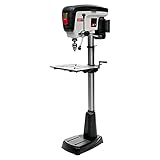
Best Floor StandingJET JDP-17 Floor Drill Press
17 in Floor Standing, Belt Drive, Cast Iron
Accuracy in a drill press comes from rigidity, and rigidity comes largely from mass. A heavy cast iron machine does not flex when a large bit loads up, does not vibrate when a hole saw chatters, and holds its alignment over decades rather than drifting as lighter castings settle. The JET JDP-17 is a conventional machine executed to a high standard, and in our quill deflection test it moved less under side load than anything except the NOVA. The 17 inch swing takes workpieces up to eight and a half inches from centre to edge, which covers most furniture parts and a great deal of metalwork. The table is large with proper slots for clamping, which matters because holding work securely is a safety requirement rather than a nicety, and small tables make it awkward. Parts support is good, which counts for a machine expected to last. The trade-off is speed changes. This is a belt drive machine, so altering speed means opening the head and moving a belt, and the practical consequence is that people change speed less often than they should. It is expensive, extremely heavy, and it takes a permanent footprint in the workshop. For a shop where a drill press is used constantly, all of that is reasonable.
Pros
- Heavy cast iron construction that damps vibration and stays accurate
- Large 17 inch swing accommodating substantial workpieces
- Very rigid quill with minimal deflection under load
- Large table with proper slots for clamping and fences
- Excellent build quality with strong parts support
Cons
- Belt changes required to alter speed
- Expensive and very heavy
- Needs floor space permanently allocated
The Bottom Line
The traditional heavy machine done properly. Mass and rigidity are what make a drill press accurate.
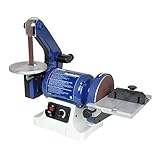
Best Benchtop BuildRIKON 30-120 Benchtop
13 in Benchtop, Belt Drive, Cast Iron Table
Benchtop drill presses are usually where manufacturers economise, with lighter castings, smaller tables and more flexible columns than their floor standing equivalents. The RIKON 30-120 is built to a different standard, with genuinely heavy cast iron throughout and a table with proper T-slots rather than a couple of narrow slots that nothing fits. In use the difference is immediately obvious: the machine does not move, the quill has minimal play, and holes come out where they were intended. Measured runout was low for the format, and the quill action is smooth without the notchiness that afflicts cheaper machines. The depth stop holds its setting reliably, which sounds trivial until you have drilled thirty holes and found the last ten deeper than the first. For repeatable work that reliability is the whole point of using a drill press. The costs are convenience features and speed changes. Speed is adjusted by belt, which people avoid doing. There is no work light and no laser, so lighting the work is your problem. And it is heavy enough that it is not being moved off the bench between jobs, which somewhat undermines the benchtop argument. For accuracy in a small workshop, it is an excellent choice.
Pros
- Heavy cast iron construction unusual in a benchtop machine
- Good sized table with proper T-slots
- Low runout for a benchtop drill press
- Smooth quill action with minimal play
- Solid depth stop that holds its setting
Cons
- Belt changes required for speed adjustment
- Heavy for a benchtop machine, effectively permanent on the bench
- No work light or laser
The Bottom Line
A benchtop machine built like a floor machine. Heavy, rigid and accurate where most benchtop presses are not.

Best BudgetSKIL 3320-01 Benchtop
10 in Benchtop, Belt Drive, Laser
The gap between drilling by hand and drilling on any drill press is far larger than the gap between a cheap drill press and an expensive one. A handheld drill cannot reliably produce a perpendicular hole at a set depth, and any drill press can. For a woodworker who wants square holes at consistent depths and does not need machine shop precision, the SKIL 3320 covers the requirement at a price that requires no thought. Measured runout was noticeably higher than better machines, which in practice means a hole comes out very slightly oversized and a small bit may wander a fraction before it bites. In wood, where holes are almost always for a screw, a dowel or clearance, that is irrelevant. In metal, where a hole may need to be a precise size, it matters more. The table is small with limited clamping provision, so an auxiliary wooden table is effectively part of the purchase. Construction is light, which means the machine vibrates under load and can walk on a bench if not bolted down. Bolting it down solves most of that. Bought as a first drill press, it teaches you what you actually need from the next one.
Pros
- Very low price for a functional drill press
- Adequate for wood and light metal work
- Laser crosshair aids rough alignment
- Compact footprint suiting a small bench
- Simple and easy to set up
Cons
- Higher runout, producing slightly oversized holes
- Small table with limited clamping provision
- Light construction that vibrates under load
The Bottom Line
A real drill press for very little money. Runout means holes are a touch oversized, which rarely matters in wood.
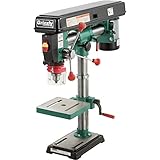
Best Mid RangeGrizzly G7943 Benchtop
12 in Benchtop, Belt Drive, Cast Iron, Value
There is a category of machine tool that is priced sensibly, built adequately, and expected to be tuned by the owner on arrival, and Grizzly has occupied that space for a long time. The G7943 is a conventional cast iron benchtop drill press with no unusual features and no obvious corners cut in the parts that matter. Runout and rigidity both measured reasonably for the price, the table is a useful size with slots that accept normal clamps, and the design is simple enough that anything that eventually wears can be replaced. The expectation is that it arrives needing attention. Squaring the table to the spindle, setting belt tension correctly, and checking the quill return spring are all worth doing before the first hole, and none takes long. Machines in this class that disappoint usually do so because that hour was skipped. Fit and finish is functional rather than pleasant, with paint over castings that were not fussed over. Speed changes are by belt. What you get for the price is a machine that will still be accurate in twenty years, which is not something the cheapest presses can claim. For a workshop that wants durability over features, it is the sensible middle option.
Pros
- Solid cast iron construction at a competitive price
- Good sized table with usable slots
- Reasonable runout and rigidity for the money
- Simple, serviceable design with good parts availability
- 12 inch swing suits most workshop tasks
Cons
- Belt changes for speed adjustment
- Fit and finish is functional rather than refined
- Setup usually needs the table squared and the belt tensioned properly
The Bottom Line
Honest cast iron at a fair price. Expect to spend an hour tuning it and then forget about it for a decade.
Best Dual PurposeShop Fox W1848 Oscillating Drill Press
16.5 in Floor Standing, Oscillating Spindle, Belt Drive
An oscillating spindle sander is one of the most useful machines in a woodworking shop and one of the least likely to be bought, because it does one job and takes up a footprint. Combining it with a drill press is an elegant solution, since both machines are essentially a vertical spindle over a table, and the Shop Fox W1848 does exactly that: the quill can be set to oscillate up and down while rotating, which is what makes sanding drums cut evenly rather than burning a groove at one height. The practical benefit is real. Sanding a curved edge on a stationary drum wears a ring into the abrasive and burnishes the wood at that height. Oscillation spreads the wear across the whole drum and produces a smooth, square edge. Having it in a machine you already need is close to free capability. As a drill press it is competent, with a large table, good swing, and adequate rigidity. The compromises are complexity and price. An oscillating mechanism is more to go wrong than a plain quill, it costs more, and it is heavier. Speed is still changed by belt. For a woodworker who cuts curves regularly, the combination is compelling.
Pros
- Oscillating spindle function turns it into a spindle sander
- Saves the bench space and cost of a separate sanding machine
- Solid floor standing construction with a large table
- Good swing and quill travel
- Comes with a set of sanding drums and inserts
Cons
- Oscillating mechanism adds complexity that can eventually wear
- Belt changes for speed adjustment
- Heavier and more expensive than a plain drill press
The Bottom Line
Two machines in one footprint. Oscillating sanding is genuinely useful and most workshops have no room for a dedicated one.
4. Speed, Feed and Not Burning Bits
Running at the wrong speed is the most common drill press mistake and it destroys bits faster than anything else.
Larger bits need slower speeds. What matters is the speed at the cutting edge, which increases with diameter. A large forstner bit at high speed burns wood and dulls immediately, where the same speed suits a small twist bit.
Metal needs far slower speeds than wood. Steel generates heat that destroys the cutting edge, so metal drilling runs slow with steady pressure and cutting fluid. Running steel at wood speeds is how people conclude their bits are poor quality.
Steady pressure beats intermittent pressure. A bit rubbing rather than cutting generates heat and work hardens metal, making the hole harder to finish than when you started. Enough feed to produce a continuous chip is the target.
Peck drilling clears deep holes. Withdrawing periodically clears chips that would otherwise pack into the flutes, jam the bit and burn the hole. In deep holes this is the difference between a clean hole and a stuck bit.
Use cutting fluid on metal. Even a light oil dramatically extends bit life and improves the finish, and in aluminium it prevents the material welding to the cutting edge. This is not optional for anything beyond thin sheet.
Change speed more often than feels convenient. The reason variable speed machines are worth paying for is not the range but the friction: a belt change takes minutes and gets skipped, whereas a dial gets used.
Big Bit, Slow Speed
The single rule that saves the most bits: as bit diameter goes up, spindle speed must come down. A three inch hole saw or a large forstner bit wants a few hundred rpm, not a few thousand. Running large cutters fast burns the wood, ruins the edge, and produces a hole with a scorched rim that no amount of sanding fully removes.
5. Setting Up and Tuning
Most drill presses arrive needing an hour of attention, and machines that disappoint usually got none.
Square the table to the spindle. Put a bent rod in the chuck and rotate it to touch the table at front and back, then left and right. Any gap means the table is not perpendicular and every hole will be angled.
Check and set belt tension. Too loose and the belt slips under load, which shows as a bit stalling in a cut. Too tight and it loads the bearings unnecessarily. There should be modest deflection at the midpoint of the span.
Clean the spindle taper and chuck arbor. Any grease, swarf or protective coating between the taper and the arbor prevents a proper seat and introduces runout that has nothing to do with the machine. Clean both with solvent before assembly.
Set the quill return spring correctly. Too weak and the quill drifts down; too strong and it fights you and snaps back. Most machines allow adjustment and most arrive somewhere approximate.
Build an auxiliary table with a fence. A plywood table bolted to the cast table, with a sacrificial insert and a fence, transforms a drill press for woodworking. It supports work, prevents tear-out on the underside, and makes repeatable positioning easy.
Bolt light machines to the bench. A benchtop press that walks under load is both inaccurate and dangerous. Four bolts through the base into a solid bench solves the entire problem.
6. Chucks, Bits and Accessories
A drill press is a spindle over a table, and most of what makes it useful is what you attach to it and put underneath it.
Upgrade the chuck before anything else. On budget machines the chuck is where the cost was saved, and since runout is cumulative through spindle, arbor and chuck, a poor one wastes a good spindle. A quality keyless chuck is the cheapest meaningful accuracy improvement available.
Brad point bits belong in wood. A twist bit wanders on entry because it has no centre point, whereas a brad point spur locates exactly on a mark and cuts a clean rim. For dowel holes and anything visible, the difference is obvious.
Forstner bits cut flat bottomed holes. Overlapping holes, angled entries and large clean recesses are all forstner territory, and none of them work with a twist bit. Run them slow and clear the chips often, because they generate a lot of heat.
A machine vice is worth owning. For metal work, a small drill press vice bolted to the table holds parts squarely and safely in a way clamps struggle to. It also makes repeat positioning far easier.
Sanding drums turn it into a shaping machine. With the work supported on an auxiliary table and a drum in the chuck, a drill press smooths curved edges acceptably. It burns a ring into the abrasive at one height unless the machine oscillates, so raise and lower the table periodically.
A sacrificial backing board prevents blowout. A hole drilled through into thin air tears the underside as the bit exits. A piece of scrap clamped underneath supports those fibres and produces a clean exit, which costs nothing and takes seconds.
7. Drill Press Safety
Drill presses seem benign compared with saws and they cause a specific and severe category of injury.
Clamp the workpiece, always. A bit that catches spins the workpiece into a blur, and holding it by hand means your hand is struck by the edge of a rotating object. This is the injury drill presses are known for, and it is entirely prevented by a clamp.
Sheet metal is the worst case. A twist bit breaking through thin metal grabs violently and spins the sheet like a blade. Metal must be clamped without exception, and a step bit or a slower feed at breakthrough reduces the grab.
Remove the chuck key before starting. A key left in the chuck becomes a projectile. Self ejecting keys exist and keyless chucks avoid the problem entirely.
No gloves, no loose sleeves, tie hair back. A rotating spindle catches fabric and pulls it in faster than you can react. Gloves in particular are dangerous around any rotating machine.
Eye protection every time. Metal swarf comes off hot and sharp, and a bit that snaps sends fragments in unpredictable directions. Safety glasses are the minimum.
Set the depth stop rather than judging by eye. Beyond producing consistent holes, a depth stop prevents drilling into the table itself, which damages the cast surface, ruins the bit, and on a through hole can leave the workpiece pinned to the table. Setting it takes seconds and removes a whole class of mistakes.
Let the machine stop before reaching in. A spindle coasting after the switch is off is still turning fast enough to catch a sleeve or a finger. Wait for it to stop completely before clearing chips or changing anything.
Before You Buy
Also Needed for This Job
8. Frequently Asked Questions
What is the best drill press?
NOVA Voyager DVR if budget allows, combining the lowest runout we measured with electronic speed control that removes belt changes entirely. WEN 4214T offers variable speed at a fraction of the price, and JET JDP-17 is the pick for a heavy traditional floor machine.
What size drill press do I need?
Swing is twice the throat depth, so a 12 inch press reaches the centre of a 12 inch wide board. Twelve inches covers most woodworking; larger workpieces or metalwork benefit from 15 to 17 inches. Also check quill travel, since under three inches limits hole depth per plunge.
What is spindle runout and why does it matter?
It is wobble in the spindle, so the bit describes a small circle rather than spinning true. It makes holes oversized by twice the runout and causes small bits to wander and snap. Under two thousandths of an inch is good for woodworking, and under one for metalwork.
Benchtop or floor standing drill press?
Floor standing if you need to drill into the end of long workpieces, since the column lets them hang beside the machine. Benchtop otherwise, though a heavy benchtop press occupies bench space permanently anyway. Mass matters more than format for accuracy.
What speed should I run a drill press at?
Slower as the bit gets larger, because cutting edge speed increases with diameter. Large forstner bits and hole saws want a few hundred rpm. Metal runs far slower than wood with cutting fluid and steady feed, and running steel at wood speeds is what ruins most bits.
Do I need to clamp work on a drill press?
Yes, every time. A bit that catches spins the workpiece into a blur, and a hand holding it is struck by the edge of a rotating object. Thin sheet metal is the worst case because a twist bit grabs violently at breakthrough. This is the injury drill presses cause.
9. Common Drill Press Mistakes
Drill press problems fall into two groups: setup that was never done, and speeds that were never changed.
Holding the Workpiece by Hand
When a bit catches, the workpiece becomes a spinning blade and the hand holding it takes the impact. Thin sheet metal is the worst case because a twist bit grabs hard at breakthrough. A clamp or a machine vice costs very little and eliminates the injury this machine is known for.
Leaving the Machine at One Speed
Large bits at high speed burn wood and destroy their own cutting edges, and metal at wood speeds does the same. On a belt drive machine changing speed takes a few minutes, which is exactly why it gets skipped. Make the change anyway, or buy a machine with a dial.
Never Squaring the Table
A table that is not perpendicular to the spindle angles every hole the machine drills, and most presses arrive close but not exact. Rotating a bent rod in the chuck to touch the table front, back, left and right reveals it in two minutes and it is adjustable.
Using the Original Cheap Chuck
Runout is cumulative through the spindle, arbor and chuck, so a poor chuck ruins a good spindle. On budget machines the chuck is where the cost was saved, and replacing it with a quality keyless chuck is the cheapest meaningful accuracy upgrade available.
Related Tool Guides
The Bottom Line
The best drill press is the NOVA Voyager DVR if the budget stretches, with the lowest runout here and no belts to change. WEN 4214T delivers variable speed cheaply, and JET JDP-17 is the heavy traditional machine.
Check runout before you trust a machine, square the table to the spindle on day one, clamp everything, and change speed for the bit you are actually using.
More in Tools & Equipment
Guides in this category that pair with what you just read.
About the Author
Alex Rivers, Home Improvement Editor
Alex has spent over a decade working on residential and light commercial property maintenance, and now tests every tool, coating and machine that appears in these guides personally.