The 7 Best Torque Wrenches in 2026
We checked 12 torque wrenches against a calibrated analyzer at multiple points across their range, then repeated each measurement ten times to test consistency. Only 7 earned a spot.
Alex Rivers
Home Improvement Editor
Last Updated
October 17, 2026
In This Guide
A torque wrench exists to answer one question: is this fastener tight enough, and not too tight. Both failure modes are expensive. Under-torqued wheel lugs come loose; over-torqued cylinder head bolts stretch and warp things that cost a great deal to fix. What separates a good torque wrench from a bad one is not features, it is whether it reads the same number ten times in a row. Here is what actually does.
Our Picks at a Glance
The Short Answer
Tekton 24335 1/2" Drive Click (Best Overall). The torque wrench most people should own. Accurate, repeatable, sensibly priced, and it comes with a certificate showing it was actually checked.
- Check Price
- Check Price
- Best Digital GearWrench 85077 Electronic Torque Wrench — Digital, 1/2" Drive, 25-250 ft-lb, Angle ModeCheck Price
- Check Price
- Best Professional CDI 2503MFRMH 1/2" Drive Click — Click Type, 1/2" Drive, 30-250 ft-lb, ProfessionalCheck Price
- Check Price
- Check Price
We may earn a commission when you buy through these links, at no extra cost to you. How we test
Best Overall
Tekton 24335 1/2" Drive Click
1. Click, Split-Beam, Beam, and Digital
Four mechanisms are used to measure torque in hand tools, and they differ in accuracy, in how much maintenance they need, and in whether they can do the angle measurement modern engines require.
Click Type
The most common design. You set a value on a scale, and an internal spring-loaded mechanism releases with an audible and tactile click when that torque is reached. Accurate, affordable, and easy to use. The maintenance requirement catches people out: storing one at a high setting keeps the spring compressed, which causes it to take a set and drift out of calibration, so it must be wound back to the low end of the scale after every use.
Split Beam
Uses a different internal mechanism that does not keep a spring under tension, so there is nothing to unwind and calibration holds considerably longer. Adjustment is quick and there is no maintenance ritual to forget. They cost more and tend to be bulkier, and their minimum torque values are often higher than click wrenches.
Beam Type
The simplest design: a bar deflects under load and a pointer indicates torque on a scale. There is nothing to calibrate, nothing to wear, and nothing to unwind, so a beam wrench stays accurate essentially forever. The drawback is that you must be able to see the scale while pulling, which is often impossible in the positions where fasteners actually live.
Digital
An electronic strain gauge measures torque and displays it live, with programmable alerts at target values. The important capability is angle mode, which measures rotation in degrees after reaching a torque value. Modern torque-to-yield fasteners require exactly that, and no mechanical wrench can do it. The costs are battery dependence, price, and electronics that can fail.
The Numbers Don't Lie
±4%
Typical consumer accuracy specification
20-80%
Of range where accuracy is best
5,000
Cycles between recommended calibrations
12 in-lb
Equals 1 ft-lb, a common conversion error
2. Drive Size and Torque Range
Choosing the right size is more consequential than choosing the right brand, because a wrench used outside its accurate band gives confidently wrong numbers.
Accuracy Is Worst at the Extremes
Torque wrenches are most accurate through roughly the middle of their range, commonly quoted as 20 to 80 percent of full scale. A 10 to 150 ft-lb wrench set to 12 ft-lb is being used right at the bottom where its accuracy is poorest, and the reading may be well outside its stated specification. This is why one wrench cannot cover everything.
Match Drive Size to the Work
A 1/4-inch drive wrench covers inch-pound work: small electronics, interior trim, and delicate assemblies. A 3/8-inch drive covers roughly 10 to 80 ft-lb, which includes brakes, suspension, valve covers, and most under-hood work. A 1/2-inch drive covers roughly 30 to 250 ft-lb, which includes wheel lug nuts, axle nuts, and heavy suspension components.
The Practical Two-Wrench Set
For most home mechanics, a 1/2-inch wrench for wheels and heavy work plus a 3/8-inch wrench for everything under 80 ft-lb covers the large majority of jobs with both wrenches used in their accurate band. Adding a 1/4-inch inch-pound wrench becomes worthwhile if you work on small assemblies or motorcycles.
Length Affects Feel, Not Accuracy
A longer wrench requires less hand force to reach the same torque, which makes high values easier to achieve smoothly. It does not change the reading, because the mechanism measures torque rather than force. Longer wrenches are simply harder to fit into tight spaces.
| Drive Size | Typical Range | Common Uses |
|---|---|---|
| 1/4 inch | 20-200 in-lb | Electronics, trim, small assemblies |
| 3/8 inch | 10-80 ft-lb | Brakes, suspension, valve covers |
| 1/2 inch | 30-250 ft-lb | Lug nuts, axle nuts, heavy suspension |
| 3/4 inch | 100-600 ft-lb | Truck and heavy equipment |
3. The 7 Best Torque Wrenches in 2026 — Tested & Ranked
We checked each wrench against a calibrated torque analyzer at 20, 50, and 80 percent of its rated range, repeated each measurement ten times to assess repeatability rather than one-off accuracy, and evaluated scale clarity, click feel, and adjustment precision. These seven earned their place.

Best OverallTekton 24335 1/2" Drive Click
Click Type, 1/2" Drive, 10-150 ft-lb
Torque wrench value is determined almost entirely by whether the tool reads the same number consistently, and the Tekton 24335 does. Against our calibrated analyzer it measured within its stated specification at every point across the range, and more importantly it repeated: ten consecutive pulls at the same setting produced readings tight enough together that the tool can be trusted for work where the number actually matters. Plenty of budget wrenches hit the mark once and scatter afterward, which is functionally useless. The mechanical execution is good. The dual-range scale is clearly marked and easy to read in poor light, the adjustment collar moves positively without slop, and the click is genuinely unmistakable, felt through the handle as much as heard, which matters when you are working under a car with a compressor running. It ships with a hard case, which is not a luxury but a requirement, since a torque wrench knocking around a toolbox drawer loses calibration. The included certificate showing the actual measured values from testing is unusual at this price. The limits are inherent to the type and range. A click wrench signals when you reach the set value and never tells you what you are actually at, so it is not a diagnostic tool. And the 10 to 150 ft-lb range covers wheels, suspension, and most engine work, but not small fasteners specified in inch-pounds.
Pros
- Measured within specification at every test point against our calibrated analyzer
- Excellent repeatability, returning consistent readings across ten consecutive pulls
- Clear, well-marked dual-range scale that is easy to read without squinting
- Positive, unmistakable click that you feel as well as hear
- Includes a hard storage case and a calibration certificate
Cons
- Click type gives no reading, only a signal at the set value
- The 10 to 150 ft-lb range does not cover small fasteners requiring inch-pounds
- Requires unwinding to the low end of the scale after every use
The Bottom Line
The torque wrench most people should own. Accurate, repeatable, sensibly priced, and it comes with a certificate showing it was actually checked.
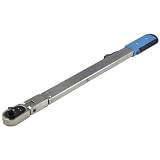
Best Split BeamPrecision Instruments PREC3FR250F Split Beam
Split Beam, 1/2" Drive, 40-250 ft-lb
The most common way a torque wrench loses accuracy has nothing to do with abuse. Click wrenches work by compressing an internal spring, and storing one at a high setting keeps that spring loaded, which causes it to take a set and drift out of calibration over time. Every click wrench manual says to unwind to the low end of the scale after use, and a very large number of people never do. A split-beam wrench has no spring under tension, so there is nothing to unwind and nothing to drift. In our testing the PREC3FR250F was among the most accurate and repeatable tools in the group, holding within specification at every measured point with tight clustering across repeated pulls. The flex head is genuinely useful rather than a gimmick, letting you reach fasteners at angles that would otherwise require an adapter, and adapters introduce their own torque error. Build quality is professional grade throughout, and the tool feels like equipment rather than a consumer product. The reservations are price and range. It costs considerably more than a good click wrench, which is justified for someone using it regularly and hard to justify for occasional wheel changes. Its 40 ft-lb minimum also puts it out of range for lighter work, so it is not a one-wrench solution unless your work is all in the higher range.
Pros
- Split-beam design does not need to be unwound after use, which is the main click wrench chore
- Holds calibration far longer than click wrenches because no spring is kept under tension
- Very accurate and repeatable in our testing across the full range
- Flex head reaches fasteners in awkward positions without adapters
- Made in the USA with a professional-grade build
Cons
- Expensive relative to click wrenches
- The 40 ft-lb minimum makes it unsuitable for lighter fasteners
- Heavier and bulkier than a comparable click wrench
The Bottom Line
The wrench that solves the click wrench maintenance problem. If you forget to unwind tools, this is the one to buy.

Best DigitalGearWrench 85077 Electronic Torque Wrench
Digital, 1/2" Drive, 25-250 ft-lb, Angle Mode
Modern engines increasingly use torque-to-yield fasteners, which are tightened to a specified torque and then turned a further specified number of degrees. A click wrench simply cannot perform that second step, which makes a digital wrench with angle mode not a convenience but a requirement for a growing amount of engine work. The GearWrench 85077 handles it well, measuring rotation electronically and alerting at the target angle just as it does at the target torque. Its live readout changes how the tool feels to use even on ordinary work. Rather than pulling blindly toward a click, you watch the value climb, which makes it obvious when a fastener is binding or when you are approaching the target too fast. Alerts are audible, visual, and haptic, so it works in a noisy shop and under a car where you cannot see the display. Storing preset values speeds up repetitive jobs, and switching units removes a common source of arithmetic error. In our testing accuracy was good across the range, though marginally behind the best mechanical wrenches at the low end. The reservations are batteries and complexity. A digital wrench with dead batteries is a breaker bar, and the electronics are a failure point mechanical tools do not have. Keep spare batteries with the tool.
Pros
- Live digital readout shows actual torque as you pull rather than only signaling at the target
- Torque-plus-angle mode is required for modern engine fasteners and no click wrench can do it
- Audible, visual, and vibration alerts at the target value
- Stores multiple preset values for repeated jobs
- Switches between ft-lb, in-lb, Nm, and kg-cm without conversion arithmetic
Cons
- Requires batteries, which will be dead when you need it if not checked
- More expensive than mechanical wrenches of similar capacity
- Electronics are a failure point that a mechanical wrench does not have
The Bottom Line
The wrench for modern engine work, where torque-to-yield fasteners require torque plus a measured angle. Nothing mechanical can do that.

Best for Smaller FastenersTekton 24320 3/8" Drive Click
Click Type, 3/8" Drive, 10-80 ft-lb
A torque wrench is least accurate at the extremes of its range, and using a 10 to 150 ft-lb wrench to set a 15 ft-lb fastener puts you exactly where accuracy is worst. The practical answer is a second wrench sized for lighter work, and the Tekton 24320 fills that role well. Its 10 to 80 ft-lb range covers brake caliper bolts, suspension hardware, valve covers, intake manifolds, and the large amount of automotive and equipment work that sits below 80 ft-lb, and it sits comfortably in the middle of its range for most of it. It carries the same accuracy and repeatability standard as the larger Tekton wrench, holding within specification at every test point and repeating tightly across consecutive pulls. Physically it is shorter and lighter, which matters more than it sounds: a long 1/2-inch wrench simply will not fit into many engine bays, and forcing an adapter or an extension into the equation introduces error. The 3/8-inch drive matches the socket size most light work uses. The limits are at both ends. Its 80 ft-lb ceiling is below the lug nut specification for many vehicles, so it does not replace a 1/2-inch wrench. And it still does not reach the inch-pound range needed for the smallest fasteners, which requires a dedicated 1/4-inch drive tool.
Pros
- The 3/8-inch drive and lower range suit brake, suspension, and interior fasteners properly
- Same accuracy and repeatability standard as the larger Tekton wrench
- Shorter and lighter, so it fits into engine bays where a 1/2-inch wrench will not
- Clear dual-range scale and a positive, unmistakable click
- Includes a hard case and a calibration certificate
Cons
- The 80 ft-lb ceiling is too low for wheel lug nuts on many vehicles
- Still does not reach into the inch-pound range for the smallest fasteners
- Requires unwinding after each use like any click wrench
The Bottom Line
The second wrench most people should own. A 1/2-inch wrench used at the bottom of its range is inaccurate, and this covers that gap properly.

Best ProfessionalCDI 2503MFRMH 1/2" Drive Click
Click Type, 1/2" Drive, 30-250 ft-lb, Professional
Consumer torque wrenches typically specify accuracy within four percent of reading, which is fine for wheel lugs and most automotive work. Professional and industrial tools hold tighter tolerances, and the manufacturing and testing that produces them costs more. CDI builds torque tools across industrial and aerospace applications, and the 2503MFRMH is that engineering applied to a hand wrench. In our testing it was the most consistent tool in the group, with the tightest clustering across repeated pulls at every measured point. The mechanical feel reflects the price. The adjustment mechanism is noticeably smoother and more precise than consumer wrenches, the scale markings are crisp and unambiguous, and the flex head has a positive detent that holds its angle rather than flopping. It arrives with a serialized certificate showing the actual measured values from its individual test rather than a generic statement of specification, which is what you want if your work needs documentation. The reasons most people should not buy it are straightforward. It costs considerably more than tools that are entirely adequate for changing wheels and doing suspension work. Its 30 ft-lb minimum means it is not a general-purpose wrench for lighter fasteners. And like every click wrench it needs unwinding after use to protect the spring.
Pros
- Professional-grade accuracy with a tighter tolerance than consumer wrenches
- Built by a manufacturer that also produces torque tools for aerospace and industrial use
- Flex head with a positive detent for reaching awkward fasteners
- Exceptionally smooth adjustment mechanism with clear, precise scale markings
- Individually tested with a serialized certificate of calibration
Cons
- Expensive, priced as professional equipment
- The 30 ft-lb minimum limits it to mid and high-range work
- Click type still requires unwinding after use
The Bottom Line
The wrench to buy when the number genuinely has to be right. Tighter tolerance and a serialized certificate reflect a different manufacturing standard.

Best Budget DigitalACDelco ARM601-4 Digital 1/2" Drive
Digital, 1/2" Drive, 12.5-250 ft-lb
Digital torque wrenches have historically carried a large price premium, and the ARM601-4 brings the core capability down to roughly click wrench money. What you get is a live readout, programmable target values with buzzer, LED, and vibration alerts, unit switching between four measurement systems, and a peak hold mode that records the highest torque reached, which is genuinely useful for checking whether an existing fastener was tightened correctly without loosening it first. Its wide 12.5 to 250 ft-lb range covers the great majority of automotive work with one tool, which is convenient even though the usual advice about accuracy at range extremes still applies. In our testing it performed acceptably through the middle of its range and drifted further from the analyzer at the low end than premium tools did, which is the expected pattern for a budget digital wrench and a reason not to rely on it for small critical fasteners. Build quality is consistent with the price. It feels less refined than professional tools, the adjustment and ratchet action are adequate rather than smooth, and the housing is more plastic. Being fully battery dependent with no mechanical fallback is worth remembering: dead batteries make it a breaker bar. For home automotive work where the readout and alerts add real convenience, it is good value.
Pros
- Digital readout and preset alerts at a price close to good click wrenches
- Wide 12.5 to 250 ft-lb range covers most automotive work with one tool
- Buzzer, LED, and vibration alerts work in noisy or awkward conditions
- Peak hold mode records the highest value reached, useful for checking existing fasteners
- Switches between four units without conversion arithmetic
Cons
- Accuracy is a step behind premium wrenches, particularly at the low end of the range
- Build quality reflects the price, with a less refined feel than professional tools
- Battery dependent with no mechanical fallback
The Bottom Line
The affordable route into digital torque measurement. Good enough for home automotive work, and not the tool for tight-tolerance jobs.

Best BudgetEPAuto 1/2" Drive Click Torque Wrench
Click Type, 1/2" Drive, 10-150 ft-lb, Budget
The most common use of a torque wrench in a home garage is setting wheel lug nuts, which typically specify somewhere around 80 to 100 ft-lb with a reasonable tolerance. For that job, an inexpensive click wrench is genuinely adequate, and owning one is dramatically better than the alternative most people default to, which is an impact gun or a breaker bar and a guess. The EPAuto costs very little, includes a case, and has a reversible ratchet so it works for removal as well as installation. In our testing it read within a usable margin at the middle of its range, which covers lug nuts well. Where it showed its price was repeatability: consecutive pulls at the same setting scattered more than the Tekton and CDI wrenches did, meaning individual results were less predictable even when the average was reasonable. Accuracy also degraded further at the extremes of the range than premium tools. For a fastener with a wide acceptable window that is fine. For a cylinder head or a critical suspension component, it is not the tool. Build quality is consistent with the price, with an adjustment mechanism that feels coarser and a click that is less crisp than better wrenches. Buy it as a dedicated wheel wrench or as a first torque wrench, and step up if your work demands tighter numbers.
Pros
- Very inexpensive while delivering usable accuracy for wheel lug nuts and general work
- Reversible ratchet head for both tightening and loosening
- Includes a storage case, which cheap wrenches often omit
- Clear enough scale markings and a definite click
- Widely available and cheap enough to own as a dedicated wheel wrench
Cons
- Repeatability is noticeably looser than premium wrenches in our testing
- Accuracy degrades more at the extremes of the range
- Build quality and adjustment feel reflect the price
The Bottom Line
Good enough for wheels and general work, and the right buy if the alternative is no torque wrench at all. Not for tight-tolerance jobs.
4. Accuracy, Repeatability, and Calibration
Two properties determine whether a torque wrench is worth owning, and only one of them appears on the packaging.
Accuracy is how close a reading is to the true value. Consumer wrenches typically specify within four percent of reading, professional tools tighter. On a 100 ft-lb setting, four percent is four foot-pounds, which is well inside the tolerance of most fastener specifications.
Repeatability is whether it gives the same reading every time, and it matters more. A wrench that reads three percent high consistently is usable, because the error is predictable. A wrench that scatters across a ten-foot-pound band from pull to pull is not, even if the average is perfect, because any individual fastener could be anywhere in that band. This is what separated the good wrenches from the cheap ones in our testing far more clearly than headline accuracy did.
Calibration drifts with use and with storage. Manufacturers commonly recommend recalibration every 5,000 cycles or annually, whichever comes first. For a home mechanic doing seasonal wheel changes, annual recalibration is overkill; every few years is reasonable. For anyone using one weekly, follow the interval.
A calibration certificate is worth looking for. A certificate listing actual measured values from the individual tool test is meaningfully different from a printed statement of nominal specification. It shows the tool was tested rather than assumed to be within tolerance.
You can sanity check a wrench at home. Clamp the drive in a vise, hang a known weight from the handle at a measured distance from the drive center, and compare the resulting torque against the setting where it clicks. Torque equals weight multiplied by distance, so 25 pounds at two feet is 50 ft-lb. It is not a substitute for professional calibration, and it will catch a wrench that has gone badly wrong.
Always Unwind a Click Wrench
Storing a click wrench at a high setting keeps its internal spring compressed, and over months that spring takes a set and the tool drifts out of calibration. Wind it back to the low end of its scale, not to zero on wrenches whose manuals specify the lowest marked value, after every single use. This one habit does more to preserve accuracy than anything else you can do, and skipping it is why so many secondhand torque wrenches read wrong.
5. Using a Torque Wrench Correctly
Technique introduces more error than most tools do. These are the details that separate a meaningful torque reading from a number that happens to appear on a scale.
Pull smoothly and stop at the click. A slow, steady pull gives the mechanism time to respond accurately. Jerking produces a spike that trips the click early, and continuing to pull after the click over-torques the fastener, sometimes badly. One click, then stop.
Hold the handle at the marked grip point. Torque is force multiplied by distance from the fastener, and the wrench is calibrated assuming your hand is at the designated grip area. Gripping further out than that increases actual torque above the reading, and choking up reduces it.
Never use a torque wrench to loosen fasteners. Breaking a seized bolt free can require far more torque than the wrench is rated for, and overloading the mechanism damages calibration. Use a breaker bar for removal and reserve the torque wrench for final tightening.
Threads must be clean and correctly prepared. Torque measures the resistance of the whole system, and friction from dirty, rusty, or damaged threads absorbs torque that never reaches clamping force. A fastener that reads 100 ft-lb through rusty threads may be holding far less than one at 100 ft-lb through clean ones.
Follow the specified lubrication condition. Torque specifications assume either dry or lubricated threads, and the difference is large. Applying oil or anti-seize to a fastener specified dry can produce substantially more clamping force at the same torque reading, which is a common way to stretch or snap bolts.
Respect the tightening sequence. On anything with multiple fasteners around a joint, wheels, cylinder heads, intake manifolds, tighten in the specified crossing pattern and in stages rather than fully tightening one at a time. Sequence distributes clamping load evenly and prevents warping.
Do not use extensions or adapters carelessly. A straight extension in line with the drive does not change torque, but a crow foot or an offset adapter that moves the fastener away from the drive centerline changes the effective lever length and therefore the actual torque applied. That requires a correction calculation.
6. Common Applications and Torque Specs
Torque specifications always come from the manufacturer for your specific vehicle or equipment, and the figures below are typical ranges to indicate what capacity you need rather than values to use.
Wheel lug nuts. Commonly 80 to 100 ft-lb on passenger cars and higher on trucks, which is why a 1/2-inch drive wrench is the standard garage tool. Always tighten in a star pattern rather than around the circle, and retorque after the first drive following a wheel change, since seating can allow lugs to loosen slightly.
Brake caliper and bracket bolts. Typically in the 20 to 80 ft-lb range depending on the vehicle, which puts them squarely in 3/8-inch drive territory. These are safety-critical fasteners where both under and over-tightening cause real problems.
Spark plugs. Usually low, often 15 to 25 ft-lb, and highly sensitive to over-torquing because the threads are in aluminum on most modern engines. Stripping a spark plug thread in a cylinder head is an expensive repair, which makes this one of the strongest arguments for owning a properly ranged wrench.
Engine internals and cylinder heads. Frequently torque-to-yield, requiring a torque value followed by a specified rotation in degrees, and often a multi-stage sequence. This is the work that requires a digital wrench with angle mode, and it is the least forgiving of guesswork.
Bicycle and motorcycle components. Usually specified in inch-pounds or newton-metres and often very low, particularly on carbon fiber parts where over-torquing causes catastrophic failure. A 1/4-inch drive inch-pound wrench is the correct tool, and a 1/2-inch wrench is useless here.
Watch the units. One foot-pound equals twelve inch-pounds, and confusing the two produces errors of a factor of twelve in either direction. Newton-metres are common on European and Japanese equipment, and one foot-pound is roughly 1.36 newton-metres. Digital wrenches that switch units remove this hazard entirely.
Before You Buy
Also Needed for This Job
7. Frequently Asked Questions
What is the best torque wrench?
The Tekton 24335 1/2-inch click wrench is the best overall for most people, measuring within specification at every test point with excellent repeatability and shipping with a calibration certificate. For modern engine work requiring torque plus angle, the GearWrench 85077 digital wrench is necessary, and the Precision Instruments split beam avoids the unwinding maintenance click wrenches require.
Do I need to unwind a torque wrench after use?
Yes, for click type wrenches. Storing one at a high setting keeps the internal spring compressed, which causes it to take a set and drift out of calibration over months. Wind it back to the low end of the scale after every use. Split beam and beam type wrenches have no spring under tension and do not require this.
What size torque wrench do I need?
A 1/2-inch drive wrench covering roughly 30 to 250 ft-lb handles wheel lug nuts and heavy suspension work. A 3/8-inch drive covering 10 to 80 ft-lb handles brakes, valve covers, and most under-hood work. Since accuracy is best through the middle of a wrench range, owning both means each job is done in the accurate band.
How often should a torque wrench be calibrated?
Manufacturers typically recommend every 5,000 cycles or annually, whichever comes first. For a home mechanic doing occasional wheel changes, every few years is reasonable, while weekly use warrants following the stated interval. Always recalibrate after a drop, and always unwind a click wrench after use to slow the drift in the first place.
Can I use a torque wrench to loosen bolts?
No. Breaking a seized fastener free can require far more torque than the wrench is rated to handle, and overloading the internal mechanism damages its calibration. Use a breaker bar or a regular ratchet for removal, and reserve the torque wrench exclusively for final tightening to a specified value.
Is a digital torque wrench worth it?
It is necessary if you work on modern engines with torque-to-yield fasteners, which require a torque value followed by a specified rotation in degrees that no mechanical wrench can measure. The live readout and unit switching are genuine conveniences on other work. The trade-offs are battery dependence, higher price, and electronics that can fail.
8. Common Torque Wrench Mistakes
Torque wrench errors mostly come from technique and storage rather than from the tool being inaccurate out of the box.
Storing a Click Wrench at a High Setting
Leaving the spring compressed for months causes it to take a set, and the tool quietly drifts out of calibration while still clicking confidently. Wind it back to the low end of its scale after every use. This is the single most common reason a torque wrench that was accurate when new no longer is.
Continuing to Pull After the Click
The click is the signal that you have reached the set value, and any further movement over-torques the fastener beyond it. On a critical fastener that can mean a stretched bolt or a stripped thread. One click and stop, and if you are unsure whether you felt it, back off and repeat rather than pulling harder.
Using a Wrench at the Bottom of Its Range
Torque wrenches are most accurate through roughly the middle of their range, and a 10 to 150 ft-lb wrench set to 12 ft-lb is being used exactly where it is least reliable. Owning a second, smaller wrench for lighter work keeps every job inside the accurate band and costs less than one bad repair.
Ignoring the Dry or Lubricated Specification
Torque specifications assume a particular thread condition, and applying oil or anti-seize to a fastener specified dry substantially reduces friction, which means far more clamping force at the same reading. That is how bolts get stretched and snapped while the wrench says the number was correct.
Related Tool & DIY Guides
Brand Review
Tekton Tools Review
A closer look at the brand behind two of the wrenches in this guide.
Buyer's Guide
Best Tekton Hand Tools
Wrenches, sockets, and pliers from the same value-focused lineup.
Buyer's Guide
Best Cordless Drills
Drill/drivers and combo kits compared across every major battery platform.
The Bottom Line
The best torque wrench for most people is the Tekton 24335, which held accuracy and, more importantly, repeatability across our full test range at a sensible price. If modern engine work is on your list, the GearWrench 85077 digital wrench with angle mode is the only type that can do it. And if you know you will forget to unwind a click wrench, the Precision Instruments split beam removes the problem entirely.
Buy two sizes rather than one, pull smoothly and stop at the click, and wind a click wrench back down after every use. Those three habits matter more than which brand is on the handle.
More in Tools & Equipment
Guides in this category that pair with what you just read.
About the Author
Alex Rivers, Home Improvement Editor
Alex has spent over a decade working on residential and light commercial property maintenance, and now tests every tool, coating and machine that appears in these guides personally.