The 7 Best Laser Levels in 2026
We checked 12 laser levels against a calibrated reference at 30 feet, tested visibility in bright rooms and outdoors, and dropped a few. Only 7 earned a spot.
Alex Rivers
Home Improvement Editor
Last Updated
October 18, 2026
In This Guide
A laser level replaces the single most tedious part of any layout job: transferring a level line across a room without accumulating error. The catch is that laser levels vary enormously in what they actually project, and buying a simple cross-line laser when you needed 360-degree coverage means doing the job three times. Here is how to match the type to the work, and which tools hold their accuracy.
Our Picks at a Glance
The Short Answer
Bosch GLL3-330CG Green 360° Three-Plane (Best Overall). The laser level that does every interior layout job from one setup. Three 360-degree planes and a green beam make it the tool to buy once.
- Check Price
- Best for Professionals DeWalt DW089LG Green 3x360 — Three-Plane 360°, Green Beam, 20V MAX CompatibleCheck Price
- Check Price
- Check Price
- Best Compact Klein Tools 93LCLS Compact Cross-Line — Cross Line + Plumb Spot, Red Beam, Very CompactCheck Price
- Best for Outdoors Johnson Level 40-6543 Self-Leveling Rotary — Rotary Laser, Horizontal & Vertical, Detector IncludedCheck Price
- Best Durability Stabila LAX 300 G Cross Line Green — Cross Line 360° Horizontal, Green Beam, Jobsite RatedCheck Price
We may earn a commission when you buy through these links, at no extra cost to you. How we test
Best Overall
Bosch GLL3-330CG Green 360° Three-Plane
1. Line, Cross-Line, Three-Plane, and Rotary
Laser levels differ mainly in what geometry they project, and that determines which jobs they can do in one setup. Buying the wrong type is the most common and most frustrating mistake in this category.
Cross-Line Lasers
Project one horizontal and one vertical line that cross, typically covering an arc rather than a full circle. This is the right tool for hanging pictures and shelves, running a chair rail, aligning a tile course on one wall, or setting a door casing plumb. They are compact, inexpensive, and cover the large majority of household layout tasks.
Three-Plane 360-Degree Lasers
Project a full horizontal circle plus two full vertical circles at right angles. A level line runs entirely around the room and plumb lines run up two perpendicular walls, across the ceiling, and down to the floor, all from one setup. This is what you want for tiling a whole bathroom, installing cabinets, framing, or any job spanning multiple walls, because it removes the accumulated error of repeated setups.
Rotary Lasers
Spin a single spot rapidly to describe a plane, and are read with a handheld detector rather than by eye. Because the detector senses the beam electronically, rotary lasers work outdoors in full sun at long range, which no line laser can do. They are the correct tool for grading, deck posts, fence lines, and foundations, and clumsy for interior line work.
Point and Dot Lasers
Project individual reference dots rather than lines, typically plumb up and down plus level points. Used mainly for transferring points between floor and ceiling, such as locating a light fixture directly above a floor mark. A niche tool, and several cross-line lasers include a plumb spot that covers the common case.
The Numbers Don't Lie
±1/8" at 30 ft
Typical consumer accuracy spec
4x
Green beam visibility versus red
3-4°
Typical self-leveling range
Detector
Required for any outdoor work
2. Red vs Green Beams
Beam color is not cosmetic. It changes how visible the line is, how long the battery lasts, and how much the tool costs, and the right choice depends on where you work.
Why Green Looks Brighter
The human eye is most sensitive to wavelengths in the green part of the spectrum, and at equal output power a green laser line appears several times brighter than a red one. That is a property of your eye rather than of the laser, and it is why green tools remain readable in a normally lit room at distances where a red line has faded to almost nothing.
What Green Costs
Green laser diodes are more complex and consume considerably more power, which means shorter runtime from the same battery and a higher purchase price. Green tools also tend to be more temperature sensitive, and some have a brief warm-up before reaching full brightness in cold conditions.
When Red Is the Right Choice
In dim conditions, at short range, or where you can control the lighting, a red laser is perfectly adequate and gives you longer runtime and a lower price. For a tool used occasionally around a house, red plus AA batteries means it works whenever you pick it up rather than needing a charge.
Neither Works Outdoors
In daylight, both red and green beams become invisible within a few feet. Outdoor work requires a laser with pulse mode and a handheld detector that senses the beam electronically, or a rotary laser system. Beam color makes no meaningful difference to this limitation.
| Factor | Red Beam | Green Beam |
|---|---|---|
| Visibility indoors | Adequate, dim rooms better | Clearly visible in normal light |
| Battery life | Longer | Shorter |
| Price | Lower | Higher |
| Cold weather | Less affected | May need warm-up |
| Outdoors | Needs a detector | Needs a detector |
3. The 7 Best Laser Levels in 2026 — Tested & Ranked
We checked each tool against a calibrated reference at 30 feet, tested visibility in a brightly lit room and outdoors, timed self-leveling, verified out-of-range warnings, and dropped each from bench height onto a hard floor before rechecking accuracy. These seven earned their place.

Best OverallBosch GLL3-330CG Green 360° Three-Plane
Three-Plane 360°, Green Beam, Rechargeable
The difference between a cross-line laser and a three-plane 360-degree laser is the difference between marking one wall and laying out an entire room without moving the tool. The GLL3-330CG projects a full horizontal circle plus two full vertical circles at right angles, which means a level line runs completely around the room while plumb lines run up two perpendicular walls and across the ceiling and floor simultaneously. For tiling, cabinet installation, framing, or laying out multiple walls, that eliminates repeated setups and the small errors each one introduces. Its green beam is the second reason to choose it. The human eye is far more sensitive to green than to red at the same power, and in our testing the green lines remained clearly visible in a normally lit room at distances where red lasers had faded to a barely perceptible mark. That difference determines whether you can work without dimming lights. Accuracy held within specification against our calibrated reference throughout testing, including after being knocked off a bench. Two costs. Green diodes consume considerably more power, so runtime is shorter than a comparable red tool, which the rechargeable pack and AA fallback mitigate. And it is expensive, which only makes sense if you do enough layout work to use the capability.
Pros
- Three full 360-degree planes, one horizontal and two vertical, cover an entire room from one setup
- Green beam is several times more visible than red in normal room lighting
- Held within specification against our calibrated reference across the full test distance
- Rechargeable battery plus AA fallback, so a dead pack does not end the job
- Excellent bracket system with fine adjustment and multiple mounting options
Cons
- Expensive relative to cross-line lasers
- Green diodes draw significantly more power, so runtime is shorter than red equivalents
- Large enough that it needs a proper case rather than a toolbox pocket
The Bottom Line
The laser level that does every interior layout job from one setup. Three 360-degree planes and a green beam make it the tool to buy once.
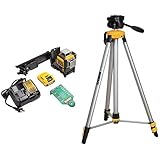
Best for ProfessionalsDeWalt DW089LG Green 3x360
Three-Plane 360°, Green Beam, 20V MAX Compatible
On a jobsite, the practical questions about a laser level are whether it will survive the week and whether its battery is one you already carry. The DW089LG answers both. It runs on standard DeWalt 12V and 20V MAX packs, which for any crew already on that platform means no separate battery inventory and no dead tool because someone forgot to charge a proprietary pack. Its over-molded housing is built for the reality of tools riding in a truck bed and being set on uneven surfaces. Optically it is a serious tool. Three full 360-degree green planes, one horizontal and two vertical, cover an entire room from a single setup, and the beams remained clearly readable at working distances in typical interior lighting. Being able to switch individual planes off matters more than it sounds: running only the horizontal line when that is all you need roughly doubles working time between charges. Self-leveling was fast and accuracy held consistently against our reference. The reservations are price, weight, and appropriateness. This sits at the premium end, particularly once you account for batteries and a charger if you are not already in the DeWalt ecosystem. The battery mount also makes it heavier than comparable tools. For a homeowner hanging shelves and tiling a backsplash occasionally, it is considerably more tool than the work requires.
Pros
- Runs on DeWalt 12V or 20V MAX batteries, which many jobsites already stock
- Three 360-degree green planes with strong visibility at distance
- Rugged over-molded housing built to survive jobsite handling
- Individual plane control lets you switch off lines you do not need to save battery
- Consistent accuracy in our testing with fast self-leveling
Cons
- Premium price, especially with batteries and a charger
- Heavier than comparable tools due to the battery mount
- Overkill for occasional homeowner use
The Bottom Line
The three-plane laser for a working jobsite. Battery compatibility and a housing built for abuse are what set it apart.

Best ValueHuepar 903CG Cross Line Green
Cross Line, Green Beam, Magnetic Bracket
Laser levels used to carry a steep brand premium, and Huepar is a large part of why that has changed. The 903CG delivers a bright green cross-line at a price well below name-brand equivalents, and in our accuracy testing it held within its stated specification against a calibrated reference at 30 feet, which is the measure that actually matters. On visibility it was noticeably brighter than red cross-line tools in the same lighting, which is the main practical benefit of green. The included magnetic pivoting bracket is more useful than most bundled accessories. It clamps to steel studs, track, and any ferrous surface, and the fine pivot adjustment lets you dial the line precisely without moving the mount. Pulse mode, which lets the tool work with a laser detector, extends usefulness outdoors where the beam is invisible to the eye. The out-of-level warning flashing the beam is a genuinely important safety feature, since a laser that has been bumped past its self-leveling range and keeps projecting a confident but wrong line is worse than no laser at all. The honest reservations are build quality and scope. There is more plastic in the housing than professional tools use, and long-term durability under daily abuse is less proven. And as a cross-line tool it projects one horizontal and one vertical line rather than covering a full room.
Pros
- Green cross-line performance at a fraction of the price of name-brand equivalents
- Held accuracy within specification in our 30-foot reference test
- Includes a magnetic pivoting bracket that clamps to steel studs and track
- Pulse mode allows use with a detector for longer outdoor distances
- Self-leveling with an out-of-level warning that flashes the beam
Cons
- Build quality is a step below professional tools, with more plastic in the housing
- Cross-line only, so it does not cover a full room from one setup
- Long-term durability is less proven than established brands
The Bottom Line
The most laser level per dollar in this guide. For a homeowner or a light-duty contractor, the value is genuinely hard to argue with.

Best Cross-LineBosch GLL55 Self-Leveling Cross Line
Cross Line, Red Beam, Compact
Most laser level work is simpler than the marketing implies: a level line along one wall for a row of pictures, a shelf, a chair rail, or a tile course, plus a plumb line for a door casing or a cabinet. The GLL55 does exactly that job with no complexity, and it does it accurately. Against our calibrated reference it held comfortably within specification, and its self-leveling was among the fastest in the group, settling almost immediately after placement. Its practical advantage over fancier tools is that it is small enough to live in a toolbox permanently and runs a long time on standard AA batteries. Red diodes draw far less power than green ones, and for a tool that gets used occasionally, not needing to remember to charge it is genuinely valuable. The out-of-range warning is reliable, flashing the beam when the tool has been knocked beyond its self-leveling range rather than silently projecting a wrong line. The trade-offs are beam color and coverage. A red beam is meaningfully harder to see than green in a bright room, and in our testing it required dimming lights at distances where a green tool remained clear. It is also cross-line rather than 360 degrees, so laying out a full room means moving and re-establishing the tool. Neither matters for hanging a shelf; both matter for tiling a bathroom.
Pros
- Compact and light enough to keep in a toolbox permanently
- Very fast self-leveling with a reliable out-of-range warning
- Excellent accuracy, holding well within specification in our testing
- Long runtime from AA batteries thanks to efficient red diodes
- Includes a versatile mounting base with a threaded tripod socket
Cons
- Red beam is noticeably harder to see than green in bright interior lighting
- Cross-line only, covering one wall rather than a whole room
- No pulse mode, so it cannot be used with a detector outdoors
The Bottom Line
The reliable everyday cross-line laser. Compact, accurate, and it runs a long time on AAs, which matters for a tool used occasionally.

Best CompactKlein Tools 93LCLS Compact Cross-Line
Cross Line + Plumb Spot, Red Beam, Very Compact
The most capable laser level is the one you did not bring. Klein built the 93LCLS around that observation, making a genuinely compact cross-line laser small enough to carry in a tool pouch on a service call or keep in a kitchen drawer for household jobs. In practice that portability means it gets used for the two-minute tasks where setting up a full tripod-mounted tool would feel like overkill, and those tasks are most of what a laser level is actually needed for. It projects a standard horizontal and vertical cross-line plus a plumb spot beneath the tool, which is more useful than it sounds for transferring a ceiling point down to the floor when locating a fixture or a partition. The magnetic bracket clamps to conduit, track, and ferrous surfaces, and there is a threaded socket for a tripod. Build quality is what you expect from Klein, which is to say it will survive being dropped. The limits follow from the size. Working range is shorter than full-size tools, so it is suited to rooms rather than long runs. The red beam has the usual visibility disadvantage in bright light. And it has no pulse mode, no detector compatibility, and no 360-degree coverage. Within its intended scope it is excellent.
Pros
- Very small and light, genuinely pocketable for a service call or a quick job
- Adds a plumb spot below the tool for transferring points to the floor
- Magnetic mounting bracket with a clamp and a threaded socket
- Durable construction typical of Klein hand tools
- Inexpensive and simple, with nothing to learn before using it
Cons
- Shorter working range than full-size tools
- Red beam with the visibility limitations that implies
- Basic feature set with no pulse mode or 360-degree coverage
The Bottom Line
The laser you actually have with you. Small enough to carry routinely, which is worth more than features you left in the van.

Best for OutdoorsJohnson Level 40-6543 Self-Leveling Rotary
Rotary Laser, Horizontal & Vertical, Detector Included
Line lasers project a visible beam onto a surface, which works beautifully indoors and fails completely outdoors, where sunlight overwhelms the beam within a few feet. Rotary lasers solve that differently: a single spot spins rapidly to describe a plane, and a handheld detector mounted on a grade rod beeps when it crosses that plane. Because the detector senses the beam electronically rather than relying on your eye, it works in full daylight at distances measured in hundreds of feet. For setting deck post heights, checking grade for drainage, running a fence line level, or laying out a foundation, this is the correct tool and a line laser is simply not usable. The Johnson 40-6543 includes the detector, a grade rod, and a tripod, which matters because a rotary laser without a detector is only half a system and buying the pieces separately costs more. It rotates in both horizontal and vertical orientations, covering both grading and vertical layout tasks, and the construction is built for outdoor site use. The reservations are about fit. Indoors, a rotary laser is bulky, requires a tripod, and gives you a spinning spot rather than the crisp continuous line a cross-line laser projects on a wall. For interior work a line laser is faster and easier in every respect.
Pros
- Rotary design with a detector works outdoors at distances where line lasers are invisible
- The correct tool for grading, foundations, deck posts, and fence lines
- Handles both horizontal and vertical rotation for a range of layout tasks
- Includes a detector, grade rod, and tripod, which makes it usable out of the box
- Rugged, weather-resistant construction for site conditions
Cons
- Overkill and awkward for interior line work compared to a cross-line laser
- Bulky, requiring a tripod and real transport space
- The detector adds a step, since you read a beeping receiver rather than seeing a line
The Bottom Line
The only tool here that works across a yard in daylight. If you are setting deck posts or grading, nothing else does this job.

Best DurabilityStabila LAX 300 G Cross Line Green
Cross Line 360° Horizontal, Green Beam, Jobsite Rated
A laser level is only useful while it is still accurate, and accuracy is exactly what a drop takes away. Stabila has built its reputation on tools that survive real site conditions, and the LAX 300 G is the clearest example of that in this guide. In our deliberate drop testing, dropping each tool from bench height onto a hard floor, it was the only laser that showed no measurable change against our calibrated reference afterward, while two cheaper tools shifted enough to matter over a 30-foot run. For anyone whose tools live in a truck and get handled by more than one person, that is the entire argument. The optics are serious too. A full 360-degree horizontal plane means a level line runs completely around a room from one setup, which covers the majority of interior layout work, and a green beam keeps it clearly visible in normal room lighting. The kit includes a bracket, a target plate, and a hard case, so it arrives ready to work. The trade-offs are price and configuration. It is priced as professional equipment, and it offers one vertical plane rather than the two on full three-plane lasers, so squaring a room from a single setup is not possible. Green diode power draw also means shorter runtime than red-beam alternatives.
Pros
- Exceptional build quality with a housing rated to survive real jobsite drops
- Full 360-degree horizontal plane plus a vertical line
- Green beam with strong visibility in bright interior conditions
- Includes a bracket, target plate, and hard case in the kit
- Held accuracy through deliberate drop testing that shifted cheaper tools
Cons
- Expensive, positioned as a professional rather than consumer tool
- Only one vertical plane rather than the two on three-plane lasers
- Runtime is shorter than red-beam alternatives
The Bottom Line
The laser to buy if the tool lives in a truck. Stabila build quality means it holds calibration through treatment that knocks cheaper tools out.
4. Accuracy, Self-Leveling, and What the Specs Mean
Accuracy specifications look similar across the category and mean different things depending on distance, and self-leveling has a limit that catches people out.
Accuracy is expressed per distance. A typical consumer specification is plus or minus one eighth of an inch at 30 feet. The error scales, so the same tool at 60 feet is roughly a quarter inch out. For hanging a shelf that is irrelevant; for running a tile course the length of a room it matters, and for outdoor grading over 100 feet it matters a great deal.
Self-leveling has a working range. Most self-leveling lasers compensate for roughly three to four degrees of tilt using an internal pendulum. Set the tool on a surface outside that range and it cannot level itself. Good tools flash the beam or refuse to project when out of range; cheap ones may simply project a confident, wrong line, which is far more dangerous than no line at all.
Check the out-of-range warning before you trust the tool. Tilt it deliberately past the self-leveling range and confirm that it warns you. Knowing that the tool will tell you when it cannot level is the difference between a reference you can rely on and one you have to second-guess.
Manual mode disables leveling deliberately. Most tools offer a locked mode that projects a line at whatever angle the tool sits, which is what you want for marking a stair stringer or a deliberate slope. It is also a trap: leaving the tool in manual mode and assuming the line is level produces confidently wrong work.
Verify calibration periodically. Set the laser 30 feet from a wall, mark the line, rotate the tool 180 degrees, reposition it to project onto the same spot, and compare. Any difference is twice the actual error. Doing this after a drop, and once a year regardless, catches a tool that has quietly drifted.
The Check That Takes Two Minutes
Place the laser roughly 30 feet from a wall and mark where the horizontal line falls. Move the tool to about 5 feet from the same wall, adjust height until the line hits the same mark, then turn the tool 180 degrees to project on the opposite wall and mark it. Move back to the far position and compare. If the marks disagree, the error you see is double the tool's actual error, and it needs recalibration.
5. Mounts, Tripods, and Detectors
The laser projects the line, but how you position and hold it determines whether the line lands where you need it. Mounting is where most of the practical frustration in this category lives.
Tripods with fine height adjustment. A standard camera tripod works with most lasers through the common threaded socket, but a laser tripod with a fine height adjustment crank is far better, because setting a line to an exact height by loosening and sliding a tripod leg is genuinely difficult. Look for the thread size, since laser tools use both 1/4-20 and 5/8-11 depending on class.
Magnetic pivoting brackets. These clamp to steel studs, track, conduit, and any ferrous surface, and the pivot lets you fine-tune the line without moving the mount. For interior work in commercial construction, this is often more useful than a tripod. Many tools include one.
Pole mounts and grabber poles. A telescoping pole braced between floor and ceiling holds a laser at any height without floor space, which is invaluable in a room where a tripod would be in the way. Worth having if you do ceiling work or tiling.
Detectors are mandatory outdoors. A handheld receiver senses the beam electronically and beeps when it crosses the plane, which is the only way to use a laser in daylight. The laser must support pulse mode for a detector to work, so check that specification if outdoor use is on your list.
Target plates improve visibility. A small red or green plastic plate held at the far end of a run makes a faint line dramatically easier to see, which extends the practical working range of a red laser considerably. They cost very little and are the cheapest way to improve a tool you already own.
Ceiling and wall brackets with a scale. Some brackets include a graduated scale that lets you offset the line a precise amount from a reference, which is useful for tasks like setting a suspended ceiling grid below a known point.
6. Indoor Versus Outdoor Use
The single most common disappointment with laser levels is buying one for outdoor work and discovering the beam vanishes in daylight. The two environments genuinely require different tools.
Indoors
A line laser projects a visible line onto walls, floors, and ceilings, and you read it directly with your eye. Green beams stay readable in normally lit rooms, red beams often need lights dimmed at distance. Cross-line lasers cover single-wall tasks, and three-plane 360-degree lasers cover whole rooms from one setup.
Outdoors
Sunlight overwhelms any laser beam within a few feet, so the line is simply not visible. Outdoor work requires either a rotary laser with a detector, or a line laser with pulse mode paired with a detector, in both cases reading the beam by an audible signal from a receiver rather than by eye. Beam color is irrelevant to this.
The Practical Consequence
If your list of jobs includes setting deck posts, checking drainage grade, running a fence line, or laying out a patio, you need a detector-compatible system. If it is all interior work, a line laser without pulse mode is fine and cheaper. If it is both, buy a line laser with pulse mode and add a detector, which is the most flexible arrangement short of owning two tools.
Twilight Is Not a Workaround
People sometimes plan to do outdoor laser work at dusk to make the beam visible. It works for short distances and is a poor plan for a real job, since the usable window is brief and you are working in fading light on tasks that benefit from seeing clearly. Buy the detector.
Before You Buy
Questions to Settle First
Also Needed for This Job
7. Frequently Asked Questions
What is the best laser level?
The Bosch GLL3-330CG is the best overall, projecting three full 360-degree green planes that cover an entire room from one setup with excellent visibility and proven accuracy. For value, the Huepar 903CG delivers green cross-line performance for far less, and for outdoor grading work the Johnson 40-6543 rotary laser with its included detector is the correct tool.
Is a green laser level better than red?
Green is several times more visible to the human eye at the same power, which keeps the line readable in normally lit rooms where a red beam fades. The costs are shorter battery life, higher price, and more temperature sensitivity. In dim conditions or at short range, red is perfectly adequate and cheaper. Neither is visible outdoors without a detector.
Can you use a laser level outside?
Not by eye. Sunlight overwhelms any laser beam within a few feet regardless of color or power. Outdoor work requires a rotary laser with a handheld detector, or a line laser with pulse mode paired with a detector, where the receiver senses the beam electronically and beeps rather than you seeing a line.
How accurate are laser levels?
A typical consumer specification is plus or minus one eighth of an inch at 30 feet, and the error scales with distance, so the same tool is roughly a quarter inch out at 60 feet. Professional tools are tighter. Verify periodically by marking a line, rotating the tool 180 degrees, and comparing, since any difference you see is double the actual error.
What is the difference between cross-line and 360-degree lasers?
A cross-line laser projects one horizontal and one vertical line covering an arc, which suits single-wall tasks like hanging shelves or a chair rail. A three-plane 360-degree laser projects a full horizontal circle plus two full vertical circles, covering an entire room from one setup, which matters for tiling, cabinets, and framing where repeated setups accumulate error.
Do I need a tripod for a laser level?
For anything beyond a quick mark, yes. A laser sitting on a table or a bracket is fixed at that height, and most layout work requires setting the line at a specific height. A laser tripod with a fine height adjustment crank is far easier to use than sliding camera tripod legs. Check the thread size, since laser tools use both 1/4-20 and 5/8-11.
8. Common Laser Level Mistakes
Laser level problems are rarely about the tool being faulty and almost always about the type, the mode, or an unverified assumption.
Buying a Line Laser for Outdoor Work
The beam simply is not visible in daylight, and no amount of brightness or beam color changes that. Outdoor grading, deck posts, and fence lines require a rotary laser or a pulse-mode line laser paired with a handheld detector. This is the single most common disappointment in the category.
Leaving the Tool in Manual Mode
Manual mode disables self-leveling so you can project a deliberate slope, which is genuinely useful for stair stringers and drainage. It is also a trap: forget to switch back and the tool projects a confident line at whatever angle it happens to sit, and the resulting work is precisely, consistently wrong.
Never Checking Calibration
Laser levels drift, and a drop can shift one enough to matter without any visible damage. The two-minute check of marking a line, rotating the tool 180 degrees, and comparing catches it. Doing this after any significant knock, and once a year regardless, is the difference between a reference and a guess.
Buying Cross-Line When the Job Needs 360 Degrees
A cross-line laser covers one wall, so laying out a whole room means moving it and re-establishing the height at each position, and every setup adds a little error. For tiling a bathroom, hanging cabinets, or framing, a three-plane 360-degree tool does the entire room from one position and the accumulated error disappears.
Everything Else About Laser Levels
Guide
How to Use a Laser Level
Setup, self-leveling, mounting and marking, plus working outdoors with a detector.
Comparison
Line Laser vs Rotary Laser
Indoor layout or outdoor grading: which laser type the job needs.
Comparison
Green vs Red Laser Level
Visibility, battery life and price: when the green beam is worth paying for.
Calibration
How to Check Laser Level Accuracy
The wall-flip and two-wall tests, the tolerance math, and when to send it back.
Comparison
Self-Leveling vs Manual Laser Level
Pendulum, electronic and manual leveling, and why manual mode matters on slopes.
Related Tool & DIY Guides
Buyer's Guide
Best Stud Finders
Find the framing before you fasten to the level line you just marked.
Buyer's Guide
Best Torque Wrenches
Another precision tool where accuracy and calibration decide whether it is worth owning.
All Guides
Browse All Best Lists
Every hands-on tested guide we have published, organized by category.
The Bottom Line
The best laser level for most interior work is the Bosch GLL3-330CG, whose three 360-degree green planes lay out an entire room from a single setup. For value, the Huepar 903CG delivers green cross-line accuracy for a fraction of the price, and for anything outdoors the Johnson 40-6543 rotary system with a detector is the only type that works in daylight.
Match the projection type to the job before you compare anything else, confirm the out-of-range warning works, and run the two-minute calibration check once a year.
More in Tools & Equipment
Guides in this category that pair with what you just read.
About the Author
Alex Rivers, Home Improvement Editor
Alex has spent over a decade working on residential and light commercial property maintenance, and now tests every tool, coating and machine that appears in these guides personally.