The 7 Best Pressure Washers in 2026
We cleaned concrete driveways, vinyl siding, wood decks, and fences with 12 pressure washers across a full season, tracking real cleaning speed, pump quality, and what broke. Only 7 earned a spot.
Alex Rivers
Home Improvement Editor
Last Updated
October 18, 2026
In This Guide
Pressure washers are sold almost entirely on PSI, which is the number least likely to determine how fast you finish a driveway. Water volume does more of the work than pressure does, and the wrong nozzle at the wrong pressure will carve permanent stripes into concrete and strip paint off siding. Here is what the specifications actually mean and which machines earn their price.
Our Picks at a Glance
The Short Answer
Simpson MegaShot MS60763 (Best Overall). The pressure washer that handles every homeowner job without complaint. Enough power for concrete, a reliable engine, and a frame that survives being dragged around.
- Check Price
- Check Price
- Check Price
- Check Price
- Check Price
- Best for Cars & Siding Karcher K5 Premium Smart Control — Electric, 2000 PSI, 1.4 GPM, Water-Cooled InductionCheck Price
- Highest-Pressure Electric Greenworks Pro GPW3000 3000 PSI Electric — Electric, 3000 PSI, 1.1 GPM, Induction MotorCheck Price
We may earn a commission when you buy through these links, at no extra cost to you. How we test
Best Overall
Simpson MegaShot MS60763
1. PSI, GPM, and Cleaning Units
Pressure washers are marketed on PSI almost exclusively, which is misleading, because pressure alone does not determine how fast a surface gets clean. Two numbers matter and they work together.
PSI is pounds per square inch, the force of the water stream. Pressure is what breaks the bond between dirt and the surface. It is what lifts embedded grime out of concrete pores and strips flaking paint. Too much of it is also what carves visible stripes into concrete and cuts through wood fibers on a deck.
GPM is gallons per minute, the volume of water flowing. Volume is what carries loosened dirt away and rinses the surface. It is also what determines how large an area you can cover per pass. A high-pressure, low-volume machine breaks dirt loose in a narrow line and then has to be walked back and forth endlessly to actually clear it.
Cleaning units combine them, and it is the number that predicts real-world speed. Multiply PSI by GPM to get cleaning units. A 2000 PSI machine at 1.4 GPM produces 2,800 cleaning units. A 3100 PSI machine at 2.4 GPM produces 7,400. That machine is not 55 percent faster, it is more than twice as effective, and on a large driveway that difference is measured in hours.
What to look for by task. Vehicles and delicate surfaces need roughly 1,500 to 2,000 PSI and low cleaning units. Siding, fences, and decks are comfortable in the 2,000 to 2,500 PSI range. Concrete driveways and masonry want 3,000 PSI and above with at least 2.0 GPM, and below roughly 5,000 cleaning units a driveway becomes a genuinely slow job.
Higher is not automatically better. A 4000 PSI machine used carelessly will permanently damage wood, siding, window seals, and paint, and can cause serious injection injuries to skin. Buying more pressure than your surfaces can tolerate means buying a tool you must deliberately restrain, which is a real risk in practice.
The Numbers Don't Lie
PSI x GPM
Cleaning units, the number that matters
5,000+
Cleaning units for practical concrete work
1,500
Max PSI recommended for vehicles
2x
Speed gain from a surface cleaner on flat concrete
2. Gas vs Electric Pressure Washers
The choice determines both what you can clean and how much the machine will demand of you over its life. Unlike many outdoor tools, the gap here has not fully closed.
Gas Pressure Washers
Gas machines dominate on water volume, which is the specification electric units cannot match. A typical gas washer moves 2.4 to 3.5 GPM against 1.2 to 2.0 for electric, and because volume carries dirt away, that gap translates directly into cleaning speed on large surfaces. Gas is also completely portable, with no cord limiting where you work. The costs are noise, engine maintenance, fuel storage and stabilization, weight, and size.
Electric Pressure Washers
Electric machines start with a switch, run far quieter, need no fuel or oil, and store in a fraction of the space. Good ones with induction motors and 2000 PSI and up handle siding, decks, fences, vehicles, and patio furniture completely competently. The limitations are water volume, a power cord that caps working range, and the fact that cheap units with universal motors have genuinely short lives.
How to Decide
If your main job is a concrete driveway or a large patio, buy gas or the most capable electric unit you can, and buy a surface cleaner regardless. If you mainly wash siding, cars, decks, and furniture, a quality electric machine is quieter, easier to store, and entirely sufficient. If you want one machine for everything and have somewhere to keep it, gas is the more versatile choice.
| Factor | Gas | Electric |
|---|---|---|
| Typical GPM | 2.4-3.5 | 1.2-2.0 |
| Cleaning units | 6,000-14,000 | 2,500-6,000 |
| Portability | Anywhere | Cord-limited |
| Maintenance | Oil, fuel, filters, plugs | Pump care only |
| Noise | Hearing protection advised | Conversation level |
3. The 7 Best Pressure Washers in 2026 — Tested & Ranked
We cleaned a concrete driveway with a season of algae, a vinyl-sided wall, a weathered wood deck, and a cedar fence with each machine, timing coverage, noting surface damage, and running extended sessions to check for heat fade and pump behavior. These seven earned their place.

Best OverallSimpson MegaShot MS60763
Gas, 3100 PSI, 2.4 GPM, Honda GC190
Most homeowner pressure washer regret comes from buying a machine that cannot clean concrete, and the MegaShot sits comfortably above that threshold. At 3100 PSI and 2.4 gallons per minute it produces roughly 7,400 cleaning units, which is the figure that actually predicts how fast a driveway gets clean, and in our testing it stripped a season of algae and dirt off a concrete pad at a walking pace with a surface cleaner attached. Electric units at half those cleaning units took nearly three times as long on the same surface. The Honda GC190 engine is a substantial part of the value. It started within two pulls in every test session including after winter storage with stabilized fuel, and it is common enough that any small engine shop can service it and any parts counter stocks components. The steel frame and pneumatic tires matter more than they sound, because a pressure washer gets dragged across lawns, gravel, and curbs, and the small plastic wheels on cheaper units bog down constantly. The costs are the standard gas costs. Annual oil changes, fuel stabilization before storage, air filter service, and enough noise to warrant hearing protection over an afternoon. It is also physically large and heavy, needing genuine storage space rather than a shelf. For a homeowner cleaning driveways, siding, decks, and fences, it is the right size of tool.
Pros
- Honda GC190 engine starts reliably and is serviceable essentially anywhere
- 3100 PSI at 2.4 GPM produces roughly 7,400 cleaning units, enough for driveways and concrete
- Steel frame with 10-inch pneumatic tires that roll easily over grass and gravel
- Axial cam pump with maintenance-free design that has proven durable in long-term reports
- Includes five quick-connect nozzles covering everything from soap to a concentrated stream
Cons
- Gas engine requires oil changes, fuel stabilization, and seasonal maintenance
- Loud enough to warrant hearing protection over a long session
- Heavy and bulky compared to electric units, requiring real storage space
The Bottom Line
The pressure washer that handles every homeowner job without complaint. Enough power for concrete, a reliable engine, and a frame that survives being dragged around.

Best ElectricRyobi RY142300 2300 PSI Brushless
Electric, 2300 PSI, 1.2 GPM, Brushless Induction
Electric pressure washers have a bad reputation earned mostly by cheap ones, which use universal motors that are loud, run hot, and typically fail within a couple of seasons of regular use. The Ryobi RY142300 uses a brushless induction motor instead, which is quieter, runs cooler, and lasts dramatically longer, and that single design choice is the main reason to pay more than budget electric pricing. In our testing it was noticeably quieter than any other pressure washer here, gas or electric, and it showed no sign of heat-related power fade during extended runs. Its 2300 PSI is genuinely high for an electric unit and handles vinyl siding, wood decks, fences, patio furniture, and vehicles comfortably. On light concrete work it manages, though slowly. The on-board storage for the hose, cord, wand, and nozzles is a small thing that makes a real difference in whether a pressure washer stays organized rather than becoming a tangle in the corner of the garage. The limitation is water volume. At 1.2 gallons per minute it moves roughly half the water of a gas unit, and since volume is what carries dirt away, large flat surfaces take considerably longer. Combined with the need for a nearby outlet and the limited reach of a power cord plus a hose, it is a tool for the areas around a house rather than a whole property.
Pros
- Brushless induction motor is far quieter and longer lived than the universal motors in cheap electric units
- 2300 PSI is genuinely high for an electric washer, handling siding, decks, and light concrete work
- Starts instantly with a switch, no fuel, no oil, no pull cord, and no winterizing an engine
- On-board storage for hose, cord, wand, and nozzles keeps everything together
- Quiet enough to use in a driveway without irritating the whole street
Cons
- 1.2 GPM water volume limits how quickly it cleans large flat surfaces
- Requires a nearby outlet and a good water supply, with limited hose reach
- Costs more than budget electric washers, though it lasts far longer
The Bottom Line
The electric pressure washer worth owning. The induction motor is the difference between a tool that lasts a decade and one that lasts two summers.

Best Gas ValueGenerac SpeedWash 3200 PSI
Gas, 3200 PSI, 2.7 GPM, Generac OHV
The SpeedWash competes directly with the Simpson on output and undercuts it on price, and its clearest advantage is what comes in the box. Most pressure washers ship with a set of nozzles and nothing else, leaving you to buy a turbo nozzle and a surface cleaner separately at real cost. Generac includes a turbo nozzle, a soap blaster, and a power broom, which covers most of what a homeowner actually needs to attack driveways, siding, and decks without a second purchase. At 3200 PSI and 2.7 gallons per minute it produces roughly 8,600 cleaning units, which is the highest figure in this guide and translated in our testing into the fastest raw cleaning speed on concrete. The PowerDial wand is the standout feature, letting you change pressure levels at the handle rather than walking back to swap a nozzle, which genuinely speeds up work that moves between surfaces, such as washing siding and then rinsing a walkway. The reservations are about long-term support and included accessory quality. The Generac engine is reliable but less universally serviceable than a Honda, and finding parts is easier through Generac channels than at any small engine shop. The included attachments are functional but visibly lighter duty than aftermarket equivalents, so heavy users will eventually replace them. Neither undermines the core value proposition.
Pros
- 3200 PSI at 2.7 GPM gives roughly 8,600 cleaning units, among the highest here
- Includes a turbo nozzle, soap blaster, and power broom attachments in the box
- PowerDial wand changes pressure at the handle without swapping nozzles
- Costs meaningfully less than premium gas units with similar output
- Large pneumatic tires and a well-balanced frame for moving around a property
Cons
- Generac engine is less universally serviceable than a Honda
- Included attachments are useful but not built to last as long as the machine
- Same noise, fuel, and maintenance requirements as any gas washer
The Bottom Line
More cleaning power per dollar than anything else here, with genuinely useful attachments included. The value pick for gas.

Best BudgetSun Joe SPX3000 2030 PSI
Electric, 2030 PSI, 1.76 GPM, Dual Detergent Tanks
The SPX3000 has been among the best-selling pressure washers in America for years, and it earns that on straightforward value. It costs a fraction of a gas unit while delivering 2030 PSI and 1.76 gallons per minute, which is enough to clean siding, fences, decks, patio furniture, and vehicles effectively. For a homeowner who pressure washes a few times a year, that covers most of the actual demand. The dual detergent tanks are genuinely useful and rare at this price, letting you keep a house wash in one and a degreaser in the other and switch between them with a dial rather than draining and refilling. The Total Stop System, which cuts the pump when you release the trigger, is an important feature because running a pump in bypass generates heat and is a leading cause of premature pump failure. Its light weight and compact size make it easy to carry to a job and store on a shelf, which matters in a crowded garage. The compromises are construction and motor type. The universal motor is louder and has a considerably shorter service life than an induction motor, which is the core difference between this and the Ryobi. The frame, wheels, and much of the housing are plastic, and it feels like a tool with a finite lifespan. Framed as a few-seasons purchase at a low price, it is a reasonable buy.
Pros
- Very inexpensive while still delivering usable 2030 PSI and 1.76 GPM
- Two onboard detergent tanks let you switch between soaps without refilling
- Light and compact, easy to carry and store on a shelf
- Total Stop System shuts the pump off when the trigger releases, extending pump life
- Five quick-connect nozzles included covering all common tasks
Cons
- Universal motor is louder and shorter lived than an induction motor
- Plastic construction throughout, including the wheels and frame
- Water volume is decent for electric but well below any gas unit
The Bottom Line
The best-selling electric pressure washer for a reason: it is cheap and it works. Expect a few seasons rather than a decade.
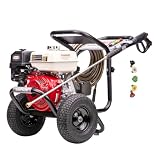
Best Heavy DutySimpson PowerShot PS60869
Gas, 4000 PSI, 3.5 GPM, Honda GX270, Triplex Pump
The gap between a homeowner pressure washer and a commercial one is mostly the pump. Consumer machines use axial cam pumps that are compact, sealed, and disposable, typically rated for a few hundred hours. The PS60869 uses a triplex plunger pump, which runs cooler, lasts thousands of hours, and can be rebuilt with a seal kit rather than replaced. If you clean regularly or run long sessions, that is the difference between a machine that lasts five years and one that lasts twenty. Performance follows the specification. At 4000 PSI and 3.5 gallons per minute it produces 14,000 cleaning units, roughly double a good homeowner unit, and in our testing it cleaned a large concrete pad in less than half the time of the 3100 PSI machines. Paired with a surface cleaner it covers ground at a genuine walking pace. The Honda GX270 is a commercial engine built for long duty cycles rather than intermittent homeowner use. The reasons most people should not buy it are equally clear. It is expensive, physically large, and heavy. More importantly, 4000 PSI will destroy wood decking, cut into vinyl siding, strip paint, and injure you badly if the stream contacts skin. This is a machine for concrete, masonry, and heavy equipment cleaning, and using it on delicate surfaces requires deliberately backing the pressure down.
Pros
- Triplex plunger pump is rebuildable and rated for far more hours than consumer axial pumps
- 4000 PSI at 3.5 GPM gives 14,000 cleaning units, roughly double a good homeowner machine
- Honda GX270 commercial engine built for long duty cycles
- Welded steel frame with commercial-grade hose and fittings
- Cleans large concrete areas dramatically faster than any homeowner unit
Cons
- Expensive, at commercial equipment pricing rather than homeowner pricing
- High pressure will permanently damage wood, siding, and paint if used carelessly
- Heavy, large, and genuinely more machine than most homes need
The Bottom Line
Commercial capability in a machine a homeowner can buy. Overkill for siding, and transformative on large concrete areas.

Highest-Pressure ElectricGreenworks Pro GPW3000 3000 PSI Electric
Electric, 3000 PSI, 1.1 GPM, Induction Motor
The standard reason to buy gas is that electric machines cannot clean concrete, and the GPW3000 is the clearest counterexample available. Read the flow figure carefully: Greenworks quotes 2.0 gallons per minute, but that is measured at 100 PSI. At its full 3000 PSI it flows 1.1 GPM, about 3,300 cleaning units — the most pressure of any electric unit here, though the Sun Joe SPX3000 moves more water and edges it on cleaning units, and entry-level gas machines produce roughly twice as much. In our concrete testing it removed algae and embedded dirt effectively rather than merely brightening the surface, which is where lower-powered electric units stop. Its induction motor gives it the durability and lower noise that separate serious electric washers from disposable ones, and the steel frame and larger wheels make it far easier to move around a property than the small plastic-framed electric units. For a homeowner who wants a machine that will clean a driveway but does not want to own a small engine, this is the most direct answer in this guide. Two practical considerations. It draws substantial current, and running it on a circuit shared with other loads will trip breakers, so a dedicated 20-amp circuit or a heavy-gauge outdoor-rated cord on its own circuit is worth arranging. And despite the high pressure, its 1.1 GPM water volume at full pressure is well below gas machines, so large flat areas take longer even though the cleaning action is strong. Pair it with a surface cleaner to close most of that gap.
Pros
- 3000 PSI is the highest pressure of any electric unit in this guide
- Induction motor for long life and lower noise than universal motor units
- Genuinely capable on concrete, closing most of the gap to entry-level gas machines
- Steel frame and larger wheels than typical electric washers
- No fuel, oil, or winterizing an engine, just the pump to protect
Cons
- Draws enough current that a dedicated circuit is advisable
- Heavier and bulkier than most electric pressure washers
- Still slower than gas on large flat areas because of lower water volume
The Bottom Line
The electric pressure washer for people who want gas-level pressure without an engine. It genuinely cleans concrete.
4. Nozzles, Surface Cleaners, and Attachments
The nozzle on the end of the wand changes the effective pressure at the surface more than any setting on the machine, and choosing the wrong one is the leading cause of pressure washer damage.
The Standard Nozzle Colors
Red is 0 degrees, a pencil-thin jet that concentrates all the pressure into a tiny point. It will carve concrete and should almost never be used. Yellow is 15 degrees for heavy stripping on hard surfaces. Green is 25 degrees, the general-purpose choice for concrete and driveways. White is 40 degrees for siding, vehicles, and delicate surfaces. Black is a low-pressure soap nozzle that draws detergent through the machine.
The Turbo or Rotary Nozzle
A turbo nozzle spins a 0-degree jet in a rapid cone, delivering the striking power of a zero-degree tip across the coverage of a 25-degree fan. It is genuinely the fastest way to clean concrete with a standard wand and is included with some machines. It is also aggressive enough to damage wood and siding, so keep it on hard surfaces.
Surface Cleaners Are the Real Upgrade
A surface cleaner is a shrouded disc with two or more rotating jets underneath that you push across flat concrete like a floor buffer. It roughly doubles cleaning speed on driveways and patios, eliminates the striping that hand-waving a wand always produces, and dramatically reduces overspray. If you clean any significant area of flat concrete, this is the single most worthwhile accessory available.
Extension Wands and Gutter Attachments
Telescoping wands let you reach second-story siding and soffits from the ground, which is safer than working from a ladder with a hose that produces recoil. Curved gutter attachments clean gutters from the ground too. Both are inexpensive and remove genuinely dangerous ladder work.
Why Your Driveway Has Stripes
Cleaning flat concrete by waving a wand back and forth always produces visible stripes, because the pressure at the center of the fan is higher than at the edges and overlap is never perfect. The stripes are not dirt, they are differential cleaning. A surface cleaner solves it completely by applying uniform pressure across its full width, which is why professionals use one on every flat surface.
5. What You Can and Cannot Pressure Wash
Pressure washers cause a large amount of accidental property damage every year, almost all of it avoidable by knowing which surfaces tolerate what.
Concrete and masonry. The best candidates. Use 3,000 PSI and a 25-degree nozzle or a surface cleaner. Avoid a zero-degree tip, which will etch permanent lines into the surface that no amount of subsequent cleaning removes.
Vinyl and fiber cement siding. Use a 40-degree nozzle at moderate pressure and spray at a slight downward angle, never upward, because water forced upward gets behind the siding and into the wall cavity where it causes rot and mold. Keep the wand at least a foot away.
Wood decks and fences. The most commonly damaged surface. Wood fibers are soft and high pressure carves visible furrows and raises the grain permanently. Use a 40-degree nozzle at 1,500 PSI or less, keep the wand moving, and work with the grain. A deck cleaner applied first does most of the work chemically so you need far less pressure.
Vehicles. Use no more than about 1,500 PSI with a 40-degree nozzle, keep at least two feet away, and never aim directly at seals, badges, or trim. A foam cannon and a proper wash mitt do a better job on paint than pressure alone.
Never pressure wash: asphalt shingles, which lose their protective granules and fail early; old mortar, which blows out of joints; painted surfaces you intend to keep, since pressure strips paint readily; windows and their seals; electrical panels, meters, and outdoor outlets; and anything with a person, pet, or plant in the path of the stream.
Personal safety matters more than people assume. A high-pressure stream can inject water and contaminants under the skin, producing an injury that looks minor and requires emergency surgery. Never point a wand at anyone, wear closed shoes and eye protection, and be aware that recoil on a high-output machine is strong enough to unbalance you on a ladder.
6. Pump Care, Winterizing, and Common Failures
Pressure washers almost always fail at the pump, and almost all of those failures come from three specific mistakes that are easy to avoid.
Do not run the machine in bypass for long. When the engine or motor is running and you are not squeezing the trigger, water circulates inside the pump and heats up rapidly. Sustained bypass is the single most common cause of pump failure. Machines with a total stop system shut off automatically; on machines without one, shut it down if you will be more than a minute or two.
Never starve the pump for water. A pressure washer needs a strong, uninterrupted water supply. An undersized or kinked hose, a partially open spigot, or a long narrow hose run starves the pump, causing cavitation that damages seals and valves quickly. Use a short 5/8-inch or 3/4-inch hose from a fully open spigot, and turn the water on before starting the machine.
Winterize with pump antifreeze. Water left in a pump freezes and cracks the housing, which is a terminal failure on a sealed consumer pump. After the last use of the season, run the machine briefly with pump saver antifreeze drawn through it, which both displaces water and lubricates the seals. This is a five-minute job that saves the machine.
Check and clean the inlet filter. A small screen at the water inlet catches grit that would otherwise reach the pump. It clogs gradually, restricting flow and starving the pump without any obvious symptom other than reduced pressure. Pull it and rinse it a few times a season.
Store the hose properly. High-pressure hose is stiff and develops permanent kinks if coiled tightly or crushed under something heavy. A kinked high-pressure hose can burst under load, which is both dangerous and expensive. Coil it in large loops and hang it rather than leaving it in a pile.
Before You Buy
Also Needed for This Job
7. Frequently Asked Questions
What is the best pressure washer?
For most homeowners the Simpson MegaShot MS60763 is the best all-around choice, with 3100 PSI at 2.4 GPM and a Honda engine that is serviceable anywhere. For the best electric option, the Ryobi RY142300 brushless induction unit is quiet and long-lived. For the most cleaning power per dollar, the Generac SpeedWash 3200 includes attachments most machines make you buy separately.
Is PSI or GPM more important?
Both matter, and the useful figure is cleaning units, which is PSI multiplied by GPM. Pressure breaks dirt loose while water volume carries it away and covers area. A 3100 PSI machine at 2.4 GPM produces 7,400 cleaning units and cleans more than twice as fast as a 2000 PSI machine at 1.4 GPM, despite the pressure difference looking modest.
What PSI do I need to clean a driveway?
Aim for 3,000 PSI or more with at least 2.0 GPM, which puts you above roughly 6,000 cleaning units. Below about 5,000 cleaning units a concrete driveway becomes a genuinely slow job. Pair whatever machine you buy with a surface cleaner attachment, which roughly doubles speed on flat concrete and eliminates striping.
Can I pressure wash my deck?
Yes, carefully. Use a 40-degree nozzle at 1,500 PSI or less, keep the wand moving, work with the grain, and stay at least a foot away. Wood fibers are soft and higher pressure carves permanent furrows and raises the grain. Applying a deck cleaner first does most of the work chemically so far less pressure is needed.
Are electric pressure washers powerful enough?
For siding, decks, fences, vehicles, and patio furniture, absolutely. A quality electric unit with an induction motor at 2000 PSI and above handles all of that competently. For large concrete areas they are usable but slower, because their water volume of 1.2 to 2.0 GPM is well below the 2.4 to 3.5 GPM a gas machine delivers.
Why did my pressure washer pump fail?
Most commonly from running in bypass, meaning the machine running while the trigger is released, which heats the circulating water and destroys seals. The other frequent causes are starving the pump with an inadequate water supply, which causes cavitation, and freezing over winter without running pump antifreeze through it.
8. Common Pressure Washer Mistakes
Pressure washers cause more accidental property damage than any other homeowner tool, and the errors are remarkably consistent.
Using a Zero-Degree Nozzle on Concrete
The red zero-degree tip concentrates all the machine's pressure into a pencil-thin point, and dragging it across concrete etches permanent lines that no future cleaning removes. It exists for very specific spot work and should essentially never be used on a driveway. Use a 25-degree tip or, far better, a surface cleaner.
Spraying Siding Upward
Siding is designed to shed water running down it, and forcing water upward drives it behind the panels into the wall cavity where it causes rot and mold that appears months later. Always spray at a slight downward angle, use a 40-degree nozzle, and keep the wand at least a foot from the surface.
Leaving the Machine Running Between Passes
Running with the trigger released circulates water inside the pump, and that water heats rapidly. Sustained bypass operation is the leading cause of pump failure, and it happens constantly when people leave the machine idling while they move a ladder or coil a hose. Shut it down for anything longer than a minute.
Skipping Winterization
Water left in a pump freezes, expands, and cracks the housing, which ends the machine. Running pump saver antifreeze through the unit after the last use of the season takes five minutes, costs very little, and also lubricates the seals. This is the single highest-value maintenance task on a pressure washer.
Related Cleaning & Exterior Guides
Buyer's Guide
Best Surface Cleaners
The attachment that roughly doubles cleaning speed on flat concrete and eliminates striping.
Buyer's Guide
Best Electric Pressure Washers
A closer look at electric units, induction motors, and what they genuinely handle.
Buyer's Guide
Best Driveway Cleaners
Degreasers and stain removers that do the chemical work so you need less pressure.
The Bottom Line
The best pressure washer for most homeowners is the Simpson MegaShot MS60763, which has enough cleaning units for concrete and a Honda engine you can get serviced anywhere. For the best electric option, the Ryobi RY142300 and its induction motor will outlast three cheap electric units. And for maximum value in gas, the Generac SpeedWash 3200 includes attachments most machines make you buy separately.
Whatever you buy, add a surface cleaner and learn the nozzle colors. Those two things will do more for your results than another thousand PSI.
More in Tools & Equipment
Guides in this category that pair with what you just read.
About the Author
Alex Rivers, Home Improvement Editor
Alex has spent over a decade working on residential and light commercial property maintenance, and now tests every tool, coating and machine that appears in these guides personally.