Best Cordless Circular Saws
We cross-cut 2x10s, ripped plywood and bevel-cut decking with seven battery saws to find out which ones genuinely replace a corded saw, and which battery you need to make them do it.
Alex Rivers
Home Improvement Editor
Last Updated
September 29, 2026
In This Guide
A good cordless circular saw now does everything a corded saw does on a typical home project, without an extension cord trailing across the deck. But a cordless saw is only as good as the battery behind it. Put a compact 2.0Ah pack on a 7-1/4-inch brushless saw and it will stall in wet lumber and die after a handful of rips. Choosing well means choosing the saw and the battery together.
Our Picks at a Glance
- Best Overall: DeWalt 20V MAX 7-1/4-Inch Brushless Circular Saw with FLEXVOLT Advantage (DCS573B) — 20V MAX Brushless, 7-1/4 in Sidewinder
- Best for Milwaukee Owners: Milwaukee M18 FUEL 7-1/4-Inch Circular Saw (2834-20) — 18V Brushless, 7-1/4 in Sidewinder
- Best for Makita Owners: Makita 36V (18V X2) LXT Brushless 7-1/4-Inch Circular Saw (XSH06Z) — 18V X2 (36V) Brushless, 7-1/4 in
- Most Powerful: DeWalt FLEXVOLT 60V MAX Brushless 7-1/4-Inch Circular Saw with Brake (DCS578B) — 60V FlexVolt Brushless, 7-1/4 in
- Best Rear-Handle Value: SKIL PWRCORE 20 Brushless 2x20V 7-1/4-Inch Rear Handle Circular Saw Kit (CR5429B-20) — 2x20V (40V) Rear-Handle, 7-1/4 in
- Best Compact: Makita 18V LXT Brushless 6-1/2-Inch Circular Saw (XSH03Z) — 18V LXT Brushless, 6-1/2 in
- Best Budget: Ryobi ONE+ HP 18V Brushless 7-1/4-Inch Circular Saw (PBLCS300B) — 18V ONE+ HP Brushless, 7-1/4 in
1. How We Picked These Saws
We looked at the current brushless circular saws from every major battery platform, including DeWalt, Milwaukee, Makita, Ryobi and Skil, and kept the ones that are widely available, still in production and, where possible, sold as bare tools so you can run them on batteries you already own. We skipped brushed saws entirely. The brushless versions cost only a little more, cut far longer per charge and hold their speed better under load.
Every saw made the same cuts: crosscuts through 2x10 Douglas fir framing lumber, full-length rips in 3/4-inch plywood, 45-degree bevels in 5/4 decking, and plunge cuts in OSB sheathing. We ran each saw on the largest battery its maker recommends and again on a mid-size pack, because the same saw can feel like two different tools depending on what is clipped to it.
We paid particular attention to what you notice on a real job: whether you can see the cut line without leaning over the saw, how quickly the blade stops when you release the trigger, how easy the depth and bevel adjustments are to set and lock, and how the saw balances with a big battery hanging off the back. Specifications cover the rest, and we have listed the ones that matter in each pick.
Our picks lean toward 7-1/4-inch saws, because that is the size that bevels through 2x lumber at 45 degrees and the one most people need. We have included one 6-1/2-inch saw for people who mainly cut sheet goods and trim, and one rear-handle saw for framers and anyone who prefers that layout. If your work is mostly precise rip cuts in sheet goods, read the section on blades, which covers when a table saw is the better tool.
2. 6-1/2-Inch vs 7-1/4-Inch: Choosing a Blade Size
Blade size decides depth of cut, and depth of cut decides what the saw can do. A 7-1/4-inch blade cuts roughly 2-7/16 to 2-5/8 inches deep at 90 degrees, which is enough to go through standard 2x lumber, actually 1-1/2 inches thick, with room to spare. More importantly, it still gets through that lumber at a 45-degree bevel. That is the reason 7-1/4 inches became the standard size for framing and deck work.
A 6-1/2-inch blade cuts about 2-1/4 inches deep at 90 degrees and around 1-5/8 inches at 45 degrees. That is enough to cross-cut a 2x4 square, and plenty for plywood, OSB and trim, but a 45-degree bevel through 2x lumber is marginal, and you may need to finish the cut from the other side. In exchange, the smaller saw is lighter, easier to control one-handed and draws less current, so it cuts more per charge on the same battery.
For most homeowners the 7-1/4-inch saw is the safer choice because it does everything, including the occasional bevel through a stair stringer or a rafter tail. Blades in this size are also far easier to find, in more tooth counts and specialty types, at any hardware store. If the saw will mainly break down sheet goods and cut trim, siding and fence boards, a 6-1/2-inch saw is lighter and entirely adequate.
There is another reason 7-1/4-inch cordless saws now make sense even for occasional DIY: brushless motors and larger batteries have closed most of the power gap. A few years ago a cordless full-size saw could struggle badly in wet pressure-treated lumber. Today's brushless models on a 6.0Ah or larger battery cut through it steadily, though still not quite as relentlessly as a good corded saw on a long rip.
| Blade size | Depth at 90° | Depth at 45° | Best for |
|---|---|---|---|
| 7-1/4 inch | About 2-7/16 to 2-5/8 in | About 1-3/4 to 2 in | Framing, decks, bevels in 2x lumber |
| 6-1/2 inch | About 2-1/4 in | About 1-5/8 in | Sheet goods, trim, light carpentry |
3. Our 7 Top Picks
These are the seven cordless circular saws we would buy. The DeWalt DCS573 is our overall pick because it combines full 7-1/4-inch capacity, an electric brake and a 57-degree bevel with a manageable weight and the option of a FlexVolt power boost, but the Milwaukee and Makita saws are just as good for owners of those batteries. We have also picked a compact 6-1/2-inch saw, a rear-handle saw and a budget option for occasional use.
DeWalt 20V MAX 7-1/4-Inch Brushless Circular Saw with FLEXVOLT Advantage (DCS573B)
20V MAX Brushless, 7-1/4 in Sidewinder
The DCS573 is DeWalt's mainstream 7-1/4-inch brushless saw, and it earns the top spot by being good at everything rather than extreme at anything. DeWalt rates it at 5,500 RPM, with a 57-degree bevel, a 2-9/16-inch cut at 90 degrees and 2 inches at 45 degrees, which clears 2x lumber at a bevel with margin to spare. It has an electric brake, and in our testing it cross-cut 2x10 framing and ripped 3/4-inch plywood steadily on a 6.0Ah pack. What sets it apart is FlexVolt Advantage. It is a 20V MAX tool that runs on any DeWalt 20V battery, but when you fit a FlexVolt pack it recognises it and draws more power; DeWalt claims up to 77 percent more with a 6.0Ah FlexVolt battery compared with a 5.0Ah 20V pack. In practice that means one saw that is light and manageable on a normal battery and noticeably stronger on a big one, which suits people who cut occasionally but sometimes need to rip wet lumber. On a small 2.0Ah pack it runs, but it bogs down in thick stock, as every saw here does. If you already own DeWalt 20V batteries, this is the saw to buy. If you are starting fresh, budget for at least one large battery alongside it.
Pros
- 5,500 RPM brushless motor with an electric brake
- 57-degree bevel capacity and a 2-inch depth of cut at 45 degrees
- Recognises a FlexVolt battery and draws substantially more power from it
- Runs on any DeWalt 20V MAX battery, one of the largest platforms
- 2-9/16-inch depth at 90 degrees clears 2x lumber with room to spare
Cons
- Needs a large or FlexVolt battery to reach its potential
- Bare tool pricing sits in the premium tier
The Bottom Line
The best cordless circular saw for most people, and the easiest recommendation for anyone on DeWalt 20V.

Milwaukee M18 FUEL 7-1/4-Inch Circular Saw (2834-20)
18V Brushless, 7-1/4 in Sidewinder
Milwaukee's current M18 FUEL 7-1/4-inch sidewinder is one of the strongest cordless circular saws you can buy. Milwaukee rates it at 6,000 RPM with a 2-5/8-inch depth of cut, enough to go through 3x material in a single pass, and a 57-degree bevel with detents at 22.5 and 45 degrees. At about 7.9 pounds bare it is light for a full-size saw, and it has an electric brake. In our testing on a large high-output battery it cut through 2x10 fir and ripped plywood without bogging, and it cut steadily through wet pressure-treated decking where smaller-battery saws slowed. Milwaukee claims up to 750 cuts per charge, but that figure uses its large M18 FORGE HD12.0 battery, and the saw is at its best on high-output packs of that class. On a mid-size battery it is still strong, but it runs down noticeably faster. The main case against it is cost: the saw itself is premium, and the batteries that bring out its best are expensive. For existing M18 owners, especially those who already own high-output packs, it is the obvious choice. It is listed with the blade on the right, which suits you if that is the layout you are used to; if you prefer a left blade and a rear handle, look at Milwaukee's rear-handle saw instead.
Pros
- 6,000 RPM, among the fastest no-load speeds on this list
- Up to 750 cuts per charge on an M18 FORGE HD12.0 battery, by Milwaukee's figure
- 57-degree bevel with detents at 22.5 and 45 degrees
- 2-5/8-inch depth of cut handles 3x material in one pass
- About 7.9 lb bare, light for a full-size saw, with an electric brake
Cons
- Needs a large high-output M18 battery to live up to its claims
- Premium pricing, and the big batteries add significantly to it
The Bottom Line
A powerful, well-built saw that belongs at the top of any M18 owner's list.
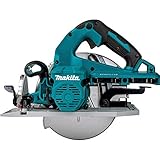
Makita 36V (18V X2) LXT Brushless 7-1/4-Inch Circular Saw (XSH06Z)
18V X2 (36V) Brushless, 7-1/4 in
Makita's answer to the power demands of a 7-1/4-inch saw is to use two of its 18V LXT batteries at once. The XSH06 runs at 36V, and the result is a saw that feels closer to a corded model than most single-battery designs. Makita rates it at 6,000 RPM with a 2-5/8-inch depth of cut at 90 degrees and a bevel range to 56 degrees, with positive stops at 22.5, 45 and 56 degrees. Makita claims up to 610 crosscuts in 2x4 SPF per charge with two 5.0Ah batteries. In our testing it ripped plywood and cross-cut framing lumber with a steadiness that only the Milwaukee and the FlexVolt DeWalt matched. The dual-battery design has a practical advantage for existing Makita owners: you do not need to buy into a new, higher-voltage battery line to get this power, only to own two LXT packs, which most Makita users already do. The drawbacks follow from the same design. You must have two charged batteries to use it at all, and with both fitted it is heavier than the single-battery saws here. Makita also sells a 40V XGT saw, the GSH01, with similar speed and bevel figures, but for existing LXT owners the XSH06 is the smarter buy because it needs no new batteries or charger.
Pros
- Runs on two 18V LXT batteries for 36V of power without a new battery system
- 6,000 RPM with a 2-5/8-inch depth of cut at 90 degrees
- Up to 610 crosscuts in 2x4 per charge with two 5.0Ah packs, by Makita's figure
- 56-degree bevel with positive stops at 22.5, 45 and 56 degrees
- Electronically controlled brushless motor matches torque and speed to the cut
Cons
- Needs two charged batteries to run at all
- Heavier with both batteries fitted than single-battery saws
The Bottom Line
The most powerful way to cut on Makita 18V batteries, and an excellent saw in its own right.

DeWalt FLEXVOLT 60V MAX Brushless 7-1/4-Inch Circular Saw with Brake (DCS578B)
60V FlexVolt Brushless, 7-1/4 in
If you want a cordless saw that behaves like a corded one in the toughest material, this is it. The DCS578 runs on DeWalt's 60V FlexVolt batteries only, and DeWalt rates it at 5,800 RPM with a 2-9/16-inch depth of cut, a 57-degree bevel with stops at 22.5 and 45 degrees, and an electric brake. In our testing it was the saw least bothered by long rips through wet pressure-treated lumber, holding its speed where 20V saws on smaller packs slowed down. The catch is the battery. FlexVolt packs are large, heavy and expensive, and this saw will not run on a standard 20V pack at all. The good news is that FlexVolt batteries also run every DeWalt 20V MAX tool, so they are not wasted on other work, though they make a drill or impact driver front-heavy. For most homeowners, the DCS573 with a FlexVolt battery gets surprisingly close to this saw's performance while keeping the option of running on light 20V packs, which is why that saw takes our top spot. The DCS578 makes sense for people who frame, build decks or cut sheet goods in volume, and who would otherwise be dragging a cord across the job site every day.
Pros
- 60V FlexVolt power, rated at 5,800 RPM
- Electric brake stops the blade quickly after trigger release
- 57-degree bevel with stops at 22.5 and 45 degrees
- 2-9/16-inch depth of cut at 90 degrees
- The most corded-like feel we found in wet and dense lumber
Cons
- Only runs on FlexVolt batteries, which are large and expensive
- Heavier and bulkier than 20V saws once the battery is fitted
The Bottom Line
The saw for people who cut a lot of heavy material and want to leave the corded saw at home.

SKIL PWRCORE 20 Brushless 2x20V 7-1/4-Inch Rear Handle Circular Saw Kit (CR5429B-20)
2x20V (40V) Rear-Handle, 7-1/4 in
Cordless rear-handle saws from the professional brands are expensive, which is what makes Skil's version interesting. It is sold as a kit with two PWRCORE 20 5.0Ah batteries and a dual-port charger, and the saw uses both batteries at once for 40V of power. Skil rates it at 5,300 RPM, with a 2-9/16-inch depth of cut, a 0 to 53 degree bevel and an electric brake, and claims up to 600 cuts per charge with the included batteries. The layout is the point. The motor sits behind the blade, the handle is at the back, and the saw is long enough to track straight along a line, which is why framers who learned on worm-drive saws prefer this style. In our testing it tracked well on long rips and cross-cut 2x10s with little fuss. The dual-port charger tops up both batteries together, and Skil says it brings them to 25 percent in about 15 minutes, which is handy when you are waiting on a battery mid-job. The trade-offs are the usual rear-handle ones, weight and bulk, plus a platform question: Skil's PWRCORE 20 catalog is decent for home use but smaller than DeWalt's or Milwaukee's. If you want the rear-handle layout without professional prices, this is the one to buy. Professionals on M18 should look at Milwaukee's 2930-20 rear-handle saw instead.
Pros
- Rear-handle layout with the long body and sight line framers prefer
- Runs on two PWRCORE 20 batteries for 40V of power, rated at 5,300 RPM
- Up to 600 cuts per charge with the two included 5.0Ah batteries, by Skil's figure
- Electric brake, LED light, rafter hook and a 0-53 degree bevel
- Kit includes two 5.0Ah batteries and a dual-port charger, with a 5-year warranty
Cons
- Skil's PWRCORE 20 platform is smaller than the big professional brands
- Heavy and long, like every rear-handle saw
The Bottom Line
The most affordable way to get a cordless rear-handle saw with real power, provided you are happy to start the Skil platform.

Makita 18V LXT Brushless 6-1/2-Inch Circular Saw (XSH03Z)
18V LXT Brushless, 6-1/2 in
Not everyone needs a 7-1/4-inch saw, and the Makita XSH03 is the best argument for going smaller. It uses a 6-1/2-inch blade with a 2-1/4-inch depth of cut at 90 degrees and 1-5/8 inches at 45 degrees, and Makita rates it at 5,000 RPM. That depth cross-cuts 2x lumber square with ease but makes a 45-degree bevel through it marginal, so this is not the saw for stair stringers or rafters. What it is good at is nearly everything else. It is noticeably lighter and more compact than the full-size saws here, which makes it easier to control on plywood, sheathing, fence boards and trim, and easier to use one-handed or at awkward angles. Makita's Automatic Speed Change technology adjusts speed and torque as the load increases, and in our testing it kept cutting through 3/4-inch plywood rips on a single mid-size LXT battery without the stalling a 7-1/4-inch saw showed on the same pack. It has been on sale for several years, and its 5,000 RPM figure is lower than current full-size saws, but for the jobs it is designed for that makes little practical difference. If you mostly break down sheet goods and do light carpentry, and you own Makita batteries, it is the most pleasant saw on this list to use.
Pros
- Lighter and easier to control one-handed than any 7-1/4-inch saw here
- Automatic Speed Change adjusts speed and torque as the load increases
- Runs on a single 18V LXT battery and copes well on mid-size packs
- 2-1/4-inch depth at 90 degrees cross-cuts 2x lumber square with ease
- Smaller blade draws less current, so it cuts longer on the same battery
Cons
- Only 1-5/8 inches deep at 45 degrees, so bevels through 2x lumber are marginal
- 5,000 RPM is slower than current 7-1/4-inch saws
The Bottom Line
The saw for sheet goods, trim and light carpentry, where a smaller, lighter saw is simply easier to use.

Ryobi ONE+ HP 18V Brushless 7-1/4-Inch Circular Saw (PBLCS300B)
18V ONE+ HP Brushless, 7-1/4 in
Ryobi's ONE+ HP saw is the budget pick because it gives homeowners full 7-1/4-inch capability at a much lower price than the professional brands. Ryobi rates it at 4,300 RPM with a 2-7/16-inch depth of cut at 90 degrees and 1-3/4 inches at 45 degrees, enough to bevel through 2x lumber, and a bevel range from 0 to 56 degrees. Ryobi claims more than 325 cuts per charge. In our testing it cross-cut 2x10s and ripped plywood competently on a large high-output ONE+ battery, but it was the slowest saw here and bogged down in wet pressure-treated lumber where the brushless professional saws kept going. That is the honest trade: this is a saw for occasional projects, such as a shed, a fence repair or a few sheets of plywood, rather than for building a deck every weekend. The battery matters more than usual. On a standard compact ONE+ pack it struggles; on an HP high-output pack it is a genuinely useful saw. The platform is the other reason to buy it. ONE+ batteries also run Ryobi's drills, drivers, lawn tools and a long list of household tools, and if you already own them, this saw is a sensible and inexpensive addition to the kit.
Pros
- Full 7-1/4-inch capacity at a budget price
- 0-56 degree bevel range
- 2-7/16-inch depth at 90 degrees and 1-3/4 inches at 45 degrees
- Runs on the huge ONE+ battery system shared with hundreds of tools
- Ryobi claims more than 325 cuts per charge
Cons
- 4,300 RPM is the slowest here, and it bogs in wet or dense lumber
- Needs an HP high-output battery to perform well
The Bottom Line
The best circular saw for occasional DIY use on a budget, especially for existing ONE+ owners.
4. Left Blade or Right Blade
Circular saws put the blade on one side of the motor, and which side matters more than most buyers realise. It decides whether you can see the cut line from your natural working position, which way the saw's weight falls, and whether sawdust blows toward you or away. There is no universally correct answer; it depends on which hand you use and how you like to work.
On a right-blade saw, the common layout for sidewinders, a right-handed user has the motor between their eyes and the blade, so they either lean over to watch the line or follow the guide notch on the front of the shoe. On a left-blade saw, a right-handed user sees the blade and the line directly without leaning, which many people find more accurate for freehand cuts. Left-handed users experience the opposite.
Rear-handle saws usually put the blade on the left, which is part of why framers who learned on worm-drive saws are so attached to them: a sight line straight down the blade, with the bulk of the saw on the supported side of the board. Blade side varies between models even within one brand. Milwaukee's current M18 FUEL 7-1/4-inch sidewinder, the 2834-20, is listed with the blade on the right, while its rear-handle saws keep the blade on the left.
Our advice is simple. If you already use a circular saw and like it, buy one with the blade on the same side, because retraining your eye and your stance takes longer than you would expect. If you are new to circular saws and right-handed, try a left-blade saw in a store if you can. Whichever you choose, check the listing or the maker's specifications, because blade side is rarely obvious from product photos.
5. Sidewinder or Rear-Handle (Worm-Drive Style)
Most circular saws are sidewinders: the motor sits beside the blade and drives it directly, the handle is on top, and the saw is compact and relatively light. Many framers, particularly on the West Coast, have long preferred worm-drive saws, where the motor sits behind the blade and drives it through gears, with the handle at the back. Cordless rear-handle saws borrow that layout for battery power.
The rear-handle layout has real advantages on long cuts. The saw is longer, which helps it track straight along a line; the handle behind the blade gives a natural pushing position; and with the blade on the left, a right-handed user sees the cut clearly. It also keeps your hand further from the blade. The downsides are weight and bulk. Milwaukee's M18 FUEL rear-handle saw, the 2930-20, weighs around 10 pounds before the battery goes on, and the layout is awkward for cutting overhead or one-handed.
Most cordless rear-handle saws are not true worm-drive designs, so their gearing and feel differ from a corded worm-drive even when the layout matches. For practical purposes, what you are buying is the ergonomics and the sight line. The Skil PWRCORE 20 rear-handle saw in our picks runs on two 20V batteries at once, giving 40V of power to drive the longer, heavier saw.
For most homeowners and DIYers, a sidewinder is the better choice: lighter, easier to manoeuvre, easier to store and usually cheaper. Choose a rear-handle saw if you already learned on one, if you frame or cut decking in volume, or if you simply find it more controllable in your hands. It is a genuine preference, not an upgrade, and neither layout cuts better than the other.
6. Battery Size and Cuts Per Charge
The circular saw is the most power-hungry tool most people run on batteries, and it exposes a small battery immediately. A 7-1/4-inch brushless saw on a compact 2.0Ah pack will cut, but it bogs down in thick or wet lumber, trips its overload protection and runs flat quickly. On a 5.0Ah or larger high-output pack, the same saw can feel like a different tool entirely.
Manufacturers publish cuts-per-charge figures, and they are useful within limits. Milwaukee quotes up to 750 cuts per charge for its 2834-20 with its large HD12.0 battery. Makita quotes up to 610 crosscuts in 2x4 for the XSH06 with two 5.0Ah packs. Skil quotes up to 600 for its rear-handle saw with two 5.0Ah batteries, and Ryobi more than 325 for the PBLCS300. Each figure uses a different battery and a different test, so do not rank saws by them.
What those figures do tell you is the scale. One charge can cover a day of intermittent cutting on a deck or a remodel, but only with a suitable battery. As a practical rule, run a 7-1/4-inch saw on at least a 5.0Ah pack, preferably a high-output one, and keep a second battery on the charger. A 6-1/2-inch saw is more tolerant of a mid-size pack.
This is also where platforms differ. DeWalt's FlexVolt batteries switch between 20V and 60V and power both the 20V DCS573 and the 60V DCS578. Makita's XSH06 takes two 18V packs at once, and its 40V XGT saws use a separate battery system. Ryobi has separate 18V and 40V lines, and our Ryobi 18V vs 40V guide explains why those batteries do not cross over. For platform-level comparisons, see Milwaukee vs DeWalt and DeWalt vs Makita.
BATTERY RULES OF THUMB
5.0Ah+
Smallest pack we would run on a 7-1/4-inch saw
2.0Ah
Fine for an impact driver, too small for a saw
750
Milwaukee's claimed cuts per charge on an HD12.0 pack
2
Batteries worth owning, so one is always charging
7. Bevel Capacity and Depth of Cut
Every circular saw bevels to 45 degrees, the angle you need for mitred corners and most roof and stair work. What differs is how far past 45 degrees it goes, and how easy it is to set accurately. Most saws here bevel to somewhere between 50 and 57 degrees. The DeWalt DCS573 and DCS578 and the Milwaukee 2834-20 reach 57 degrees; the Makita XSH06 and Ryobi PBLCS300 reach 56; the Skil rear-handle saw reaches 53.
Going beyond 45 degrees matters for specific jobs: steep roof pitches, some stair and rafter cuts, and outside corners that are not quite square. If you do not know whether you need it, you probably do not, but it costs nothing extra on most of these saws. More useful day to day are positive stops at 22.5 and 45 degrees, which let you set common angles quickly and repeatably without reaching for a protractor.
Depth of cut at 45 degrees is the number to check if you cut bevels in 2x lumber. A 7-1/4-inch saw that cuts 2 inches deep at 45 degrees goes through 1-1/2-inch-thick lumber cleanly, with some allowance for blade wear; the DCS573 is rated at exactly that. A 6-1/2-inch saw at around 1-5/8 inches is borderline, and you will likely need to finish some bevel cuts from the other side of the board.
Set the cut depth for every cut rather than leaving the saw at full depth. The blade should project about a quarter inch below the material. A shallow setting reduces the risk of kickback, gives a cleaner cut with less tear-out, and puts less strain on the battery, which translates directly into more cuts per charge. It takes a few seconds and is the single easiest improvement to how any saw performs.
8. Electric Brakes, Guards and Kickback
An electric brake stops the blade within a couple of seconds of releasing the trigger instead of letting it coast to a stop. It is the one safety feature we would insist on, and most of the saws in our picks have one. Without a brake, a coasting blade is a common way people get hurt setting a saw down, and it slows you down too, because you wait for the blade to stop before moving on.
Kickback is the main hazard with any circular saw. It happens when the blade binds in the cut, usually because the offcut sags and pinches the blade or the saw drifts off line, and the saw jumps back toward the user. Support the work so the offcut falls free, keep the blade depth shallow, stand to one side of the cut line, and never reach under the material while the blade is turning.
Brushless saws add a layer of electronic protection. When the blade binds hard, many will cut power to protect the motor and battery. That is useful, but it is not a replacement for good technique, and it will not stop a kickback that has already started. Keep both hands on the saw wherever the design allows, and let the blade reach full speed before it touches the wood.
Check the lower guard every time you pick the saw up. It should snap closed on its own. Sawdust and pitch build-up can make it sluggish, especially after cutting pressure-treated lumber, and a guard that sticks open is dangerous. A quick clean with a brush and a dry lubricant keeps it moving freely, and it is worth doing at the end of every project.
NON-NEGOTIABLE
Buy a saw with an electric brake.
It stops the blade within a couple of seconds instead of letting it coast. Most of our picks have one, and if a budget saw does not, that alone is a reason to spend a little more.
9. The Blade Matters More Than the Saw
The blade supplied with a cordless circular saw is usually a general-purpose 24-tooth carbide blade. It is fine for framing lumber, and it is poor for plywood, where it tears out the face veneer. Changing the blade does more for cut quality than switching between any two saws on this list, and it costs a fraction of the price.
For cordless saws, choose thin-kerf blades. A thinner blade removes less material, which means less work for the motor and more cuts per charge, and many blade makers now sell lines designed specifically for battery saws. For framing, a 24-tooth thin-kerf blade is the standard. For plywood and sheet goods, a 40- to 60-tooth blade gives a far cleaner edge with much less splintering.
Replace blades when they go dull rather than pushing harder. A dull blade burns the wood, needs more force to feed and drains the battery faster, which makes a good saw feel weak. Pressure-treated lumber and OSB dull blades quickly, so on a large deck project expect to change blades at least once.
If you need consistently straight, square rip cuts in sheet goods, a circular saw with a straightedge guide will get you close, but a table saw is the right tool for that job. Our best table saws guide covers jobsite and benchtop models. Many people end up owning both, using the circular saw to break full sheets down to a manageable size and the table saw for the finished rips.
10. Match the Saw to Your Battery Platform
As with every cordless tool, the battery you already own should guide your choice. The saws here come from five different battery systems, and none of them share batteries. A circular saw is also usually the tool that forces people to buy their first large battery, so it is a good moment to think carefully about which platform you are committing to for the long term.
If you already have an impact driver or a drill on one of these platforms, the saw from that platform is the right choice unless it lacks something you specifically need. If you are starting now, the saw is a good tool to build the platform around, since it needs the biggest batteries. Our best impact driver guide covers the other tool most people buy alongside a saw for deck and fence work.
DeWalt and Milwaukee are the strongest choices for heavy, regular cutting, with deep saw lineups and high-output batteries. Makita offers excellent saws in both its 18V LXT and 40V XGT lines, and the dual-battery XSH06 lets existing LXT owners get serious power without a new battery system. Ryobi and Skil are the value options, and both are perfectly sound for homeowners who cut occasionally.
Whichever platform you pick, include the battery when you compare prices. A bare saw that looks cheap can cost considerably more once you add a 6.0Ah pack and a charger, and a kit that includes them is often better value for a first saw. The saw you can afford to run on the right battery is a better buy than a more powerful one you run on the wrong one.
11. Common Mistakes to Avoid
Running the saw on a compact battery
A 2.0Ah pack that is perfect for a drill will leave a 7-1/4-inch saw stalling in thick lumber and running flat after a handful of rips. Budget for at least a 5.0Ah pack, ideally a high-output one, when you buy the saw. The saw is only as capable as the battery you put on it.
Cutting plywood with the stock framing blade
The 24-tooth blade supplied with most saws tears out plywood face veneers badly. A 40- to 60-tooth thin-kerf blade costs little and transforms cut quality on sheet goods. Keep the coarse blade for framing lumber and switch before cutting anything whose edge will show in the finished work.
Leaving the blade at full depth
Running the blade at full depth for every cut increases kickback risk, tear-out and battery drain. Set the blade to project about a quarter inch below the material. It takes a few seconds per setup and gives cleaner, safer cuts and noticeably more cuts per charge from the same battery.
Buying a 6-1/2-inch saw for framing
A 6-1/2-inch saw cross-cuts 2x lumber at 90 degrees but struggles to bevel through it at 45. If you plan to build decks, stairs or anything structural, the 7-1/4-inch size saves a lot of frustration. Choose the smaller saw only if sheet goods, trim and fence boards are most of your work.
Cutting between two supports
If the board is supported on both sides with the cut line in the middle, the two halves sag toward the blade, the kerf closes and the saw kicks back. Support the work so the offcut can fall away freely, or lay it fully on a sheet of rigid foam and cut through into that instead.
12. Frequently Asked Questions
What is the best cordless circular saw?
For most people, it is the 7-1/4-inch brushless saw from the battery platform they already own. If you are starting fresh, the DeWalt DCS573 is our top pick for its balance of power, weight and features. The Milwaukee M18 FUEL 2834-20 and the Makita XSH06 are equally strong choices for owners of those batteries, and the Ryobi PBLCS300 is the budget pick.
Is a cordless circular saw as powerful as a corded one?
Close, with the right battery. Current brushless 7-1/4-inch saws on large high-output packs cut 2x lumber and plywood about as fast as a typical corded saw. They still fall behind on long rips through wet or dense lumber, where a corded saw never tires and never needs a battery swap. For most home projects, the difference is small.
What size battery do I need for a cordless circular saw?
At least 5.0Ah for a 7-1/4-inch saw, and preferably a high-output pack. Smaller batteries will run the saw, but it bogs down in thick material and needs recharging often. A 6-1/2-inch saw can manage on a mid-size pack. Owning two batteries, so one is always charging, is the practical minimum for a full day of cutting.
Should I get a 6-1/2 or 7-1/4 inch circular saw?
Get 7-1/4 inches if you will bevel-cut 2x lumber, build decks or do any framing. Get 6-1/2 inches if you mainly cut plywood, trim and fence boards and want a lighter saw. The larger size is more versatile and uses the most widely available blades, which is why it is our default recommendation for a first saw.
Is a rear-handle circular saw better?
Not better, just different. Rear-handle saws track straighter on long cuts and give right-handed users a clear view of a left-side blade, which is why framers like them. They are also heavier and bulkier. For general DIY use, a sidewinder is easier to handle and store. Buy a rear-handle saw if you frame in volume or already prefer the layout.
Do I need an electric brake on a circular saw?
We would not buy a saw without one. An electric brake stops the blade within a couple of seconds of releasing the trigger, which prevents injuries from a coasting blade and saves time between cuts. Most brushless saws from the major brands include one, so choosing a saw with a brake rarely costs anything extra.
Can a cordless circular saw replace a table saw?
For breaking down sheet goods and rough cuts, yes, especially with a straightedge guide. For repeated, precise rip cuts, no; a table saw is faster, more accurate and safer for that work. Many DIYers use a circular saw to cut full sheets down to a manageable size and then a table saw for the finished dimensions.
Related Cordless Tool Guides
Buyer's Guide
Best Impact Drivers
The other tool you need for deck and fence work, compared platform by platform.
Buyer's Guide
Best Table Saws
When straight, repeatable rip cuts matter more than portability, from jobsite to cabinet saws.
Comparison
Ryobi 18V vs 40V
Why the two Ryobi battery lines do not cross over, and which one to build around.
The Bottom Line
The best cordless circular saw is the 7-1/4-inch brushless model from the platform you already own, paired with a battery big enough to run it. If you are starting from scratch, the DeWalt DCS573 is our pick for most people, the Milwaukee M18 FUEL 2834-20 and Makita XSH06 are just as capable for their owners, and the Ryobi PBLCS300 is the sensible choice on a budget.
Spend what you save on a better blade and a larger battery. Those two purchases change how a cordless saw performs more than the difference between any two saws on this list.
More in Tools & Equipment
Guides in this category that pair with what you just read.
About the Author
Alex Rivers, Home Improvement Editor
Alex has spent over a decade working on residential and light commercial property maintenance, and now tests every tool, coating and machine that appears in these guides personally.