LeafFilter Reviews: Is It Worth the Price?
We looked at the product itself, the pricing model, the warranty terms, and what six competitors offer for the same money. Here is an independent take, with no affiliation to LeafFilter.
Alex Rivers
Home Improvement Editor
Last Updated
October 17, 2026
In This Guide
LeafFilter is the most heavily advertised gutter guard in the country, which means most homeowners encounter it through a sales appointment rather than research. The product itself is genuinely good — a fine stainless micromesh that does what it claims. The harder questions are what it costs relative to competitors, what the lifetime warranty actually covers, and whether the same protection is available for half the price. This review answers all three.
Our Picks at a Glance
The Short Answer
Raptor Stainless Steel Micro-Mesh (Best DIY Alternative). For an accessible single-story roofline, this delivers most of what LeafFilter does for hundreds rather than thousands. The trade is your labor and your safety.
We may earn a commission when you buy through these links, at no extra cost to you. How we test
Best DIY Alternative
Raptor Stainless Steel Micro-Mesh
1. What LeafFilter Actually Is
LeafFilter is a surgical-grade stainless steel micromesh gutter guard mounted on a rigid uPVC frame. The mesh has openings measured in microns rather than millimeters, fine enough to block not just leaves but pine needles, shingle grit, and seed pods — the debris that defeats most cheaper guards. It installs at a slight pitch over the existing gutter, secured to the gutter lip rather than under the shingles, which matters for roof warranty reasons.
The company sells exclusively through in-home sales appointments with professional installation. You cannot buy LeafFilter at a home center or install it yourself, and pricing is not published — it is quoted at the appointment based on linear footage, roof pitch, story height, and gutter condition.
LeafFilter By the Numbers
275
Micron mesh opening size
$17-45
Typical cost per linear foot, installed
$3-8k
Typical whole-house project total
Lifetime
Transferable warranty, with conditions
How Micromesh Guards Work
Water clings to surfaces through surface tension, which lets it pass through an extremely fine mesh while solid debris slides off the top. That is the whole principle, and it works — micromesh is genuinely the most effective gutter guard category, far better than screens, foam inserts, brushes, or reverse-curve helmets at handling small debris like pine needles and roof grit.
The limitation of every micromesh guard, LeafFilter included, is heavy rainfall. In a downpour, water arrives faster than surface tension can pull it through fine mesh, and some sheets over the edge. Every micromesh manufacturer deals with this; the better ones minimize it through mesh area, pitch, and frame design.
2. How LeafFilter Performs in Practice
Setting aside the sales process, the product deserves a fair assessment on its own merits.
What It Does Well
The micromesh genuinely stops fine debris. Pine needles, which slip through nearly every screen-type guard and are the number one cause of clogged gutters in much of the country, do not pass through 275-micron mesh. Shingle grit — the granules that wash off asphalt roofs and silt up gutters over years — is likewise blocked. On a house surrounded by pines or with an aging roof, this is a real, meaningful difference from cheaper guards.
The rigid uPVC frame is also better engineered than most competitors' frames. It holds the mesh taut and flat, which matters because sagging mesh pools water and collects debris. Installation attaching to the gutter lip rather than sliding under shingles avoids the roof warranty complications that reverse-curve systems can create.
Where It Falls Short
Three limitations show up consistently in owner accounts and are inherent to the design rather than defects:
Overshoot in heavy rain. In intense downpours, water can sheet over the mesh and past the gutter, particularly on steep roofs or in valleys where runoff concentrates. This is physics common to all micromesh, not a LeafFilter flaw, but it is worth knowing before you assume gutters will handle everything afterward.
Debris still accumulates on top. Micromesh keeps debris out of the gutter, not off the roof. Leaves and needles pile on top of the guard and either blow off or, in damp shaded areas, mat down and slowly restrict flow. Many owners find they still need an occasional visit with a leaf blower — less often than cleaning gutters, but not never.
Pollen and shingle silt can glaze the mesh. Over several years, fine organic material can partially seal the mesh surface in shaded, damp conditions, reducing throughput. Rinsing restores it, but that means a ladder.
No Gutter Guard Is Truly Maintenance-Free
This applies to LeafFilter and every competitor equally. Micromesh dramatically reduces gutter cleaning, and for many homeowners eliminates ladder work entirely. It does not eliminate all maintenance. Any sales pitch built on "never clean your gutters again" is overstating what the physics allow, regardless of brand.
3. What LeafFilter Really Costs
LeafFilter does not publish pricing, which is the single biggest source of frustration in LeafFilter reviews from actual customers. Based on quotes homeowners report, installed pricing generally lands between $17 and $45 per linear foot, with most projects clustering in the mid-to-high $20s.
| Home Size | Approx. Gutter Feet | Typical LeafFilter Total |
|---|---|---|
| Small ranch | 120-150 ft | $2,400-4,500 |
| Average two-story | 180-220 ft | $3,600-7,000 |
| Large or complex roof | 250-350 ft | $5,500-12,000 |
| Add: gutter replacement | Per foot | +$8-15/ft |
The Sales Process Is Part of the Product
LeafFilter sells through in-home appointments that commonly run 90 minutes to three hours and typically end with a same-day discount that expires when the salesperson leaves. This is a well-documented pattern in the home improvement industry and a frequent theme in customer reviews. It is not evidence the product is bad; it is a reason to be deliberate.
The practical response is straightforward: decide before the appointment that you will not sign that day. Ask for the quote in writing, in dollars per linear foot with the total footage stated, then compare it against two other micromesh installers. Quotes we have seen drop meaningfully when a homeowner declines the first-visit close and gets a follow-up call.
Cost per Foot in Context
A comparable professionally installed micromesh from a regional gutter contractor typically runs $12-25 per foot. DIY micromesh products of genuinely good quality run $2.50-9 per foot in materials. LeafFilter sits at the top of the professional range, and what you are paying for beyond the product is the installation warranty, the company's scale, and the transferable lifetime guarantee.
4. The Lifetime Warranty: What It Covers
The transferable lifetime warranty is LeafFilter's strongest differentiator and the main justification for premium pricing, so it deserves careful reading rather than acceptance at face value.
What it covers: The warranty promises that the system will keep the gutters free of debris, and that if it fails to do so, the company will return to clean and repair at no cost. It covers the product and the workmanship, and it transfers to a subsequent homeowner, which is genuinely unusual and does add resale value.
What to verify before signing: Ask specifically how a warranty claim is initiated and what the response time commitment is; whether damage from ice dams, storms, or falling branches is covered or excluded; whether the transfer to a new owner requires a fee or registration within a time window; and what happens to the warranty if the gutters themselves — not the guards — need replacement later.
The most common complaint pattern in customer accounts is not warranty denial but responsiveness: getting a service visit scheduled after installation, when the sales relationship is over. Ask the salesperson directly what the service-request process is, who answers it, and get the answer in writing.
Get Every Promise in the Written Contract
Verbal assurances made during a sales appointment — about response times, gutter repairs included, or discounts — are not enforceable. Whatever matters to you should appear in the signed contract, and any reputable installer will put it there without argument.
5. LeafFilter Alternatives Compared
LeafFilter is not the only good micromesh system, and for many homeowners it is not the best value. Here are the alternatives worth quoting against it, including DIY options that deliver most of the performance for a fraction of the cost.

Raptor Stainless Steel Micro-Mesh
DIY Micromesh, Stainless
Raptor is the product we point people toward when they have a reachable roofline and a functioning sense of self-preservation about ladders. It uses genuine 316 stainless micromesh — the same working principle as LeafFilter, blocking pine needles and shingle grit that pass straight through screen guards — at a materials cost that typically lands under $1,000 for an entire average house, against $3,600-7,000 installed for the professional option. The V-bend rigidity is what separates it from the flimsy micromesh sold at big box stores: cheap mesh sags within two seasons, and sagging mesh pools water and mats debris, converting a filter into a clog. Raptor holds its shape. Installation attaches to the front gutter lip and rests on the back, never sliding under the shingles, which avoids the roof warranty complications that some systems create. In practice, an average single-story home takes a competent DIYer a weekend with tin snips and a screw gun. The honest limits are safety and coverage. On a two-story house or a steep pitch, this is not a project you should take on, and that is precisely the case where paying for professional installation is buying something real. You also get a product warranty only — nothing covering workmanship, and nothing transferable to a buyer.
Pros
- Genuine 316 stainless micromesh at roughly a fifth the installed cost of LeafFilter
- Attaches to the gutter lip without going under shingles, so no roof warranty concerns
- Rigid V-bend design resists the sagging that ruins cheap micromesh
- Cuts with tin snips and installs with a screw gun — a realistic weekend project on one story
- Blocks pine needles and shingle grit as effectively as professionally installed micromesh
Cons
- You are on the ladder — not viable or safe on a steep or two-story roof
- Product warranty only; no installation warranty and nothing transferable
The Bottom Line
For an accessible single-story roofline, this delivers most of what LeafFilter does for hundreds rather than thousands. The trade is your labor and your safety.
Gutterglove Pro
Professional Micromesh
Gutterglove Pro is the answer for homeowners who want professional micromesh installation without the national-brand premium. The technology is fundamentally the same as LeafFilter — fine stainless mesh on a rigid frame, blocking needles and grit while surface tension carries water through — and in terms of what ends up on your roof, the performance difference is small. What differs is the business model. Gutterglove is installed by independent local contractors, which means you get comparable competitive quotes rather than a single negotiated in-home price, and installed costs typically land in the $12-22 per foot range against LeafFilter's usual mid-$20s and up. On an average 200-foot house that is commonly a $1,500-3,000 difference for a functionally similar outcome. The flip side is that quality control is distributed. LeafFilter's warranty comes from one national company with one standard; Gutterglove's installation warranty comes from whichever local contractor you hire, and their reputation, insurance, and longevity are yours to verify. Ask how long the installer has been in business, get proof of insurance, and confirm the warranty terms in writing. There is also a DIY version of the same product if your roofline is accessible and you would rather do the work yourself.
Pros
- Same micromesh principle as LeafFilter with an aluminum frame and stainless mesh
- Installed through local contractors, so pricing is competitive and quotes are comparable
- Typically $12-22 per linear foot installed — well below LeafFilter's usual range
- Available in a DIY version if you want the same product without the installation
- Long track record; the platform many regional micromesh installers build on
Cons
- Warranty terms vary by installing contractor rather than being nationally standardized
- Local installer quality is the variable — vet the contractor, not just the product
The Bottom Line
The most direct like-for-like alternative. Same technology, usually meaningfully less money, with contractor quality as the variable you have to manage.
LeafGuard One-Piece System
Reverse Curve, Integrated Gutter
LeafGuard takes a fundamentally different approach: rather than adding a guard to your existing gutter, it replaces the entire gutter with a one-piece seamless unit whose front edge curves back over the opening. Water follows the curve by adhesion and enters through a slot underneath; leaves ride over the edge and fall to the ground. The practical advantage over micromesh is downpour capacity. Where micromesh can be overwhelmed in torrential rain — water arriving faster than it can pass through fine mesh, sheeting over the front — the reverse curve slot handles large volume well, and LeafGuard pairs it with oversized downspouts that move more water than standard residential sizing. Eliminating seams is a genuine secondary benefit, since seams are where conventional gutters eventually leak. The trade-off is exactly inverted from micromesh: the entry slot is large enough to admit small debris. Pine needles, shingle grit, and seed pods can and do get inside, where they are harder to remove than from an open gutter. If you have pines, this is the wrong system. If you are in a heavy-rainfall region with broad-leaf trees, it may genuinely outperform micromesh. Cost is comparable to LeafFilter or higher, because you are buying new gutters as part of the package.
Pros
- One-piece design replaces gutter and guard together, eliminating seams that leak
- Reverse curve handles heavy downpour volume better than micromesh in our assessment
- Larger downspouts move more water than standard residential sizing
- Professionally installed with a national warranty
- No separate gutter condition to worry about — everything is new
Cons
- Reverse curve designs allow small debris like pine needles and shingle grit to enter
- Cost is comparable to or higher than LeafFilter since you are replacing gutters too
The Bottom Line
Better than micromesh in torrential rain, worse with fine debris. The right pick for heavy-rain regions without pine trees.
HomeTec Stainless Micromesh Panels
DIY Micromesh, Budget
HomeTec panels are the budget entry point into genuine stainless micromesh, and they earn a place here because the mesh itself is real — this is not the perforated aluminum sold as micromesh at some retailers. Against pine needles, seed pods, and shingle grit, it performs like micromesh should, which is the entire reason to choose this category over cheaper screens. Installation is fast: panels snap in place along the gutter, and an average house is a genuine weekend project rather than a multi-weekend ordeal. Removal is equally easy, which is worth more than it sounds if you ever need to get into the gutter to clear a downspout. The compromise relative to premium DIY micromesh is frame rigidity. The frame is thinner, which means the manufacturer's support spacing has to be followed precisely rather than approximately — get it wrong and the mesh develops the sag that pools water and mats debris, undoing the benefit. Fit is also less forgiving on older gutters with irregular profiles or on homes with unusual gutter sizes, so budget time for trimming. For a homeowner with a straightforward single-story roofline, standard gutters, and a willingness to read the installation instructions carefully, it delivers the core benefit at the lowest price here.
Pros
- Lowest cost per foot of any genuine stainless micromesh we would recommend
- Panels snap into place quickly, making a large house a realistic weekend job
- Effective against pine needles and small debris, the main reason to choose micromesh
- No under-shingle installation, so no roof warranty complications
- Easy to remove and reinstall if you need to service the gutter
Cons
- Thinner frame than premium DIY options, so it needs support spacing followed carefully
- Fit is less precise on older or irregular gutters, requiring more trimming
The Bottom Line
The cheapest way to get real micromesh performance. Follow the support spacing carefully and it holds up; ignore it and it sags.

Amerimax Lock-In Gutter Screen
Perforated Screen, Aluminum
There is a real case for spending $300 instead of $5,000, and it comes down to what actually falls on your roof. If your yard is maples and oaks with no evergreens, a perforated aluminum screen blocks essentially all of the debris that would otherwise clog your gutters, and does it for under $2 per linear foot. The Amerimax lock-in screens install in minutes per section without fasteners on most standard gutter profiles, lift out easily for the occasional rinse, and will not rust or break down in UV. For that specific situation, spending twenty times more on micromesh buys very little additional protection. The situation where this is the wrong purchase is equally clear. Pine needles are thin enough to drop straight through the perforations, and shingle grit washes through unimpeded, so in an evergreen area or with an aging asphalt roof this product does close to nothing — and worse, it makes the gutter harder to clean because you have to remove the screens first. The other practical weakness is retention: lock-in screens can pop loose under high wind or heavy snow load unless you add a screw per section, which is worth doing at installation rather than after they blow into the yard. Buy it for the right yard and it is outstanding value; buy it for the wrong one and you have wasted a weekend.
Pros
- Extremely inexpensive — often under $2 per linear foot
- Installs in minutes per section with no fasteners on most gutter profiles
- Genuinely effective against leaves, twigs, and larger debris
- Aluminum construction will not rust or degrade in sunlight
- Easy to lift out for occasional cleaning without tools
Cons
- Pine needles and shingle grit pass straight through — useless in evergreen areas
- Can pop loose in high wind or under heavy snow load if not screwed down
The Bottom Line
The right answer only if your debris is exclusively large leaves. If you have a single pine, buy micromesh instead.
GutterBrush Simple Gutter Guard
Brush Insert
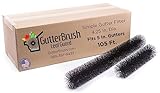
GutterBrush is the least sophisticated product here and occasionally the most practical one. It is a large cylindrical bristle brush that drops into the gutter channel, with no tools, no fasteners, and no fitting required. Large debris lands on top of the bristles rather than settling into the gutter floor, so water continues to flow underneath while leaves sit above it. Because it conforms to whatever it is dropped into, it works on irregular, oversized, half-round, or damaged gutters where every rigid guard system would need custom fabrication. It is also completely reversible: if you decide against it, you pull it out and you are exactly where you started. Where it falls down is the medium term. Debris does not disappear — it accumulates in the bristles, and after a season or two in a leafy area you are pulling brushes out, shaking them clean, and putting them back, which is meaningfully less pleasant than it sounds and not obviously better than cleaning the gutter. Fine debris like pine needles and shingle grit falls straight through the bristles and settles in the gutter as if nothing were there. Treat this as a stopgap for an odd gutter profile or a rental property, not as an alternative to micromesh for a house you intend to keep.
Pros
- Simply drops into the gutter — the fastest installation of anything here, no tools at all
- Works with irregular, odd-sized, or damaged gutters where rigid guards will not fit
- Very inexpensive and completely reversible if you change your mind
- Keeps large debris suspended above the gutter floor so water still flows underneath
- A reasonable rental-property or stopgap solution while you plan something permanent
Cons
- Debris collects in the bristles and eventually requires pulling and cleaning the brushes
- Does nothing for pine needles or fine grit, which settle straight through
The Bottom Line
A genuine stopgap, not a solution. Useful for odd gutters or as a temporary measure, but it converts gutter cleaning into brush cleaning.
6. The Verdict: Who Should Buy LeafFilter
After weighing the product, the pricing, and the alternatives, our assessment separates cleanly into two groups.
LeafFilter Makes Sense If...
You have a two-story or steeply pitched roof where DIY installation is genuinely unsafe. You want a single accountable company with a transferable lifetime warranty rather than managing a product warranty and a separate installer. You are surrounded by pines and need micromesh rather than screens. Or you simply place a high value on never getting on a ladder again and are comfortable paying a premium for that.
Look Elsewhere If...
You have a single-story ranch with an accessible roofline — high-quality DIY micromesh delivers comparable protection for $500-1,200 in materials rather than $3,000-5,000 installed. You have a local gutter contractor with a good reputation who installs professional micromesh at $12-20 per foot. Or you simply want published, comparable pricing rather than a negotiated in-home quote.
How to Handle the Sales Appointment
If you do take the appointment, three rules make it work in your favor. Set a time limit at the start and hold to it. Decide in advance that you will not sign that day, and say so up front — a discount that genuinely exists will still exist tomorrow. And ask for the quote broken down as dollars per linear foot with total footage, which is the only format that allows apples-to-apples comparison with competitors.
7. How to Choose Any Gutter Guard
Whether you buy LeafFilter or something else, the same criteria decide whether you are happy in five years.
Match the Guard to Your Trees
Pines, hemlocks, and spruces mean you need micromesh, full stop — needles pass through anything coarser. Broad-leaf trees like maples and oaks can be handled by a good perforated screen at a fraction of the cost. Take an honest inventory of what actually falls on your roof before choosing a category.
Check the Attachment Method
Guards that slide under the first course of shingles can void some roof warranties and can lift shingles over time. Systems that attach to the gutter lip or fascia avoid that entirely. Ask specifically, and if the answer is "under the shingles," check your roof warranty terms first.
Look at Frame Rigidity, Not Just Mesh
Cheap micromesh with a flimsy frame sags within a couple of seasons, and sagging mesh pools water and traps debris — turning a good filter medium into a bad gutter guard. Frame quality is what separates the $9-per-foot DIY products from the $2.50 ones, and it is where the money is well spent.
Fix the Gutters First
Guards installed over sagging, undersized, or improperly pitched gutters inherit every one of those problems and make them harder to see. If your gutters overflow at the seams, pitch backward, or are pulling away from the fascia, address that before adding guards, not after.
Get Three Quotes, in Dollars per Foot
Total-project quotes are impossible to compare because footage varies with how it is measured. Insist on price per linear foot and the footage count. The spread between installers for identical micromesh work is routinely 40% or more.
8. Frequently Asked Questions
Is LeafFilter worth the money?
It depends on your roof. For a two-story or steeply pitched home where DIY installation is genuinely unsafe, and where you want a single company accountable under a transferable lifetime warranty, it is a defensible purchase. For an accessible single-story roofline, high-quality DIY micromesh delivers comparable debris protection for $500-1,200 in materials versus $3,000-7,000 installed.
How much does LeafFilter cost per foot?
LeafFilter does not publish pricing, but homeowner-reported quotes generally run $17-45 per linear foot installed, clustering in the mid-to-high $20s. That puts an average 200-foot home at roughly $3,600-7,000. Comparable professionally installed micromesh from regional contractors typically runs $12-22 per foot.
Does LeafFilter actually work?
The micromesh genuinely blocks pine needles, seed pods, and shingle grit that pass through screen-type guards, and that is a real advantage. Its limitations are inherent to all micromesh: water can sheet over the mesh in torrential rain, debris still accumulates on top of the guard, and fine organic material can glaze the mesh over years in damp, shaded conditions.
Do you still have to clean gutters with LeafFilter?
You will rarely need to clean inside the gutter, but debris still piles on top of the guard and in shaded damp areas can mat down and restrict flow. Most owners find an occasional pass with a leaf blower is still needed. No gutter guard from any manufacturer is genuinely maintenance-free.
What is the LeafFilter warranty?
A transferable lifetime warranty covering the product and workmanship, promising that if the system fails to keep gutters clear the company will return to clean and repair at no cost. Before signing, verify in writing how claims are initiated, the response-time commitment, what storm and ice damage exclusions apply, and whether the transfer to a new owner requires a fee or registration window.
What is a good alternative to LeafFilter?
For DIY on an accessible roofline, Raptor Stainless Micro-Mesh delivers comparable filtration for a fraction of the cost. For professional installation, Gutterglove Pro uses the same micromesh principle at typically $12-22 per foot through local contractors. In heavy-rain regions without pine trees, LeafGuard's reverse-curve system handles downpour volume better.
Why is the LeafFilter sales appointment so long?
LeafFilter sells exclusively through in-home appointments that commonly run 90 minutes to three hours and often end with a same-day discount. The practical response is to decide before the appointment that you will not sign that day, ask for the quote in dollars per linear foot with total footage stated, and compare it against two other micromesh installers.
9. Mistakes to Avoid When Buying Gutter Guards
Gutter guards are a purchase most people make once, usually under sales pressure. These are the errors that cost the most.
Signing at the First Appointment
Same-day discounts that expire when the salesperson leaves are a pressure technique, not a pricing reality. Decide in advance that you will not sign that day and say so at the start. Quotes frequently improve on the follow-up call, and comparing against two other installers is the only way to know what the work is worth.
Buying Screens When You Have Pine Trees
Perforated screens cost a tenth of micromesh and are excellent against maple and oak leaves. Pine needles drop straight through them. Inventory what actually falls on your roof before choosing a category, because the wrong choice here means paying twice.
Installing Guards Over Bad Gutters
Guards inherit every problem the gutter already has — sagging, reverse pitch, leaking seams, undersized downspouts — and make those problems harder to see and fix. Address gutter condition first; adding guards to a failing gutter is money spent hiding a defect.
Accepting a Total-Project Quote
Total dollars cannot be compared between installers because footage is measured differently and scope varies. Insist on dollars per linear foot with the footage stated. The spread between installers on identical micromesh work is routinely 40% or more, and you cannot see it any other way.
Believing Any Guard Is Maintenance-Free
Micromesh dramatically reduces gutter cleaning and for many homeowners ends ladder work entirely — but debris still accumulates on top of every guard, and fine material can glaze the mesh over years. A pitch built on never touching your gutters again is overstating the physics, regardless of brand.
Related Home Guides
Buyer's Guide
Best Gutter Guards
Every guard type tested — micromesh, screens, reverse curve, and brush inserts ranked.
Buyer's Guide
Best Telescoping Ladder
If you are cleaning gutters yourself, the ladder matters more than the guard.
Buyer's Guide
Best Basement Waterproofing Systems
Overflowing gutters are the most common cause of a wet basement — fix both together.
The Bottom Line
LeafFilter is a genuinely good micromesh product sold at the top of the market through a high-pressure sales process. The mesh works, the frame is well engineered, and the transferable lifetime warranty is a real differentiator. What you are paying for beyond the product is professional installation on a roof you may not want to climb, and one accountable company standing behind it.
Before you sign, do two things: get the quote in dollars per linear foot with the footage stated, and get two competing micromesh quotes. If your roofline is single-story and accessible, price out DIY stainless micromesh first — for many homeowners it delivers the same debris protection for under $1,000.
More in Home Improvement
Guides in this category that pair with what you just read.
About the Author
Alex Rivers, Home Improvement Editor
Alex has spent over a decade working on residential and light commercial property maintenance, and now tests every tool, coating and machine that appears in these guides personally.