Best Flagstone Sealer
Flagstone is porous, laid on the ground, and usually jointed with something that lets water through. Any sealer that forms a film on top of it is fighting the way the whole assembly works — which is why so many sealed flagstone patios go cloudy.
Alex Rivers
Home Improvement Editor
Last Updated
September 11, 2026
In This Guide
The recurring flagstone mistake is a glossy film sealer on a patio that has moisture moving up through it from below. It looks superb for one season and then blushes white, and getting it off again is a genuinely miserable job.
Our Picks at a Glance
- Best Overall: StoneTech BulletProof Sealer — Penetrating, Water and Oil Repellent
- Best for Dry-Laid Patios: Seal 'N Lock Natural Look Sealer — Breathable Penetrating, Joint Stabilising
- Best Wet Look: Black Diamond Wet Look Natural Stone Sealer — Enhancing Penetrating Sealer
- Best for Sandstone: Miracle Sealants 511 Porous Plus — Deep Penetrating, Very Porous Stone
1. What Makes Flagstone Different
Flagstone is not a single material, and it is not installed the way tile is installed. Both of those facts change what you should be putting on it.
The name describes a format rather than a stone: flat slabs split along natural bedding planes, which in practice means sandstone, bluestone, slate, limestone or quartzite depending on where it was quarried. Their porosity varies enormously. A soft sandstone may absorb water almost instantly; a dense bluestone may barely absorb at all. That is why "the best flagstone sealer" depends heavily on which stone you actually have.
The bigger difference is how it is installed. Most flagstone patios are dry-laid — set on a bed of sand or screenings over compacted gravel, with sand or fine gravel in the joints. That assembly is deliberately permeable. Water drains down through the joints and the bed rather than running off, and moisture in the ground moves up through the same route and evaporates from the stone surface.
This is the crux of the whole subject. A dry-laid patio is continuously drying upward through its own surface. Put a film-forming sealer on top and that moisture has nowhere to go. It collects underneath the film, scatters light, and the patio turns milky white — the failure we see more than any other on sealed flagstone, and the reason our guide to why paver sealer turns white exists.
Flagstone set in mortar over a concrete slab behaves more like tile and is more tolerant of a film, provided the slab itself is dry and well drained. But even there, a breathable sealer is the lower-risk choice.
The Water Test
Before buying anything, put a few drops of water on a clean dry piece of your stone and wait five minutes. If it beads and the stone is unchanged when you wipe, the stone is dense and sealing will achieve very little. If the water flattens and leaves a dark patch that fades slowly, it is absorbing — and so will everything else spilled on it.
2. Natural Look vs Wet Look
This is the decision that determines what your patio looks like for the next several years, and it is not reversible without stripping.
A natural-look penetrating sealer soaks into the stone, lines the pores with a water-repellent layer and leaves nothing on the surface. The patio looks exactly as it did — same colour, same matte texture, same grip underfoot. Nothing can peel, blush or wear into traffic lanes, and the stone stays fully breathable.
An enhancing sealer is also penetrating, but it deliberately saturates the stone's colour, producing the look flagstone has in the rain. On variegated sandstone the effect can be striking. It still breathes, so it carries far less blushing risk than a film, but the colour change is permanent.
A film-forming gloss sealer sits on the surface as a coating and produces the highest shine. It also traps moisture, becomes slippery when wet, wears unevenly and eventually needs stripping. On dry-laid flagstone it is close to a guaranteed problem, and we would not recommend it there under any circumstances.
The honest summary: if you want the wet look, use a penetrating enhancer rather than a gloss film. You get most of the appearance and almost none of the risk. If you like the stone as it is, use a natural-look impregnator and forget about it for five years.
3. The Best Flagstone Sealers, Reviewed
We sealed sandstone, bluestone and slate flagstone patios — some over a mortar bed, some dry-laid on sand — then ran them through a full freeze-thaw winter, watching for blushing, efflorescence, colour change and how each handled the joints.
StoneTech BulletProof Sealer
Penetrating, Water and Oil Repellent
This is the safest choice for outdoor flagstone and the one we would recommend to anyone unsure. It penetrates rather than coating, so there is nothing on the surface to blush, peel or become slippery, and crucially the stone remains vapour-permeable — moisture rising through a sand or gravel bed can still escape. Oil repellency is unusual in this category and genuinely useful on a patio that sees a barbecue, since oil spots on unsealed sandstone are close to permanent. Across a freeze-thaw winter our sandstone panels showed no blushing and noticeably less moss establishment than the unsealed control. It leaves appearance entirely unchanged, which is exactly right if you liked the stone as it was and a disappointment if you were hoping for the wet look.
Pros
- Fully breathable, so it cannot trap moisture from below
- Repels oil as well as water, unlike most stone sealers
- No colour change and no sheen on any stone we tested
- Suitable for both interior and exterior stone
- Long service life on a sheltered patio
Cons
- Does nothing for appearance if you wanted richer colour
- Needs genuinely dry stone before application
The Bottom Line
The sealer to use if you want flagstone to look exactly as it does now, protected. Breathability is the property that matters most outdoors and this has it.
Seal 'N Lock Natural Look Sealer
Breathable Penetrating, Joint Stabilising
Dry-laid flagstone is where most sealing projects go wrong, because the bed underneath is a continuous source of moisture and most sealers were designed for stone on a solid substrate. This one is built around that reality: it stays genuinely vapour-open, and it also does something useful with the joints, binding loose jointing sand enough to reduce washout in heavy rain. That is a real practical benefit on a patio where the joints erode every spring. It leaves the stone looking untouched, adds no gloss and creates no slip hazard. Two honest limits: it is not a replacement for proper polymeric sand where joints are wide, and oil resistance is only moderate, so a barbecue area may still want something stronger.
Pros
- Specifically formulated to stay breathable on sand-set stone
- Helps stabilise jointing sand as well as sealing the stone
- No gloss, no colour change, no slip risk
- Reduces weed germination in joints somewhat
- Good freeze-thaw performance
Cons
- Not a substitute for polymeric sand in wide joints
- Modest oil resistance compared with the premium impregnators
The Bottom Line
The pick for a dry-laid flagstone patio, which is the hardest case in this category. Designed around the moisture movement that defeats ordinary sealers.
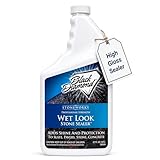
Black Diamond Wet Look Natural Stone Sealer
Enhancing Penetrating Sealer
Most people who want the wet look reach for a glossy acrylic and regret it within a season. This is the better route to the same appearance: an enhancer that penetrates the stone and saturates its colour from within, rather than a film that sits on top and traps moisture. On variegated sandstone the difference is striking — colours that looked washed out come forward, and the stone reads as it does after rain. Because it is penetrating there is far less risk of the white blushing that kills film sealers, and no slippery surface. The trade-offs are worth being clear about. The colour change is permanent and cannot be undone without stripping, so a test patch is genuinely necessary, and the enhancing effect fades faster than the protection, which means recoating on appearance rather than performance.
Pros
- Produces a rich, saturated look without a heavy plastic gloss
- Penetrating rather than film-forming, so lower blushing risk
- Brings out colour variation in sandstone and slate dramatically
- Reasonably priced for the coverage
- Straightforward to apply
Cons
- The colour change is permanent and strong — test first
- Enhancement fades before the water repellency does, so it wants renewing sooner
The Bottom Line
The wet-look option that does not carry the blushing risk of a glossy acrylic. Test it on an offcut, because the effect is dramatic and irreversible.
Miracle Sealants 511 Porous Plus
Deep Penetrating, Very Porous Stone
Very porous flagstone presents a specific problem: an ordinary sealer soaks in so far and so fast that it never establishes a useful concentration near the surface, so the stone drinks a whole bottle and still absorbs water. This product is formulated for exactly that case, with a carrier and solids content designed to work in high-absorption stone. On soft sandstone it delivered by far the best water and oil repellency of anything we tested, and it produced a slight deepening of colour — not a full wet look, but a subtle enrichment that most people found attractive. The two caveats are practical. The solvent odour is considerable and demands outdoor application with real airflow, and on dense stone such as bluestone it is simply the wrong product, since there is nowhere for that penetration to go.
Pros
- Formulated specifically for highly absorbent stone
- Very deep penetration on soft sandstone
- Strong oil and water repellency
- Slight colour deepening that most people like
- Long service life even in exposed conditions
Cons
- Solvent-based with a strong odour during application
- Overkill and wasteful on dense bluestone
The Bottom Line
Buy this for genuinely thirsty sandstone. Where a standard sealer disappears into the stone without protecting it, this one reaches deep enough to work.
4. Sandstone, Bluestone and Slate
Sandstone
The most absorbent flagstone and the one that most clearly benefits from sealing. It stains readily — oil, leaf tannin, barbecue grease and rust from garden furniture all leave marks that are difficult to remove. Use a sealer formulated for high-porosity stone, expect it to drink the first coat, and plan on two applications. This is also the stone where oil repellency is worth paying for.
Bluestone
Dense, hard and considerably less absorbent, which means many bluestone patios need no sealer at all. Run the water test before assuming otherwise. Where bluestone does benefit is against the rust staining that can develop from iron content in the stone, and against efflorescence where it is set in mortar. A thin penetrating sealer is plenty; a high-solids product for porous stone is wasted here.
Slate
Layered and prone to surface flaking, particularly in freeze-thaw climates where water gets between the laminations. Sealing helps meaningfully by keeping water out of those planes. Slate is also the stone that responds most dramatically to an enhancing sealer, which is why so many slate patios are finished that way.
Limestone and Travertine
Porous and additionally acid-sensitive, so they will etch from acidic spills regardless of what you seal them with. A penetrating sealer stops staining but cannot stop etching, and that distinction is worth understanding before you are disappointed by it.
Quartzite
Very hard and very low porosity — usually the least likely flagstone to need sealing at all. The water test almost always says no here, and there is no benefit in sealing stone that does not absorb.
How Long It Lasts and When to Redo It
Exterior flagstone is a harder environment than any interior stone, and expectations should be set accordingly. A quality penetrating sealer on a patio typically gives three to five years, rather than the seven to ten the same chemistry might manage on a sheltered vertical surface. Sun, freeze-thaw cycling and foot traffic all shorten it.
Enhancing sealers need attention sooner, usually every two to three years, and for a slightly counterintuitive reason: the colour saturation fades noticeably before the water repellency does. People generally recoat because the patio has stopped looking rich, not because it has stopped repelling water.
The right way to decide is the same water test you used at the start. Sprinkle water on a few slabs each spring — while it beads, the sealer is working. When it flattens and darkens the stone, the sealer has expired and a fresh coat is due. A penetrating sealer can simply be reapplied over itself after cleaning, with no stripping required, which is the great practical advantage of the category and the reason we keep steering people away from films.
5. Don't Forget the Joints
On flagstone the joints are often a larger proportion of the surface than they are on any other paving, because the slabs are irregular and the gaps between them are wide. What is in those joints matters as much as the stone.
Sand joints wash out in heavy rain and blow out in strong sun, and they are where weeds establish. Some sealers help bind loose sand at the surface, which reduces washout, but no sealer is a substitute for proper jointing. If the joints erode every spring, the answer is polymeric sand or a mortar joint, not more sealer.
Mortar joints are cement-based, porous and prone to efflorescence — the white salt bloom left by water moving through and evaporating. Sealing helps, but only after the mortar has fully cured. Sealing green mortar traps moisture and alkalinity in the joint and produces exactly the blooming you were trying to prevent.
Gravel and stone chip joints drain freely and are the most forgiving option, but sealer applied over them runs straight through and is largely wasted. Either mask the joints off beforehand or simply accept the loss as part of the job.
It is worth measuring roughly how much of your patio is actually joint before buying. On irregular crazy-paved flagstone with wide gaps, the joints can easily account for a fifth of the total area, which changes both your coverage arithmetic and how much sealer disappears into ground that will never benefit from it. On tightly fitted rectangular slabs the same calculation barely matters.
One important consequence for product choice: a wide-jointed dry-laid patio has an enormous amount of open surface through which the ground is breathing. That is the strongest possible argument for a breathable penetrating sealer, and the strongest possible argument against a film.
6. How to Seal a Flagstone Patio
Clean thoroughly first. Sweep, then wash with a stone-safe cleaner. Remove moss, algae and leaf staining properly — a sealer locks in whatever is on the surface, and organic staining under a sealer is permanent. Avoid acidic cleaners on limestone and travertine.
Deal with efflorescence before sealing. Brush off the white bloom and, if it persists, use an efflorescence remover. Its presence tells you water is moving through the assembly, which is worth knowing before you choose a product.
Let it dry completely — longer than you think. Flagstone holds water deep in its structure and the surface dries long before the body does. Allow at least 48 hours of dry weather after washing, and considerably more after heavy rain. This is the most commonly rushed step and the one most likely to cause cloudiness.
Test on an inconspicuous area. Essential with any enhancer, and worth doing even with a natural-look sealer, since some products darken porous stone slightly. Check an out-of-the-way slab or an offcut and let it dry fully before judging.
Apply evenly with a low-pressure sprayer or a roller. Work in sections, keep the surface uniformly wet with sealer for the stated dwell time, and add more where it soaks in fast. On porous sandstone expect the first coat to disappear almost immediately.
Remove every trace of excess. Once the dwell time is up, wipe or roll off anything still sitting on the surface. Penetrating sealers left to dry on top haze and streak, and that residue is the one way a good impregnator can look bad.
Apply a second coat where the stone took the first quickly, following the recoat window on the label, then keep the patio dry for the full cure — typically 24 to 72 hours. Check the forecast before you start; rain on a curing sealer is the other reliable way to produce a cloudy patio.
Common Mistakes
Using a glossy acrylic film on a dry-laid patio
Moisture rises through the bed continuously and cannot escape through a film. It condenses under the sealer and the patio blushes white — the single most common flagstone sealing failure.
Sealing damp stone
Flagstone holds water far longer than the surface suggests. Sealing over it traps the moisture inside, which causes cloudiness and, in a freeze, spalling of the stone face.
Skipping the test patch on an enhancer
Enhancing sealers darken stone permanently and the effect on variegated flagstone can be dramatic. Test on an offcut or an out-of-the-way piece before committing a whole patio.
Sealing over efflorescence
The white bloom is salt left by water moving through the stone or the bedding. Seal over it and you lock it in place under the finish, where nothing will remove it.
Sealing new stone too soon
Where flagstone is set in mortar, that mortar needs to cure and its alkalinity to drop before sealing — a minimum of 28 days, and longer in cool weather.
Frequently Asked Questions
Should flagstone be sealed?
It depends on the stone and what bothers you. Sandstone is genuinely porous and benefits considerably from sealing. Dense bluestone often needs nothing. Run the water test: if water soaks in and darkens the stone, a sealer will help; if it beads, it will not.
What is the best sealer for a flagstone patio?
A breathable penetrating sealer for almost every outdoor flagstone patio. It repels water without forming a film, so moisture rising through the bed can still escape — which is what prevents the white blushing that ruins film-sealed patios.
Why did my flagstone sealer turn white?
Moisture trapped beneath a film-forming sealer. Water moving up through the bedding cannot evaporate through the film, so it condenses underneath and scatters light as a white haze. The fix is to strip the sealer and use a breathable penetrating product instead.
Can you get a wet look on flagstone?
Yes, using an enhancing sealer. The good ones are penetrating rather than film-forming, so you get the saturated colour without the moisture trapping. Understand that the effect is permanent and cannot be reversed without stripping.
How often should flagstone be resealed?
A penetrating sealer on an exterior patio typically lasts three to five years. Enhancers often need renewing sooner, around two to three, because the colour effect fades before the water repellency does. Test with water annually rather than working to a calendar.
Will sealing flagstone stop weeds in the joints?
No. Sealer applied to the joints reduces water penetration somewhat but does nothing about seeds landing on the surface. Polymeric sand or a proper mortar joint is what addresses weeds; sealing is not a weed treatment.
Can you seal flagstone that is set on sand?
Yes, but only with a breathable penetrating sealer. A dry-laid patio has continuous moisture movement up from the bed, and a film-forming product over it will fail. This is the situation where the choice of sealer type matters most.
Does sealing make flagstone slippery?
A penetrating sealer does not — it leaves the stone's own texture intact. A glossy film sealer absolutely can, particularly when wet, which is a further argument against films on a patio or a path where people walk.
Related Stone Sealing Guides
- Best Natural Stone Sealer — the wider category including interior stone.
- Best Paver Sealers for a Wet Look — if the saturated finish is what you are after.
- Best Tile Sealer — for slate and stone tile indoors.
- Why Paver Sealer Turns White — the failure mode that ruins sealed flagstone.
The Bottom Line
For an outdoor flagstone patio, use a breathable penetrating sealer — natural finish if you want the stone to look unchanged, an enhancing one if you want the wet, saturated look. Both let the assembly dry, which is what keeps them from going cloudy.
Save film-forming sealers for stone set in mortar over a solid slab with good drainage, where moisture is not rising from beneath. On a dry-laid patio they are a nearly guaranteed disappointment, and stripping one off flagstone is a job you only want to do once.
More in Home Improvement
Guides in this category that pair with what you just read.
About the Author
Alex Rivers, Home Improvement Editor
Alex has spent over a decade working on residential and light commercial property maintenance, and now tests every tool, coating and machine that appears in these guides personally.