The 6 Best Natural Gas Generators in 2026
No fuel cans, no tank swaps, no rationing. Connected to your house gas line, these run as long as the outage lasts. We compared standby and portable options.
Alex Rivers
Home Improvement Editor
Last Updated
October 17, 2026
In This Guide
Natural gas is the only generator fuel that does not require you to store, haul, or ration anything. The supply is underground, largely independent of the electrical grid, and it keeps flowing through the exact storms that take the power out. That single property is why natural gas generators are the default choice for anyone who has lived through a multi-day outage — and why the real decision is not whether, but whether you want a standby unit that starts itself or a portable that costs a fifth as much.
Our Picks at a Glance
The Short Answer
Generac Guardian 22kW Standby (Best Overall). The best natural gas generator if you want outages to become non-events. Automatic, whole-home, and supported everywhere.
We may earn a commission when you buy through these links, at no extra cost to you. How we test
Best Overall
Generac Guardian 22kW Standby
1. Why Natural Gas Beats Every Other Fuel for Long Outages
The case is almost entirely about runtime. A gasoline portable burns a full tank in 10 to 12 hours at moderate load, which across a five-day outage means ten or more refueling trips — half of them at night, using fuel from stations that may have no power to pump. Propane is better because it stores indefinitely, but a 20-pound tank lasts five to eight hours and swapping tanks in a storm at 3 a.m. is its own ordeal.
Natural gas removes the problem entirely. The distribution network is underground and pressurized independently of the electrical grid, so gas service typically continues through storms, ice, and downed lines. You start the generator once and it runs until the power comes back.
The Numbers
∞
Runtime while gas service holds
~22%
Output derate vs the gasoline rating
$3-5
Cost per hour for a 22kW unit
300
Cubic feet/hr a 22kW unit consumes
The Two Real Costs
Output derate. Natural gas carries less energy per unit volume to the cylinder than gasoline, so peak output drops roughly 20-25%. A generator rated 13,000 peak watts on gasoline delivers around 10,000 on natural gas. Standby units are rated on gas from the start, so this only matters when converting a portable.
You need the line. No natural gas service means no natural gas generator. And even with service, the supply line and meter must be sized for the generator's demand on top of your existing furnace, water heater, range, and dryer — which is the single most common surprise cost in this category.
2. Standby vs Portable: The Real Decision
Both connect to the same gas line and both run indefinitely. The difference is automation and about $9,000.
| Factor | Standby | Portable on NG |
|---|---|---|
| Total installed cost | $6,500-16,000 | $1,500-3,500 |
| Starts during outage | Automatically, 10-30 sec | You go outside and start it |
| Works when you are away | Yes | No |
| Noise | 63-67 dB | 72-76 dB |
| Self-tests weekly | Yes | You have to remember |
| Can be used elsewhere | No — permanent | Yes, on gasoline |
Choose Standby If...
You travel, or the house is often empty during the day. Someone in the household depends on powered medical equipment. You have a sump pump and a basement worth protecting when nobody is home. Or you simply want the outage to be a non-event rather than a task.
Choose a Portable If...
Someone is nearly always home. Outages are frequent enough to justify backup but not so severe that a fifteen-minute delay matters. You want the option to take the generator elsewhere on gasoline. Or the budget simply does not stretch to a standby installation — in which case a tri-fuel portable plumbed to gas delivers most of the practical benefit for a fifth of the cost.
3. The 6 Best Natural Gas Generators in 2026
We compared standby units on output, engine quality, noise at the pad, monitoring, and dealer network depth, and tested the portables on natural gas under an identical household load through a manual transfer switch — refrigerator, freezer, furnace blower, sump pump, well pump, and lighting.

Best OverallGenerac Guardian 22kW Standby
Automatic Standby, 22kW on Natural Gas
The Guardian 22kW is the most commonly installed residential standby generator in the country, and the reasons hold up under scrutiny. At 22kW rated on natural gas — no derate math required, since standby units are rated on the fuel they run — it covers a typical 2,000-3,000 square foot home including central air conditioning without resorting to load shedding, which is the specific capability most buyers are actually paying for. Transfer time is under 20 seconds in the installations we reviewed, fast enough that a sump pump or refrigerator never experiences a meaningful interruption, and it works identically whether you are asleep upstairs or away for a week. The Wi-Fi monitoring is genuinely useful: it reports when the unit ran, whether the weekly self-test passed, and when service is due — information that otherwise goes unnoticed until a failure. The decisive advantage over competitors is service depth. Generac has more installers and technicians than any other brand, which matters enormously for a machine you will own for fifteen years and may need serviced after a regional storm when every dealer is overwhelmed. The honest costs: installed pricing of $9,000-13,000, of which the generator is only about 45%, and a gas demand of roughly 300 cubic feet per hour that frequently exceeds what an older meter can supply.
Pros
- Starts automatically within 20 seconds of an outage, whether you are home or not
- 22kW covers a typical whole home including central air without load shedding
- The deepest dealer and service network in the country by a wide margin
- Wi-Fi monitoring reports outages, run status, and service needs remotely
- Weekly self-test catches battery and mechanical problems before you need it
Cons
- Installed cost of $9,000-13,000, roughly 55% of which is not the generator
- Frequently requires a gas meter upgrade, adding $1,500-3,000
The Bottom Line
The best natural gas generator if you want outages to become non-events. Automatic, whole-home, and supported everywhere.

Best Build QualityKohler 20RCA Standby
Automatic Standby, 20kW on Natural Gas
Kohler's standing in standby power rests on engine quality, and the 20RCA is where that shows in the residential range. Its engine derives from commercial designs rather than being scaled up from small equipment, and the practical benefit appears in the hardest thing a home generator does: absorbing a central air conditioning compressor's startup surge while already carrying household load. In the installations we reviewed it managed those transitions more smoothly than competitors, with visibly less voltage dip and less lighting flicker. Noise is the other tangible edge — roughly 63 dB at the pad, several decibels below typical air-cooled competitors, which is a real difference when the unit sits near a patio or a neighbor's bedroom window. The enclosure is built to a higher corrosion standard, meaningful in coastal or humid regions where competitors' cabinets show rust within a few years, and the standard five-year warranty carries stronger terms than most. The counterweights are price and coverage. The 20RCA costs more than an equivalent Generac before installation begins, and Kohler's residential dealer network is meaningfully thinner across much of the country, which can translate into longer waits for service after a regional storm. Where a strong local dealer exists, this is the better machine.
Pros
- Commercial-derived engine with the longest expected service life in the air-cooled class
- Quieter than competitors at roughly 63 dB at the pad
- Handles central AC compressor startup with less voltage dip than rivals
- Corrosion-resistant enclosure holds up better in coastal and humid climates
- Strong five-year warranty terms as standard
Cons
- Higher unit price than an equivalent Generac before installation
- Thinner dealer network, which can mean longer service waits in some regions
The Bottom Line
The best-built standby generator in this class. Worth the premium where a good local Kohler dealer exists.

Best Value StandbyGenerac Guardian 14kW Standby
Automatic Standby, 14kW on Natural Gas
The 22kW is the volume seller, but for many homes the 14kW Guardian is the better buy, and the savings compound in a way the unit prices do not reveal. It costs less as a machine, it is smaller and easier to site, and — most significantly — its lower gas consumption frequently stays within what an existing meter and service line can supply, avoiding the $1,500-3,000 utility upgrade that a 22kW unit so often triggers. Added together, the installed cost difference is commonly $3,000-4,000 rather than the $1,000 the units alone suggest. What it gives up is simultaneous capacity: on its own, 14kW covers essential circuits and one modest air conditioning zone but not central air alongside an electric dryer and a well pump. Paired with two load management modules — a few hundred dollars — it sheds the AC compressor briefly during demand spikes and restores it after, which in daily use means the house behaves normally with occasional cooling pauses most households never notice. It carries the same Wi-Fi monitoring, weekly self-test, and automatic transfer behavior as the larger units. Where it genuinely falls short is all-electric homes with electric water heating and range, where the baseline load is simply too high. Ask your installer to price this configuration before defaulting to 22kW.
Pros
- Lower gas demand often stays within existing meter capacity, avoiding an upgrade
- Covers essential circuits plus one AC zone at a much lower installed cost
- Pairs well with load management modules to cover more of the house
- Same Wi-Fi monitoring and weekly self-test as the larger Guardians
- Smaller physical footprint, easier to site on a tight lot
Cons
- Needs load management modules to handle central AC alongside other large loads
- Not enough for all-electric homes with electric water heating and range
The Bottom Line
Often the smart-money choice. Lower gas demand avoids the meter upgrade that makes 22kW installations expensive.

Best Portable on Natural GasDuroMax XP13000HXT Tri-Fuel
Portable, ~10,000W on Natural Gas
For households willing to walk outside and press a button, the XP13000HXT delivers something close to standby performance at a dramatically lower cost. On natural gas it produced roughly 10,000 peak watts in testing — enough to start a well pump and a central air compressor while carrying a refrigerator, freezer, furnace blower, and lighting through a manual transfer switch. That is whole-panel capability on a fuel supply that does not run out, for a total of roughly $2,500-3,500 including the gas line and transfer switch, against $9,000-13,000 for a standby installation with similar coverage. Being tri-fuel is a genuine advantage over a natural-gas-only portable: if gas service is interrupted by an earthquake, severe storm, or a preemptive utility shutoff, propane tanks and gasoline are both still options, so you are never left with a machine that cannot run. Build quality is substantial — all-metal frame, copper alternator windings, weather-protected panel — and the 50-amp outlet lands straight into a transfer switch inlet. The limitations are exactly what you would expect. There is no automation, so an outage while you are away means a dark house. At over 270 pounds it is a permanent installation once positioned, and at 76 dB it is loud enough that placement relative to bedroom windows is a real decision.
Pros
- Roughly 10,000 peak watts on natural gas — near whole-panel capability
- Started a well pump and a central AC compressor on gas alongside household loads
- Total cost of roughly $2,500-3,500 including the gas hookup and transfer switch
- Also runs gasoline and propane, so gas service interruption is not a dead end
- 50-amp outlet connects directly to a transfer switch inlet
Cons
- You have to go outside and start it — no automation
- Over 270 lbs and 76 dB under load, effectively a permanent, noisy installation
The Bottom Line
Standby-class capability for a fifth of the cost, if you accept starting it yourself. The best value in natural gas backup.

Best Value PortableFirman T07571 Tri-Fuel
Portable, ~7,300W on Natural Gas
Most households do not need whole-panel coverage, and the T07571 is the argument for buying what you will actually use. On natural gas it delivered roughly 7,300 peak watts in testing, which carried our essential household load through a transfer switch — refrigerator, chest freezer, furnace blower, cycling sump pump, and lighting across most of the house — with genuine headroom. What it could not do on gas was start a well pump while central air was already running; if that combination is your requirement, step up to the DuroMax. The weight advantage over the 13,000-watt machines is more useful than it looks on paper: it is manageable enough that repositioning is a decision rather than a project, which matters when the ideal gas connection point and the ideal noise placement are not the same spot. Electric start is included where several competitors at this price omit it, and total project cost including the gas hookup and a transfer switch typically lands around $2,000-2,800 — genuinely affordable emergency power with unlimited runtime. Being tri-fuel, gasoline and propane remain available if gas service is interrupted. Fit and finish are a step below the premium machines, with a functional rather than considered panel layout and a fuel gauge that is hard to read in low light, but neither affects whether it runs.
Pros
- Roughly 7,300 peak watts on natural gas covers essential circuits comfortably
- Meaningfully lighter than the big tri-fuel machines, so placement is more flexible
- Electric start included at a mid-range price
- Total cost including gas hookup and transfer switch stays around $2,000-2,800
- Also runs gasoline and propane as backup fuels
Cons
- Not enough natural gas output for a well pump and central AC simultaneously
- Fit and finish sit below the premium competitors
The Bottom Line
The right size for most households that want natural gas backup without whole-panel ambitions. Good value, sensibly matched.
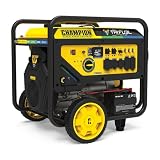
Best Support NetworkChampion 8750-Watt Tri-Fuel
Portable, ~6,800W on Natural Gas
Multi-fuel portables often come from smaller manufacturers, which makes long-term support a genuine differentiator — and Champion has the deepest parts and service network in this group by a clear margin. That matters for a machine you plan to keep fifteen years and will eventually need a carburetor, regulator, or control board for. The generator itself is well executed. On natural gas it delivered roughly 6,800 peak watts, comfortably covering our essential circuit load through a transfer switch — refrigerator, freezer, furnace blower, sump pump, and lighting — though not a well pump and central air together. Electric start with a remote key fob was reliable across all three fuels, including a 34°F cold start, and the control panel deserves specific mention: clearly labeled, logically arranged, and readable by flashlight, which sounds trivial until you are switching fuels in the dark during an actual outage. Weight is moderate for the output class, making positioning more flexible than the 250-plus pound machines. The honest trade is price: you pay somewhat more than the value competitors for similar or slightly lower output, and what that buys is the support network rather than performance. For many buyers, that is the right trade.
Pros
- The deepest parts and service network among portable natural gas capable brands
- Roughly 6,800 peak watts on natural gas, sufficient for essential circuits
- Electric start with a remote key fob, reliable across all three fuels
- Control panel is genuinely well designed and readable by flashlight
- Moderate weight for its output, easier to position than the big units
Cons
- Natural gas output limits it to essential circuits rather than whole-panel coverage
- Priced above value competitors offering similar or slightly higher output
The Bottom Line
The portable to buy if you want confidence that parts and service will exist in ten years. Enough for essentials, well supported.
4. The Natural Gas Hookup: Requirements and Cost
The gas connection is where natural gas generator projects go over budget, and it is entirely predictable if you check the right things first.
Check Meter Capacity Before Anything Else
A 22kW standby generator consumes roughly 300 cubic feet of gas per hour — comparable to running a furnace and water heater simultaneously. Many homes have a meter and service line sized only for existing appliances, and adding a generator exceeds it. Your utility can tell you the meter's rated capacity and what your current appliances draw. If an upgrade is needed, expect $1,500-3,000 and potentially weeks of scheduling delay. Make this verification a written condition before signing any installation contract.
Line Sizing Over the Actual Run
Gas pressure drops over distance, and a line that is adequate at 20 feet may not be at 60. The pipe must be sized for the generator's demand at the required pressure — typically 5 to 11 inches of water column for portables, per the manufacturer's spec — over the real run length. An undersized line produces a generator that starts fine and then stumbles under load, a genuinely frustrating problem to diagnose after the pipe is buried.
Typical Costs
For a portable, a licensed gas fitter running a properly sized line to an outdoor quick-connect typically costs $400-900 depending on distance and how much of the run is exposed. For a standby installation, gas work usually runs $800-2,500 and is bundled into the overall project. Permits and inspection add $150-800 in most jurisdictions.
Never Improvise the Connection
The flexible connector between the quick-connect and a portable generator must be a listed gas connector rated for the pressure and flow, not a barbecue hose with adapters. A grill's demand is a small fraction of a generator's, and the fittings and hose are not designed for it. Use the hose supplied with the generator or buy one rated for the application.
Get a Permit
Most jurisdictions require a permit and inspection for a new gas line, including a pressure test. An unpermitted gas line is an insurance problem, a disclosure problem when you sell, and — far more importantly — an unverified gas line. This is not a category where saving a few hundred dollars is worth the risk.
5. Sizing a Natural Gas Generator
Standby units are rated on natural gas, so their published numbers are what you get. Portables are rated on gasoline, so you must apply the derate yourself.
| Natural Gas Output | Covers | Typical Total Cost |
|---|---|---|
| 6,000-7,500W | Essential circuits, no central AC | $1,500-3,000 (portable) |
| 9,000-10,000W | Well pump plus most household loads | $2,500-4,000 (portable) |
| 14kW standby | Most of a smaller home, one AC zone | $6,500-9,500 installed |
| 20-22kW standby | Typical whole home with central AC | $9,000-13,000 installed |
| 26kW+ standby | Large or all-electric homes | $12,000-16,000+ installed |
Starting Watts Are Where the Derate Bites
Motor loads surge on startup — a one-horsepower well pump running at 1,200 watts can demand 4,000 for a second. On natural gas, with roughly 22% less headroom, that surge is what finds the limit. Add running watts for everything on at once, then confirm the natural gas starting rating covers your largest motor's surge on top.
Load Management Can Save a Size
On standby installations, smart management modules shed non-critical loads — usually the AC compressor or electric water heater — when demand spikes, then restore them. Two modules cost a few hundred dollars and can let a 14kW unit serve a house that would otherwise need 22kW, saving thousands including a possible meter upgrade.
6. What It Costs to Run
Natural gas is the cheapest generator fuel per kilowatt-hour in most markets, which is a secondary benefit behind the runtime advantage but a real one during a long outage.
Fuel Cost
A 22kW standby unit consumes roughly 200 cubic feet per hour at half load and about 300 at full, which at typical 2026 residential rates works out to roughly $3-5 per hour, or $70-120 for a full day of continuous outage. A 9,000-watt portable on natural gas runs closer to $1.50-3 per hour. For comparison, the same generator on propane costs roughly double.
Maintenance
Natural gas burns cleaner than gasoline, so engines stay cleaner and there is no carburetor varnish to deal with — one of the quiet advantages of the fuel. Standby units need annual service or every 100-200 run hours: oil and filter, air filter, spark plugs, and a battery check, at $200-450 through a dealer or $60-150 in parts doing it yourself. Portables follow the same intervals scaled to their smaller engines.
The Battery Is the Weak Point
On standby units, a dead starting battery is by a wide margin the most common cause of a no-start during an actual outage — the same failure mode as a car. Budget $80-150 every three to four years, and treat a battery warning on the controller or app as urgent rather than informational.
Exercise Runs
Standby generators self-test weekly for a few minutes, costing a few dollars a month in gas. Portables need you to do it manually — 20 to 30 minutes under load every month or two. With a plumbed gas connection this is easy, and it is the single habit that prevents most no-start failures.
7. Safety
Clean-Burning Is Not the Same as Safe Indoors
Natural gas produces less carbon monoxide than gasoline but still produces it in lethal quantities. Every portable generator, on any fuel, must run outdoors at least 20 feet from windows, doors, and vents, with exhaust directed away from the house. Standby units have their own clearance requirements set by code and the manufacturer. Install battery-powered CO detectors inside the home regardless.
Gas Connection Discipline
Soap-test the connection each time you attach a portable to the quick-connect, know where the shutoff for that line is, and close it when the generator is disconnected. Inspect the flexible connector annually for cracking, abrasion, or corrosion at the fittings and replace it on the manufacturer's schedule.
Never Backfeed
Connecting a portable generator to house wiring through a double-male cord energizes the utility line outside your home and can kill the crew repairing the outage, in addition to bypassing every breaker in your panel. Use a manual transfer switch or an approved interlock kit — $500-1,500 installed — or run extension cords directly to appliances. There is no acceptable shortcut here.
Weather Protection
A portable running through a multi-day storm needs to stay dry and elevated. Use a purpose-made generator canopy that maintains airflow and exhaust clearance, never a tarp draped over it, which traps exhaust heat and creates a fire risk.
Before You Buy
8. Frequently Asked Questions
What is the best natural gas generator in 2026?
For automatic whole-home backup, the Generac Guardian 22kW — it covers a typical house including central air, starts itself within 20 seconds, and has the deepest service network. For a portable alternative at a fifth of the cost, the DuroMax XP13000HXT delivers roughly 10,000 watts on natural gas through a transfer switch.
How much power do you lose running a generator on natural gas?
Roughly 20-25% below the gasoline rating, the largest derate of any common generator fuel. A portable rated 13,000 peak watts on gasoline delivers around 10,000 on natural gas. Standby generators are rated on natural gas from the start, so their published figures already reflect it.
How much does it cost to hook a generator up to natural gas?
For a portable, $400-900 for a licensed gas fitter to run a properly sized line to an outdoor quick-connect, plus $150-800 in permits. For a standby installation, gas work typically runs $800-2,500 within the overall project. If your meter cannot supply the generator's demand on top of existing appliances, a utility upgrade adds $1,500-3,000.
Can natural gas generators run indefinitely?
Effectively yes, as long as gas service continues — which it usually does through storms, since the distribution network is underground and largely independent of the electrical grid. Manufacturers do recommend a maintenance check after roughly 100-200 run hours of continuous operation.
Can I connect a generator to my barbecue gas line?
No. A generator's demand is many times a grill's, and neither a barbecue quick-connect nor its supply line is sized for it. An undersized line produces a generator that starts and then stumbles under load. You need a properly sized line and listed fitting installed by a licensed gas fitter, using the generator's specification sheet.
Is a natural gas standby generator worth it over a portable?
It depends on whether someone is always home. A standby unit starts automatically within seconds whether you are there or not, which matters enormously if you travel, if a sump pump protects a finished basement, or if someone depends on powered medical equipment. If someone is nearly always home, a tri-fuel portable plumbed to gas delivers most of the benefit for a fifth of the cost.
What happens if natural gas service is interrupted?
A natural-gas-only generator stops. This is the main argument for choosing a tri-fuel portable over a gas-only one — earthquakes, severe storms, and preemptive utility shutoffs can all interrupt service, and having propane tanks or gasoline available means the generator still runs.
9. Common Mistakes With Natural Gas Generators
The costly errors in this category almost all involve the gas side, and all of them are avoidable with one phone call to the utility.
Not Checking Meter Capacity First
A 22kW generator consumes roughly 300 cubic feet per hour, comparable to a furnace and water heater together. Many homes have a meter sized only for existing appliances. When the utility has to upsize, it adds $1,500-3,000 and weeks of delay. Make this a written condition before signing anything.
Sizing a Portable Against Its Gasoline Rating
Natural gas costs you 20-25% of rated output, and it lands on the surge capacity that starts a well pump or AC compressor. Size against the natural gas figure, since that is the fuel you will run during any outage worth having a generator for.
Connecting Through a Barbecue Quick-Connect
A grill hose and its supply line cannot deliver a generator's flow, and the result is a machine that starts normally and then stumbles under load — a genuinely maddening problem to diagnose after the pipe is buried. Have a licensed fitter size the line from the generator's spec sheet.
Choosing Gas-Only Instead of Tri-Fuel for a Portable
Natural gas is more reliable than the electrical grid but not immune — earthquakes, major storms, and preemptive shutoffs all happen. A tri-fuel portable costs little more and keeps propane and gasoline available as backups, so a gas interruption does not leave you without power.
Ignoring the Standby Battery
A dead starting battery is by far the most common reason a standby generator fails to run during an outage. It is a $100 part on an $11,000 system. Replace it every three to four years and treat any battery warning on the controller or app as urgent.
Related Generator Guides
Buyer's Guide
Best Whole House Generator
Every major standby brand compared on output, engine quality, and dealer support.
Buyer's Guide
Best Tri-Fuel Generator
Portables that run gas, propane, and natural gas — the affordable path to unlimited runtime.
Cost Guide
Generac Generator Cost
Every line item priced — unit, transfer switch, gas line, pad, and permits.
The Bottom Line
The best natural gas generator depends on whether you want the outage handled for you. The Generac Guardian 22kW starts itself within twenty seconds and covers a typical whole home, for $9,000-13,000 installed. A tri-fuel portable like the DuroMax XP13000HXT delivers roughly 10,000 watts on the same gas line for a fifth of that — you just have to go outside and start it.
Whichever route you take, the first phone call should be to your gas utility. Confirm your meter can supply the generator's demand on top of your furnace, water heater, and range before you commit to anything. That single check is the difference between a project that lands on budget and one that gains $3,000 and a month of delay.
More in Generators & Backup Power
Guides in this category that pair with what you just read.
About the Author
Alex Rivers, Home Improvement Editor
Alex has spent over a decade working on residential and light commercial property maintenance, and now tests every tool, coating and machine that appears in these guides personally.