The 5 Best Tri-Fuel Generators in 2026
Gasoline for maximum output, propane for storage, natural gas for unlimited runtime from your house line. We tested five on all three fuels.
Alex Rivers
Home Improvement Editor
Last Updated
October 17, 2026
In This Guide
A tri-fuel generator adds one capability to the dual fuel formula, and it is the most valuable one: the ability to run on natural gas from your existing house line. That single feature removes refueling from the equation entirely — no gas cans, no tank swaps, no rationing during a five-day outage. It is the closest a portable generator gets to a standby system, for a fraction of the installed cost. Here are the five worth buying, and exactly what the natural gas hookup involves.
Our Picks at a Glance
The Short Answer
DuroMax XP13000HXT Tri-Fuel (Best Overall). The closest a portable gets to a standby generator. Plumbed to natural gas with a transfer switch, it runs a house indefinitely.
We may earn a commission when you buy through these links, at no extra cost to you. How we test
Best Overall
DuroMax XP13000HXT Tri-Fuel
1. Why the Third Fuel Changes Everything
Portable generators have one universal weakness during long outages: someone has to keep feeding them. A 9,000-watt unit burns through a full tank of gasoline in 10 to 12 hours at moderate load, which in a five-day outage means ten or more refueling trips, at least half of them at night, using fuel from stations that may not have power to pump.
Natural gas eliminates that entirely. Connected to your home's existing gas line, the generator runs continuously for as long as the outage lasts, because gas service almost always stays up when electric service does not — the distribution system is underground and largely independent of the grid. You start it once and it runs.
Output by Fuel
100%
Rated output on gasoline
~90%
Typical output on propane
~78%
Typical output on natural gas
$400-900
Typical natural gas hookup cost
The Cost of the Third Fuel
Natural gas carries the largest derate of the three fuels — typically 20-25% below the gasoline rating, because it delivers the least energy per unit volume to the cylinder. A generator rated 13,000 peak watts on gasoline might deliver around 10,000 on natural gas. That is a real reduction and it must be accounted for in sizing, because natural gas will be the fuel you actually use during a long outage.
Tri-Fuel vs a Standby Generator
A tri-fuel portable connected to natural gas does most of what a standby generator does — unlimited runtime, whole-panel capability through a transfer switch — for roughly $1,500-3,000 all in, against $9,000-13,000 installed for a standby unit. What you give up is automation: you still have to go outside, start it, and switch circuits over. For households willing to do that, the value proposition is genuinely strong.
2. The Three Fuels Compared
| Factor | Gasoline | Propane | Natural Gas |
|---|---|---|---|
| Output | Full rated | ~90% | ~78% |
| Runtime | 10-12 hr per tank | 5-8 hr per 20 lb | Unlimited |
| Storage | 3-6 months | Indefinite | No storage needed |
| Cold weather | Reliable | Poor below 20°F | Unaffected |
| Setup required | None | Hose and tank | Plumbed quick-connect |
| Best used for | Peak load, cold starts | Reserve, exercise runs | Long outages |
The Strategy That Uses All Three
Natural gas is the workhorse — connect it and use it for any outage lasting more than a few hours, because runtime is unlimited and there is nothing to store. Propane is the backup for the rare case where gas service is also interrupted, and it is also the right fuel for monthly exercise runs since it leaves no carburetor varnish. Gasoline is for maximum output, for deep-cold starts, and for using the generator away from the house.
Natural Gas Is Not Always Available
Earthquakes, major storms, and infrastructure damage can interrupt gas service, and utilities sometimes shut gas off preemptively in disaster areas. That is precisely why tri-fuel is more useful than a natural-gas-only generator: keep two or three propane tanks as backup so a gas interruption does not leave you without power.
3. The 5 Best Tri-Fuel Generators in 2026
Each unit was run on all three fuels under an identical household load through a manual transfer switch — refrigerator, freezer, furnace blower, sump pump, well pump, and lighting — with output measured on each fuel, noise recorded at 23 feet, and a cold start performed at 34°F.

Best OverallDuroMax XP13000HXT Tri-Fuel
Portable, 13,000W Peak Gasoline
The XP13000HXT is the machine that makes the tri-fuel argument most convincingly, because it has enough output to genuinely replace a standby generator for a household willing to start it manually. On gasoline it delivered its rated 13,000 peak watts; on propane roughly 11,700; and on natural gas roughly 10,000 — and that natural gas figure is the one that matters, because it is still enough to start a well pump and a central air compressor while carrying a refrigerator, freezer, furnace blower, and lighting through a transfer switch. That is whole-panel capability on a fuel supply that never runs out. Build quality supports the role: an all-metal frame, copper alternator windings rather than aluminum, and a general heft that suggests decades of occasional service. The 50-amp outlet lands directly into a transfer switch inlet without adapters, and the CO shutoff sensor is a welcome secondary safeguard, though it does not change the 20-foot setback rule. Electric start with an included battery worked reliably including at 34°F. The costs are physical. At over 270 pounds this is effectively a permanent installation, so choose the pad location with the gas connection, the transfer switch inlet, and the required clearances in mind before delivery. At 76 dB under load it is genuinely loud, which makes placement relative to bedroom windows a real design decision.
Pros
- Highest output here — roughly 10,000 peak watts even on natural gas
- Started a well pump and a central AC compressor alongside household loads on natural gas
- CO shutoff sensor plus a 50-amp outlet for direct transfer switch connection
- All-metal construction with copper alternator windings rather than aluminum
- Electric start with an included battery and a clear, legible control panel
Cons
- Over 270 lbs — choose its permanent position carefully
- 76 dB under load, the loudest unit in this test
The Bottom Line
The closest a portable gets to a standby generator. Plumbed to natural gas with a transfer switch, it runs a house indefinitely.

Best ValueFirman T07571 Tri-Fuel
Portable, 9,400W Peak Gasoline
Most households do not need 13,000 watts, and the Firman T07571 is the argument for buying what you actually use. On natural gas it delivered roughly 7,300 peak watts in testing, which carried our essential household load through a transfer switch — refrigerator, chest freezer, furnace blower, cycling sump pump, and lighting across most of the house — with genuine headroom. What it could not do on natural gas was start a well pump while central air was already running, and if that specific combination is your requirement, step up a size. On gasoline it produced its rated 9,400 peak, and on propane roughly 8,500. The weight advantage over the big units is more meaningful than the spec sheet implies: it is manageable enough that repositioning it is a decision rather than a project, which matters if your gas connection point and your ideal noise placement are not the same spot. Electric start is included at a price where several competitors omit it, and gasoline runtime was good at roughly 12 hours at half load. Fit and finish sit below the premium machines — the panel layout is functional rather than considered, and the fuel gauge is hard to read in low light — but none of that affects whether it runs. For the money, it is the best-balanced tri-fuel unit here.
Pros
- Strong output for the price — roughly 7,300 peak watts on natural gas
- Meaningfully lighter than the 13,000W machines, making placement more flexible
- Electric start included at a mid-range price point
- Covers most essential circuits on natural gas through a transfer switch
- Good runtime on gasoline for the tank size, around 12 hours at half load
Cons
- Not enough natural gas output for a well pump and central AC simultaneously
- Fit and finish are a step below the premium competitors
The Bottom Line
The sensible middle of the tri-fuel market. Enough natural gas output for the circuits that matter, at a price that makes sense.
Best High-Output ValueGenMax GM13000HXT Tri-Fuel
Portable, 13,000W Peak Gasoline
The GM13000HXT delivers essentially the same capability as the more established 13,000-watt machines for meaningfully less money, and in testing it backed that up. On natural gas it produced roughly 9,800 peak watts, enough to carry a well pump's startup surge alongside a refrigerator, freezer, furnace blower, and full lighting circuits — near whole-panel performance on a fuel supply that does not run out. Gasoline output hit its rated 13,000 peak and propane landed around 11,600. The feature set is complete rather than stripped: electric start with a remote key fob, a CO shutoff sensor, a 50-amp outlet for direct transfer switch connection, and a full set of household receptacles for use away from the house. Cold starting at 34°F was reliable on all three fuels. The reservations are about the years after purchase rather than the machine itself. GenMax is a less established brand with a thinner parts and service network, and a generator is equipment you may need a carburetor or voltage regulator for a decade from now. Before choosing it on price, check whether a local small engine shop will work on it. The wheel kit is also weak for the weight — on soft ground or gravel, moving 250 pounds becomes genuinely difficult, so plan a firm, level location.
Pros
- 13,000W-class output at a price below comparable competitors
- Roughly 9,800 peak watts on natural gas, enough for near whole-panel coverage
- Electric start and remote key fob included
- 50-amp transfer switch outlet plus a full complement of household receptacles
- CO shutoff sensor included as standard
Cons
- Support network and parts availability are thinner than established brands
- Heavy at over 250 lbs with a wheel kit that struggles on soft ground
The Bottom Line
Big output for less money. Verify you can get parts and service locally before choosing it over a better-known brand.
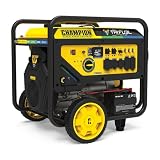
Best Support NetworkChampion 8750-Watt Tri-Fuel
Portable, 8,750W Peak Gasoline
Tri-fuel generators tend to come from smaller manufacturers, which makes long-term support a genuine differentiator, and Champion has the deepest parts and service network in this comparison by a clear margin. That matters for a machine you plan to own for fifteen years and will need a carburetor or a regulator for at some point. The generator itself is well executed. On natural gas it delivered roughly 6,800 peak watts, which covered our essential circuit load — refrigerator, freezer, furnace blower, sump pump, and lighting — comfortably through a transfer switch, though it is not enough for a well pump and central air together. Gasoline produced its rated 8,750 peak and propane roughly 7,900. Electric start with a remote fob was reliable across all three fuels including the 34°F cold start, and the control panel is genuinely well designed: clearly labeled, logically arranged, and readable by flashlight, which sounds trivial until you are switching fuels in the dark during an actual outage. Weight is moderate for the output, making it easier to position than the 13,000-watt machines. The honest trade is that you pay somewhat more than the value competitors for similar or slightly less output, and what you are buying with that difference is the support network.
Pros
- Champion's parts and service support is the best among tri-fuel brands
- Roughly 6,800 peak watts on natural gas, sufficient for essential circuits
- Electric start with a remote key fob, reliable across all three fuels in testing
- Well-designed control panel that is easy to read and operate under stress
- Reasonable weight for its output class, easier to position than the big units
Cons
- Natural gas output limits it to essential circuits rather than whole-panel coverage
- Priced above the value competitors for similar capability
The Bottom Line
The tri-fuel generator to buy if long-term parts and service matter to you. Enough output for essentials, backed by real support.
Best Mid-High OutputDuroMax XP12000HX Tri-Fuel
Portable, 12,000W Peak Gasoline
The XP12000HX sits one step below DuroMax's flagship and, for most households, is the more sensible purchase. On natural gas it produced roughly 9,300 peak watts in testing — only about 700 watts behind the XP13000HXT — which was still enough to start a well pump while carrying a refrigerator, freezer, furnace blower, and lighting through a transfer switch. The practical capability gap is narrower than the model numbers suggest, and the price and weight gaps are not. It shares the flagship's construction approach: all-metal frame, copper alternator windings rather than aluminum, and a control panel with proper weather protection. The fuel selector is simple and clearly marked, and switching between fuels was straightforward in testing, which matters because fuel switching is something you will do rarely and therefore always from memory rather than familiarity. The CO shutoff sensor is standard. Gasoline output reached its rated 12,000 peak and propane roughly 10,800. The constraints are the same ones that come with this class of machine: at over 250 pounds it is effectively a permanent installation once you position it, so plan the location around the gas connection, the transfer switch inlet, and clearance requirements. At 75 dB under load, distance from bedrooms is a design decision rather than a preference.
Pros
- Roughly 9,300 peak watts on natural gas — well pump plus household loads covered
- CO shutoff sensor and a well-protected control panel
- Copper windings and all-metal construction, same build approach as the flagship
- Slightly lighter and less expensive than the 13,000W version for similar practical capability
- Handles fuel switching cleanly with a simple, clearly marked selector
Cons
- Still over 250 lbs — effectively a fixed installation once positioned
- 75 dB under load, requiring real distance from living spaces
The Bottom Line
Nearly the flagship's capability for less money and slightly less weight. For most homes this is the right size in the DuroMax line.
4. Connecting to Natural Gas: What It Takes
This is the part most buyers underestimate, and it is worth understanding before you buy rather than after.
You Need a Plumbed Connection Point
A generator cannot simply be connected to a barbecue quick-connect and expected to run — a large generator's gas demand is many times a grill's. What you need is a properly sized gas line run to an outdoor quick-connect fitting near where the generator will sit, installed by a licensed gas fitter. Typical cost is $400-900 depending on distance from the meter and how much of the run is exposed.
Line Sizing and Pressure Matter
A 13,000-watt generator can consume 200-300 cubic feet of gas per hour, comparable to a furnace and water heater running simultaneously. The supply line must be sized for that demand at the required pressure — typically 5 to 11 inches of water column — over the actual run length. An undersized line produces a generator that starts fine and then stumbles under load, which is a maddening problem to diagnose after the fact. Give your gas fitter the generator's specification sheet, not a general description.
Check Meter Capacity First
Adding a generator's demand on top of an existing furnace, water heater, range, and dryer can exceed what an older meter can supply. Your utility can tell you the meter's capacity and what your existing appliances consume. If an upgrade is needed, the utility typically handles it, sometimes at no charge and sometimes with a fee and a scheduling delay of weeks.
Permits and Inspection
Most jurisdictions require a permit for a new gas line, with an inspection and a pressure test. This is worth doing properly — an unpermitted gas line is an insurance problem and a disclosure problem at sale, and gas leaks are not a category where improvisation pays.
Use the Right Hose
The connection between the quick-connect and the generator must be a listed flexible gas connector rated for the pressure and flow, not a barbecue hose. Most tri-fuel generators ship with an appropriate hose; if yours does not, buy one rated for the application rather than adapting something.
5. Sizing a Tri-Fuel Generator
Sizing a tri-fuel unit has one wrinkle the other categories do not: you must size against the natural gas rating, not the gasoline headline, because natural gas is the fuel you will use during the outages that matter.
| Gasoline Rating | Natural Gas Output | Realistically Covers |
|---|---|---|
| 7,500W peak | ~5,800W peak | Essentials plus a sump pump |
| 9,500W peak | ~7,400W peak | Most essential circuits |
| 12,000W peak | ~9,400W peak | Well pump plus household loads |
| 13,000W+ peak | ~10,000W+ peak | Near whole-panel, including central AC |
Starting Watts Are What Trip You
Motor loads surge on startup — a one-horsepower well pump running at 1,200 watts can demand 4,000 for a second. Add the running watts of everything on simultaneously, then confirm the natural gas starting rating covers your largest motor's surge on top of that. This is where the 22% derate bites hardest.
A Transfer Switch Is Essential Here
A generator plumbed to a fixed gas connection is effectively a permanent installation, which means running extension cords through a window makes no sense. Install a manual transfer switch or an interlock kit so the generator can power hardwired circuits — furnace, well pump, lighting — which is most of what matters. Budget $500-1,500 installed.
6. What Each Fuel Actually Costs to Run
Runtime is the main reason to choose natural gas, but cost per hour is a genuine secondary factor over a multi-day outage, and the three fuels are further apart than most owners realise.
| Fuel | Approx. Cost per Hour | Cost per Day of Outage |
|---|---|---|
| Natural gas | $1.50-3 | $36-72 |
| Gasoline | $3-5 | $72-120 |
| Propane | $5-8 | $120-190 |
Natural gas is typically the cheapest by a wide margin, and it is also the only one with no acquisition effort attached — no cans to fill, no tanks to swap, no queue at a station that may not have power to pump. Propane is usually the most expensive per delivered kilowatt-hour, particularly when bought through exchange cages that fill tanks to 15 pounds rather than 20.
Those figures assume a moderate household load rather than full output, and they move with local utility and fuel prices, so treat them as relative rather than absolute. The ranking, though, holds almost everywhere: natural gas cheapest, gasoline in the middle, propane dearest.
None of this should override the availability logic. Propane costs the most per hour and is still the fuel worth keeping in reserve, because it stores indefinitely and remains available when a regional emergency empties the gas stations. The right way to read this table is as a reason to run natural gas as the default whenever it is flowing — not as a reason to skip the backup fuels.
7. Safety and Maintenance
Every Fuel Produces Carbon Monoxide
Natural gas and propane burn cleaner than gasoline but still produce lethal amounts of carbon monoxide. The 20-foot setback from windows, doors, and vents applies to all three fuels without exception, and a garage with the door open is not outdoors. Install battery-powered CO detectors inside the house regardless of where the generator sits.
Gas Connection Safety
Soap-test the connection every time you attach the generator to the quick-connect, and inspect the flexible connector annually for cracking, abrasion, or corrosion at the fittings. Know where the gas shutoff for that line is, and shut it off when the generator is not connected. Never use a barbecue hose or an adapter chain to make a connection that was not designed for it.
Exercise Monthly, on a Gaseous Fuel
The most common failure mode for a stored generator is a carburetor gummed by stale gasoline. Running the unit under load for 20-30 minutes monthly keeps everything working, and doing it on natural gas or propane means no varnish forms at all. With a plumbed connection this takes almost no effort, which is a quiet advantage of tri-fuel ownership.
Keep Gasoline Out of It Unless You Need It
Because natural gas and propane cover almost every scenario, many tri-fuel owners simply never put gasoline in the tank, which eliminates the stale fuel problem entirely. If you do use gasoline, stabilize it or run the carburetor bowl dry before storage.
Oil and Air Filter
Change oil after the first 20-25 hours and every 50-100 hours thereafter. These engines hold roughly a quart, so degradation is fast and a missed change matters. Check the level before any extended run — the low-oil shutoff protects the engine but discovering it works during an outage is poor timing.
Before You Buy
8. Frequently Asked Questions
What is the best tri-fuel generator in 2026?
The DuroMax XP13000HXT is our overall pick — roughly 10,000 peak watts even on natural gas, enough for near whole-panel coverage including a well pump and central air. For most households, the Firman T07571 offers a better balance of output and price, and the Champion 8750 is the choice if long-term parts and service support matter most.
How much power do you lose on natural gas?
Typically 20-25% below the gasoline rating, the largest derate of the three fuels, because natural gas delivers the least energy per unit volume to the cylinder. A generator rated 13,000 peak watts on gasoline delivers roughly 10,000 on natural gas. Always size against the natural gas figure, since that is the fuel you will use during long outages.
How much does it cost to connect a generator to natural gas?
Typically $400-900 for a licensed gas fitter to run a properly sized line to an outdoor quick-connect near the generator's location, plus permit fees. Cost rises with distance from the meter. If your meter cannot supply the generator's demand on top of existing appliances, a utility meter upgrade may be needed.
Is a tri-fuel generator better than a standby generator?
It costs far less — roughly $1,500-3,000 all in versus $9,000-13,000 installed for a standby unit — and connected to natural gas it offers the same unlimited runtime. What you give up is automation: you must go outside, start it, and switch circuits manually. For households willing to do that, the value is genuinely strong.
Can I connect a generator to my barbecue gas line?
No. A large generator consumes many times what a grill does, and a barbecue quick-connect and its supply line are not sized for that demand. An undersized line produces a generator that starts and then stumbles under load. You need a properly sized line and fitting installed by a licensed gas fitter, using the generator's specification sheet.
What happens if natural gas service is interrupted?
That is exactly why tri-fuel is more useful than a natural-gas-only generator. Earthquakes, severe storms, and infrastructure damage can interrupt gas service, and utilities sometimes shut it off preemptively in disaster areas. Keep two or three propane tanks on hand as backup so a gas interruption does not leave you without power.
Do tri-fuel generators need a transfer switch?
In practice, yes. A generator plumbed to a fixed gas connection is effectively a permanent installation, which makes extension cords through a window impractical and limiting. A manual transfer switch or interlock kit — $500-1,500 installed — lets it power hardwired circuits like the furnace and well pump, and it is the only safe and legal way to connect to house wiring.
9. Common Mistakes With Tri-Fuel Generators
The errors specific to this category almost all involve the natural gas side of the equation.
Sizing Against the Gasoline Rating
Natural gas costs you 20-25% of the rated output, and natural gas is the fuel you will actually run during a multi-day outage. Size against the natural gas figure — particularly the starting watt rating, which is where a well pump or AC compressor surge will find the limit.
Connecting to an Undersized Gas Line
A large generator's demand is comparable to a furnace and water heater running together. An undersized line produces a unit that starts fine and then stumbles under load, which is maddening to diagnose afterward. Give your gas fitter the generator's specification sheet and have the line sized for the actual run length.
Using a Barbecue Hose or Adapter Chain
The connection must be a listed flexible gas connector rated for the pressure and flow, not a grill hose adapted with fittings. This is a gas leak and fire risk, not a technicality. Use the hose supplied with the generator or buy one rated for the application.
Assuming Gas Service Never Fails
Natural gas is more reliable than the electrical grid but not immune — earthquakes, major storms, and preemptive utility shutoffs all happen. Keep two or three propane tanks as backup, which costs little and preserves the whole point of buying a multi-fuel machine.
Positioning It Before Planning the Connections
These machines weigh 250 pounds or more, and once placed they stay placed. The location has to satisfy three things at once: proximity to the gas connection point, proximity to the transfer switch inlet, and at least 20 feet from windows and doors with the exhaust pointed away. Plan all three before delivery.
Related Generator Guides
Buyer's Guide
Best Natural Gas Generator
Standby and portable units built around a permanent gas connection.
Buyer's Guide
Best Dual Fuel Generator
Gas and propane only — cheaper, and enough if you have no gas line to tap.
Buyer's Guide
Best Whole House Generator
Automatic standby systems, for when starting it yourself is not acceptable.
The Bottom Line
The best tri-fuel generator for whole-house capability is the DuroMax XP13000HXT — roughly 10,000 watts on natural gas, enough for a well pump and central air through a transfer switch. For most households, the Firman T07571 is better matched to actual needs at a lower price, and the Champion 8750 is the pick when long-term service support matters most.
Two things determine whether a tri-fuel purchase works out: size against the natural gas rating, not the gasoline headline, and have a licensed gas fitter run a properly sized line using the generator's spec sheet. Get both right and a $2,000 portable does most of what a $11,000 standby system does.
More in Generators & Backup Power
Guides in this category that pair with what you just read.
About the Author
Alex Rivers, Home Improvement Editor
Alex has spent over a decade working on residential and light commercial property maintenance, and now tests every tool, coating and machine that appears in these guides personally.