The 6 Best Dual Fuel Generators in 2026
Run on gasoline for maximum output, or propane when the pumps are down and the tanks are not. We tested six on both fuels — output, runtime, noise, and cold-start behavior.
Alex Rivers
Home Improvement Editor
Last Updated
October 17, 2026
In This Guide
The case for a dual fuel generator is not economy — propane costs more per kilowatt-hour than gasoline in most markets. It is availability. In the days after a regional storm, gas stations without power cannot pump and the ones that can have hour-long lines, while propane exchange cages sit untouched outside every hardware store. A generator that runs on either fuel is genuinely more likely to be running when you need it. Here are the six worth buying, tested on both.
Our Picks at a Glance
The Short Answer
Champion 9200-Watt Dual Fuel (Best Overall). The best dual fuel generator for home backup. Enough watts to matter, remote start so you actually use it, and priced sensibly for the class.
We may earn a commission when you buy through these links, at no extra cost to you. How we test
Best Overall
Champion 9200-Watt Dual Fuel
1. Why Dual Fuel Matters More Than It Looks
A dual fuel generator carries a normal gasoline carburetor plus a propane regulator and a selector valve. Switching fuels takes seconds and requires no tools. On paper it reads like a minor convenience feature. In an actual multi-day outage, it is the difference between a running generator and a heavy paperweight.
The reason is storage life. Gasoline degrades in three to six months even with stabilizer, gumming carburetors and losing volatility. Propane stores essentially forever. Four 20-pound tanks in the corner of a garage represent several days of essential power that never goes stale, never needs rotating, and cannot spill. There is no equivalent way to hold gasoline in reserve.
What We Measured
10%
Average output loss on propane
10 yr+
Propane shelf life vs 3-6 months for gas
20°F
Where propane vaporization starts failing
68-76
dB range under load — these are not quiet
Conventional, Not Inverter
The generators here are conventional units: the engine runs at a fixed 3,600 rpm and output quality depends on holding that speed. That makes them loud — 68 to 76 dB under load — and gives them total harmonic distortion in the 15-25% range, which is fine for motors, heaters, and lights but is not ideal for laptops and modern electronics without a surge protector or line conditioner in between. What you get in exchange is roughly double the watts per dollar of an inverter unit, which is why this category exists.
2. Gasoline vs Propane: The Real Trade-Offs
Manufacturers publish separate ratings per fuel, and the gap is real and consistent. Propane delivers less energy per unit volume to the cylinder, so peak output drops roughly 10% — a figure our testing matched closely.
| Factor | Gasoline | Propane |
|---|---|---|
| Peak output | Full rated | Roughly 10% lower |
| Storage life | 3-6 months stabilized | Indefinite |
| Engine deposits | Carburetor varnish common | Burns clean |
| Cold weather | Reliable | Struggles below ~20°F |
| Post-storm availability | Poor — pumps need power | Good — tanks on shelves |
| Refueling | Must cool engine first | Swap tank in seconds |
The Strategy That Works Best
Do not pick a fuel — use both deliberately. Keep three or four propane tanks as the strategic reserve, since they never go stale. Use gasoline when you need maximum output or when it is genuinely cold. And run the generator on propane for its monthly exercise runs, because propane leaves no varnish, so the carburetor stays clean in a machine that spends most of its life sitting still.
Propane Fails in Deep Cold
Propane must vaporize inside the tank to feed the engine, and vaporization slows sharply as temperature drops. Below roughly 20°F a 20 lb tank cannot keep up with a large generator's demand, and the unit surges or drops load — precisely during the winter storms that cause outages. Keep gasoline available for cold weather, or use a 100 lb tank, which has far more surface area for vaporization.
3. The 6 Best Dual Fuel Generators in 2026
Every unit ran the same protocol on both fuels: a household load of refrigerator, freezer, furnace blower, sump pump, and lighting through a transfer switch; noise measured at 23 feet under that load; runtime to shutdown; and a cold start at 34°F after sitting overnight.

Best OverallChampion 9200-Watt Dual Fuel
Portable, 9,200W Running
The Champion 9200 sits at the size most households genuinely need: enough output to run the circuits that matter through a transfer switch, without stepping into the weight and cost of a 12,000-watt machine. In our testing it carried a refrigerator, chest freezer, furnace blower, cycling sump pump, and lighting across half the house simultaneously with real headroom, on gasoline. On propane, output fell to roughly 8,300 running watts, still comfortable for the same load though with less margin for the sump pump's startup surge. Runtime was solid at 10-12 hours per gasoline tank at half load, which covers a night without a 3 a.m. refueling trip. The electric start with a wireless key fob earns its keep in a way that is hard to appreciate until you need it: starting the generator from a covered doorway during driving rain rather than crouching over a pull cord genuinely changes how willing you are to go out at all. Cold starting was among the better performances here, firing readily at 34°F on both fuels. The honest costs are noise and mass. At 74 dB under load it is loud enough that placement matters a great deal — 20 feet minimum, downwind, ideally with a structure between it and bedroom windows. And at over 200 pounds it rolls but does not carry.
Pros
- 9,200 running watts covers most essential circuits through a transfer switch with headroom
- Electric start with a remote key fob — no pull cord in a storm
- Started reliably on both fuels at 34°F, one of the better cold starters here
- Roughly 10-12 hours of gasoline runtime at half load
- Well-priced for its output class against comparable name-brand competitors
Cons
- Loud at 74 dB under our test load — needs real distance from bedrooms
- Heavy at over 200 lbs; the wheel kit helps but it is a two-person move up steps
The Bottom Line
The best dual fuel generator for home backup. Enough watts to matter, remote start so you actually use it, and priced sensibly for the class.
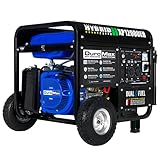
Best for Whole-Panel CoverageDuroMax XP12000EH
Portable, 9,500W Running / 12,000W Peak
The XP12000EH is what you buy when the goal is a portable that covers essentially the whole panel rather than a selected list of circuits. Its 12,000 peak watts on gasoline handled the hardest test we ran: starting a central air conditioning compressor while already carrying a refrigerator, chest freezer, furnace blower, and lighting, without tripping or noticeable voltage sag. That capability genuinely approaches what a small standby generator delivers, at roughly a fifth of the installed cost. Build quality supports the mission — an all-metal frame, copper alternator windings rather than aluminum, and a general heft that suggests it will be running in fifteen years. The 50-amp outlet lands directly into a transfer switch inlet with no adapters, which is how a generator this size should be used. On propane, peak output drops to roughly 10,800 watts, still enough for the same loads but with the AC surge consuming most of the remaining margin. The costs scale with the capability. At over 260 pounds this is not a machine you reposition casually, so choose its spot with a level path and expect it to live there. At 76 dB under load it was the loudest unit in this test, and as a conventional generator its power quality means sensitive electronics want a surge protector in between.
Pros
- 12,000 peak watts starts a central AC compressor alongside other household loads
- All-metal construction and a heavy frame that feels built to last
- 50-amp outlet connects directly to a transfer switch inlet without adapters
- Handled a well pump plus refrigerator, freezer, and furnace simultaneously in testing
- Copper windings rather than aluminum, which matters for heat tolerance and longevity
Cons
- Very heavy at over 260 lbs — plan its position and expect to leave it there
- 76 dB under load, the loudest unit in this test
The Bottom Line
The one to buy if you want a portable to cover nearly everything, including central air. Just accept that it is big, heavy, and loud.

Best ValueWestinghouse WGen9500DF
Portable, 9,500W Running
The WGen9500DF is the value benchmark in this category, delivering output within a few hundred watts of the Champion for meaningfully less money, with electric start, a remote fob, and a battery included rather than treated as accessories. In testing, its 9,500 running watts on gasoline handled our full household load through a transfer switch with room left over, and on propane it settled around 8,500 running watts, still comfortable. Runtime was the standout figure: roughly 12 hours at half load from a full tank, the longest gasoline runtime in this test, which meaningfully reduces overnight refueling during a multi-day outage. Outlet configuration is sensible, including the 30-amp twist lock that a manual transfer switch inlet expects. At 72 dB under load it was among the quieter machines here, though that is a relative statement in a class where nothing is quiet. Where the savings show is refinement. The fuel gauge is basic and hard to read in low light, the control panel layout is functional rather than thoughtful, and general fit and finish sit a step below the premium units. None of that affects whether the generator runs. Westinghouse's long-term reliability record in owner reports is genuinely strong, which is the thing that actually matters over a decade of occasional use.
Pros
- 9,500 running watts at a price that undercuts comparable competitors meaningfully
- Electric start plus remote fob, and a battery included rather than sold separately
- Excellent runtime — roughly 12 hours at half load on gasoline
- Transfer-switch-ready outlet configuration including a 30-amp twist lock
- Consistently strong reliability record in long-term owner reports
Cons
- 72 dB under load — quieter than some here but still genuinely loud
- Fuel gauge and panel layout are basic compared to premium competitors
The Bottom Line
The best watts-per-dollar in this test. If budget is a real constraint and you still need serious output, this is the one.
Best Mid-SizeFirman H05751 Dual Fuel
Portable, 5,700W Running
Most buyers reach for 9,000-plus watts because the price difference looks small, then discover they own a 250-pound machine they can barely move. The Firman H05751 is the argument for restraint. At 5,700 running watts it covered our essential load comfortably — refrigerator, freezer, furnace blower, cycling sump pump, and lighting — while adding a window air conditioner with margin to spare. What it will not do is start a well pump while running central air, and if that combination is your requirement, this is the wrong size. On propane it delivered roughly 5,100 running watts, still enough for the essentials package. The weight difference from the larger units is the real story: this is a machine one reasonably fit person can maneuver alone, which changes where you can store it and how quickly it gets deployed. Electric start is included, unusual at this price. Runtime was excellent for its tank size at roughly 14 hours at half load. At 70 dB under load it was the quietest unit in this test, though the engine note is coarser and more intrusive than the premium machines at similar levels. For a household that wants transfer-switch backup without a machine that requires two people to reposition, this is the sensible pick.
Pros
- 5,700 running watts covers essentials plus a sump pump and window AC
- Meaningfully lighter than the 9,000W-class machines, making it genuinely movable
- Electric start included at a mid-range price
- Good runtime for its tank size, around 14 hours at half load
- Sensible size for a household that does not need whole-panel coverage
Cons
- Not enough for a well pump plus central AC simultaneously
- 70 dB under load, and the engine note is coarser than premium competitors
The Bottom Line
The right size for most households that want a transfer switch without a 250-pound machine. Enough for what matters, not more.

Best Dealer SupportGenerac GP8000E Dual Fuel
Portable, 8,000W Running
There is a specification that never appears on the box: whether anyone will service the machine in ten years and whether parts will be a phone call or a hunt through auction listings. Generac's dealer network is the deepest in the industry, and for a generator that may sit unused for years between emergencies, that is a legitimate reason to choose it. The GP8000E performs well independently of that. Its 8,000 running watts carried our full essential load through a transfer switch, and Generac's PowerRush surge capability handled motor startups — the sump pump in particular — more comfortably than the rated numbers alone suggest, absorbing surge with less voltage dip than two competitors. On propane it delivered roughly 7,200 running watts. The control panel is simple and legible, which counts for something when you are reading it by flashlight, and electric start with an included battery worked reliably in every session. The honest reservations: on a pure watts-per-dollar basis, the Westinghouse and Champion units offer more, and at 73 dB the exhaust note is harsher and more penetrating than the level alone implies. If you value being able to get a carburetor or a voltage regulator locally in 2036, this is the trade worth making.
Pros
- Nationwide Generac dealer network for parts and service anywhere in the country
- PowerRush surge technology handles motor starts better than the raw rating suggests
- 8,000 running watts covers most essential circuits through a transfer switch
- Electric start with an included battery and a simple, legible control panel
- Well-proven engine platform with widely available replacement parts
Cons
- Slightly less output than similarly priced competitors from Westinghouse and Champion
- 73 dB under load with a noticeably harsh exhaust note
The Bottom Line
Buy it for the service network. Parts and support are available anywhere, which matters for a machine you keep fifteen years.

Best Budget PickChampion 4500-Watt Dual Fuel
Compact Portable, 3,600W Running
Not every household needs 9,000 watts, and the Champion 4500 is the machine we recommend when the realistic goal is keeping food cold, lights on, and phones charged through a two-day outage. Its 3,600 running watts handled a full-size refrigerator, a chest freezer, LED lighting across the house, a router, and device charging simultaneously in testing, with enough margin for a small space heater. On propane it settled around 3,250 running watts, still adequate for that package. What it will not do is start a well pump or run central air, and it does not pretend otherwise. The practical advantage over the big machines is deployability: it is light enough for one person to carry down porch steps without planning, which means it actually comes out for a four-hour outage rather than staying in the garage because moving it is a project. The design is simple — recoil start, straightforward controls, few things to break — and that simplicity is part of why these units have a strong reliability record. The compromises are exactly what the price implies: no electric start, so you are pulling a cord in whatever weather the outage brought, and modest output that rules out the heavier loads. As a first generator or a light backup to a larger unit, it is honest value.
Pros
- Lowest price here for a genuine dual fuel generator with real capability
- Light enough for one person to move without difficulty
- Covers a refrigerator, freezer, lights, and devices comfortably
- Simple, reliable pull-start design with few things to fail
- Excellent value for a first generator or a backup to a larger unit
Cons
- 3,600 running watts will not cover a well pump or central AC
- Recoil start only — no electric start at this price
The Bottom Line
The affordable entry point into dual fuel. Enough for the essentials, light enough to actually deploy, and honest about what it is not.
4. What Size Dual Fuel Generator Do You Need?
Conventional generators are cheap enough per watt that buying some headroom is affordable, but oversizing still costs you in weight, fuel burn, and noise.
| Running Watts | Covers | Typical Price |
|---|---|---|
| 3,500-4,500W | Fridge, lights, devices, small tools | $400-700 |
| 5,500-7,000W | Above plus sump pump and window AC | $600-1,000 |
| 8,000-9,500W | Most essential circuits via transfer switch | $900-1,500 |
| 10,000-12,000W | Well pump plus central AC, near whole-panel | $1,300-2,200 |
Size Against Starting Watts
Anything with a motor surges when it starts — a well pump running at 1,200 watts can demand 4,000 for a second. Add the running watts of everything you want on simultaneously, then check that the generator's starting watt rating covers your largest motor's surge on top of that running total. Undersizing here shows up as a tripped generator at the worst possible time.
Size Against the Propane Rating
If propane will be your main fuel, use the propane number rather than the headline gasoline figure. That 10% derate lands exactly where it hurts — on surge capacity — so a unit that starts a well pump on gasoline may not on propane.
A Transfer Switch Doubles What a Generator Can Do
Extension cords through a window can only reach appliances with plugs. A manual transfer switch — typically $500-1,500 installed — lets a generator power hardwired circuits like a furnace, well pump, and lighting, which is most of what actually matters during an outage. It is also the only safe and legal way to connect a generator to house wiring.
5. Transfer Switches and Safe Connection
Never Backfeed Through a Dryer Outlet
Connecting a generator to your home wiring through a double-male cord energizes the utility lines outside your house and can kill line workers repairing the outage. It also bypasses every overcurrent protection in your panel. It is illegal in most jurisdictions and it is the single most dangerous thing homeowners do with generators. Install a transfer switch or use extension cords — there is no third option.
Manual Transfer Switch
A small sub-panel installed beside your main panel with a set number of circuits — commonly 6, 8, or 10 — that you choose during installation. During an outage you plug the generator into an exterior inlet box, start it, and flip each circuit from utility to generator. Typically $500-1,500 installed including the inlet. This is the standard solution for a portable generator and transforms its usefulness.
Interlock Kit
A cheaper alternative: a mechanical plate on your existing panel that physically prevents the main breaker and a generator backfeed breaker from being on simultaneously. It gives you access to every circuit in the panel rather than a fixed subset, usually for $200-500 installed. Availability depends on your panel brand and local code, so check with an electrician.
Extension Cords Done Right
If a transfer switch is not in the budget, use heavy-gauge outdoor-rated cords — 12 gauge for runs up to 50 feet, 10 gauge beyond that — run through a window with a sealed cord pass rather than a door left ajar. Never daisy-chain cords, and never run them under rugs or through standing water.
6. Cold Weather Operation: Where Most Outages Happen
Winter storms cause a disproportionate share of extended power outages, which makes cold-weather behaviour the most important real-world characteristic of a backup generator — and the one least reflected in the specifications.
The Propane Vaporisation Problem
Propane has to boil inside the tank to feed the engine as a gas, and that boiling slows dramatically as temperature falls. Around 20°F a 20-pound tank can no longer vaporise fast enough to supply a large generator at load, and the symptom is distinctive: the unit starts normally, runs for a while, then begins surging or dropping load as the tank frosts over and pressure sags. Owners often mistake this for a fault in the generator.
There are three fixes, in order of practicality. Keep gasoline available and switch to it when temperatures drop — the simplest answer, and the reason dual fuel beats propane-only for winter. Use a larger tank, since a 100-pound cylinder has far more liquid surface area to vaporise from and keeps up in much colder conditions. Or connect two 20-pound tanks through a manifold, which splits the demand and roughly halves the vaporisation load on each.
Cold Starting on Gasoline
Gasoline is the more reliable cold-weather fuel, but a cold engine still asks more of the starting system. Electric start depends on a battery whose cranking capacity falls sharply in the cold, which is why a battery that seemed fine in October can be inadequate in January. Keep the battery charged with a maintainer if the generator is stored somewhere unheated, and confirm that the recoil backup actually works — many owners have never pulled it.
Oil viscosity matters too. Straight 30-weight oil, which many small engines specify by default, becomes noticeably thick below freezing and makes cranking harder. Most manufacturers approve 5W-30 synthetic for cold-weather operation, which flows far better on a cold start and protects just as well once warm. Check your manual and make the switch before winter rather than during it.
Running in Snow
A generator still needs the full 20-foot setback in a blizzard, which means it will be sitting in the weather. Use a purpose-built generator canopy that maintains airflow and exhaust clearance — never a tarp draped over the machine, which traps exhaust heat against the housing and is a genuine fire risk. Keep the unit elevated on blocks or a platform so accumulating or drifting snow does not reach the air intake, and clear snow away from the exhaust regularly so it cannot pack in and back-pressure the engine.
7. Generator Safety
Carbon Monoxide Applies on Propane Too
Propane burns cleaner than gasoline but still produces carbon monoxide in lethal quantities. Never run any of these generators in a garage, breezeway, covered porch, or within 20 feet of a window, door, or vent — regardless of fuel, and regardless of whether the unit has a CO shutoff sensor. Install battery-powered CO detectors inside the house as a second layer.
Three more practices matter in real use. Never refuel a hot or running engine with gasoline — spilled fuel on hot exhaust is a genuine fire risk and one of the most common generator injuries. Keep the unit dry and elevated in wet weather using a proper generator canopy rather than a tarp, which traps exhaust heat. And check the propane hose and regulator annually for cracking, soap-testing every connection when you attach a tank.
Exercise It Monthly, on Propane
The most common failure mode for a stored generator is a carburetor gummed by stale gasoline. Running the unit under load for 20-30 minutes every month keeps everything moving, and doing those runs on propane means no varnish is deposited at all. This one habit prevents most no-start failures.
Oil Changes Matter More Than You Think
These engines hold roughly a quart, so oil degrades faster than in a car and a missed change matters more. Change after the first 20-25 hours, then every 50-100 hours of run time. Check the level before every extended run, not just at intervals — most of these units have a low-oil shutoff, and finding out it works during an outage is the wrong time.
Before You Buy
8. Frequently Asked Questions
What is the best dual fuel generator in 2026?
The Champion 9200-Watt Dual Fuel is our overall pick — enough output to cover essential circuits through a transfer switch, with electric start and a remote fob, at sensible pricing. For near whole-panel coverage including central AC, the DuroMax XP12000EH. For the best value, the Westinghouse WGen9500DF delivers comparable output for meaningfully less.
How much power do you lose running a generator on propane?
About 10%, consistently. A generator rated 9,200 running watts on gasoline typically delivers around 8,300 on propane, because propane carries less energy per unit volume delivered to the cylinder. If propane will be your primary fuel, size against the propane rating rather than the headline gasoline number.
Is a dual fuel generator worth it?
For emergency backup, yes — for availability rather than economy. After a regional storm, gas stations without power cannot pump while propane tanks stay on shelves. Propane also stores indefinitely, so several tanks in the garage represent days of power that never degrades, unlike gasoline which goes stale in three to six months.
How long will a dual fuel generator run on a 20 lb propane tank?
For a 5,000-9,000 watt unit, typically 5-9 hours at moderate load. Gasoline usually gives longer runtime per fill — 10-14 hours for these machines at half load — but a propane tank can be swapped in seconds without waiting for the engine to cool, which is a real advantage during a long outage.
Do dual fuel generators work in cold weather on propane?
They struggle below about 20°F. Propane must vaporize inside the tank to feed the engine, and vaporization slows sharply in cold, causing surging or load loss. Keep gasoline available for winter outages, or use a 100 lb tank, which has much more surface area for vaporization than a 20 lb bottle.
Can I connect a dual fuel generator to my house?
Only through a manual transfer switch or an approved interlock kit, installed by an electrician. Never backfeed through a dryer outlet with a double-male cord — it energizes the utility line outside your home, can kill line workers, bypasses your panel's overcurrent protection, and is illegal in most jurisdictions.
What size dual fuel generator do I need for a house?
For essentials — refrigerator, freezer, lights, devices — 3,500-4,500 running watts. Adding a sump pump and a window air conditioner needs 5,500-7,000. Covering most essential circuits through a transfer switch takes 8,000-9,500. A well pump plus central air needs 10,000-12,000 watts.
9. Common Mistakes With Dual Fuel Generators
These machines are simple to run and easy to ruin in storage. Most failures are preventable.
Backfeeding Through a Dryer Outlet
A double-male cord from the generator to a household outlet energizes the utility lines outside your house and can kill the crew repairing the outage. It also bypasses every breaker in your panel. Install a transfer switch or an interlock kit, or use extension cords directly to appliances.
Sizing Against Gasoline While Planning to Run Propane
The 10% propane derate lands on surge capacity, which is exactly what starts a well pump or a compressor. If propane is your main fuel, size against the propane rating so the generator still has the headroom you bought it for.
Storing It With Untreated Gasoline
A gummed carburetor is the number one reason a stored generator will not start during an outage. Either stabilize the fuel and run it through the carburetor, or shut the fuel valve and let the bowl run dry — then exercise the unit on propane monthly so no varnish forms at all.
Assuming Propane Means No Carbon Monoxide
Propane burns cleaner but still produces CO in lethal amounts. The 20-foot setback from windows, doors, and vents applies identically on propane, and a garage with the door open is not outdoors. CO shutoff sensors are a backup, not a permission slip.
Relying on Propane Alone Through Winter
Below roughly 20°F a 20 lb tank cannot vaporize fast enough to feed a large generator, and it surges or quits — during exactly the storms that cause outages. Keep gasoline on hand for cold weather or step up to a 100 lb tank.
Related Generator Guides
Buyer's Guide
Best Dual Fuel Inverter Generator
Quieter, cleaner power for electronics — at roughly double the price per watt.
Buyer's Guide
Best Tri-Fuel Generator
Add natural gas to the mix for unlimited runtime from an existing house line.
Buyer's Guide
Best Home Generator for Power Outages
Standby, portable, inverter and battery options compared for multi-day outages.
Fuel
Propane Consumption
How long each tank size actually lasts.
The Bottom Line
The best dual fuel generator for most households is the Champion 9200-Watt — enough output to cover the circuits that matter through a transfer switch, with remote electric start so you actually use it in bad weather. For near whole-panel coverage including central AC, the DuroMax XP12000EH; for the best value, the Westinghouse WGen9500DF.
Whichever you buy, three rules make it work: install a transfer switch rather than backfeeding, exercise it monthly on propane so the carburetor never gums, and keep gasoline on hand because propane fails below 20°F — which is exactly when winter outages happen.
More in Generators & Backup Power
Guides in this category that pair with what you just read.
About the Author
Alex Rivers, Home Improvement Editor
Alex has spent over a decade working on residential and light commercial property maintenance, and now tests every tool, coating and machine that appears in these guides personally.