Best Reel Mowers
A reel mower gives a small lawn the cleanest cut it will ever get, for no fuel and almost no noise. It also punishes the wrong grass, the wrong height and the wrong yard. Here is how to tell which side of that line you are on.
Alex Rivers
Home Improvement Editor
Last Updated
September 29, 2026
In This Guide
A reel mower is not a cheap rotary mower with the engine removed. It is a different cutting tool that shears grass like scissors, and on the right lawn it beats a rotary on cut quality outright. On the wrong lawn, with tall fescue grown out to four inches and a scatter of oak twigs, it is a miserable afternoon. Most bad reel mower reviews are really reviews of that mismatch.
Our Picks at a Glance
- Best Overall: Fiskars StaySharp Max Reel Mower 18-Inch — 18-inch, 1 to 4 inch Cut Height, No-Contact Blade
- Best for Larger Lawns: Scotts Outdoor Power Tools 2000-20 Classic 20-Inch Reel Mower — 20-inch, 5 Blades, 1 to 3 inch Cut Height
- Best Value: Great States 415-16 16-Inch 5-Blade Push Reel Mower — 16-inch, 5 Blades, 1/2 to 2-1/2 inch Cut Height
- Best Mid-Size: American Lawn Mower Company 1815-18 18-Inch 5-Blade Reel Mower — 18-inch, 5 Blades, 1/2 to 2-3/4 inch Cut Height
- Best for Tiny Lawns: American Lawn Mower Company 1204-14 14-Inch 4-Blade Reel Mower — 14-inch, 4 Blades, 1/2 to 1-3/4 inch Cut Height
- Best with Grass Catcher: Greenworks 20-Inch 5-Blade Push Reel Mower with Grass Catcher 25072 — 20-inch, 5 Blades, 1-3/8 to 2-1/2 inch Cut, Catcher
1. How We Picked
We started from the reel mowers that are actually available to buy online in the US, which is a shorter list than it looks. Many listings are the same two or three frames sold under different brand names, and several powered reel mowers have come and gone with very thin review histories. We checked every mower here against the maker's own specifications for cutting width, blade count and, above all, cutting height range.
Cutting height was the first filter because it decides what lawns a mower can serve at all. A mower that tops out at 1-3/4 inches can only look after bermuda or zoysia well, whatever else it does right. We then weighed blade count and reel width, which together decide cut quality and how long the job takes, and wheel size, which decides how evenly the reel follows a lumpy lawn.
In our testing we paid most attention to three situations where reels fail: grass that had gone a week past its mowing day, damp grass in the morning, and lawns with twigs and seed pods scattered over them. We also checked how easy each mower was to adjust, because a reel that arrives with the bedknife out of adjustment will chew instead of cut, and many owners never realise it can be fixed in five minutes.
We left out powered reel mowers this time. The battery-assisted models we looked at had too few owner reviews, and too many of those mentioned struggling in damp grass, to recommend over a good manual reel. Gas-powered front-throw reels of the kind used on golf greens are a different class of machine at many times the price, and they are sold through specialist dealers rather than general retailers.
2. Is a Reel Mower Right for Your Lawn?
Answer three questions honestly before buying: how big is the lawn, what grass is it, and how often will you mow. A reel mower is excellent when the answers are small, warm-season or fine-bladed, and at least once a week. It is frustrating when any one of them goes the other way.
Size first. A push reel is comfortable up to around 2,000 to 3,000 square feet for most adults, and workable up to about 5,000 on a flat lawn if you enjoy the exercise. Beyond that, the job becomes long enough that people start skipping mowings, and a reel mower punishes skipped mowings more than any other kind. If your lawn is bigger than that, our guide to the best push mowers covers gas and battery options that will not leave you dreading Saturday.
Grass second. Reels are at their best on grasses that are kept short and have fine, dense blades, which mainly means bermuda and zoysia. They are fine on centipede, fine fescue and perennial ryegrass. They struggle with tall fescue, bluegrass kept tall and St. Augustine allowed to get thick, because those grasses either want a height above what most reels can reach or have stems a light reel bends rather than cuts.
Frequency third. A reel cuts well only when grass stands up into the blades, and long grass flops over. The one-third rule, which says never remove more than a third of the blade in one mowing, matters more with a reel than with a rotary. In practice that means mowing every four to seven days in peak season, not every ten to fourteen.
THE QUICK TEST
Under 3,000 sq ft, warm-season grass, mowed weekly: buy a reel.
If your lawn fails any one of those three conditions, a reel can still work, but check the cutting height range and weight carefully. If it fails two, buy a rotary mower instead.
Terrain also matters. Reels need a reasonably flat, smooth lawn, because the cutting cylinder sits close to the ground and scalps the high spots on a lumpy one. A few dips are fine; a yard full of tree roots and mole hills is not reel territory.
3. Our 6 Top Picks
Every mower below is a manual push reel, because that is still where the category is strongest; the battery-assisted reels we looked at had too few owner reviews and too many complaints about wet grass to recommend yet. The picks are ordered by how many lawns they suit, not by price. Read the cutting height range on each one before you read anything else, because a mower that cannot reach your target height is the wrong mower however well it is built.

Fiskars StaySharp Max Reel Mower 18-Inch
18-inch, 1 to 4 inch Cut Height, No-Contact Blade
The StaySharp Max exists to fix the two problems that make most people give up on reel mowers: the cutting height tops out too low, and the reel drags because the blades rub the bedknife. Fiskars solved the first by giving it a 1 to 4 inch range, which means it can mow a tall fescue or Kentucky bluegrass lawn at the 3 to 3.5 inches those grasses actually want. Every other mower on this list tops out at 3 inches or lower. It solved the second with a cutting system that shears without the blades touching the bedknife, so there is no constant friction to push against and the edges wear far more slowly. The heavy reel matters more than it sounds. Once it is spinning it keeps spinning, so a patch of thick growth or a clump of clover that would stall a light 14-inch reel gets cut instead of flattened. In our testing it was the only reel that handled a week of missed mowing without needing a second pass. The weight is also the downside. At around 52 pounds it is harder to lift over a curb, carry to a back garden or push up a real slope, and it costs enough that you should compare it against a battery rotary before buying. If your lawn is cool-season grass and you want a reel anyway, this is the one.
Pros
- Cutting height runs from 1 to 4 inches, the only mainstream reel that reaches cool-season mowing heights
- No-contact StaySharp cutting system means no blade-to-bedknife drag and far less routine sharpening
- Heavy InertiaDrive reel carries momentum through thick patches that stall lighter mowers
- Front-throw discharge sends clippings forward instead of onto your shoes
- Handle-mounted height adjustment changes all settings in one move
Cons
- At roughly 52 pounds it is about twice the weight of a basic reel, which matters on slopes and stairs
- The high price puts it within reach of a decent battery rotary mower
The Bottom Line
The one reel mower that works on tall fescue and bluegrass lawns, and the easiest to live with if you can handle the weight.
Scotts Outdoor Power Tools 2000-20 Classic 20-Inch Reel Mower
20-inch, 5 Blades, 1 to 3 inch Cut Height
Width is the spec that decides how long a reel mower job takes, and the Scotts Classic is the widest mainstream option at 20 inches. On a 3,000 square foot lawn that works out to meaningfully fewer passes than a 16-inch reel, which is the difference between a reel mower being a pleasant 30-minute job and a chore you start avoiding. The five-blade reel runs on ball bearings and cuts cleanly at typical residential heights, and the nine settings span 1 to 3 inches. That covers bermuda, zoysia and St. Augustine comfortably, and a fine fescue or perennial rye lawn kept at the upper end of its range. It does not reach the 3.5 inches a tall fescue lawn prefers in summer heat. The 10-inch front wheels are the underrated feature. Small wheels drop into every dip in an uneven lawn and the reel scalps the high spots; bigger wheels bridge those dips and keep the cut more even. The trade-off for the width is effort. A wider reel moves more grass per step, and in thick or damp growth you feel it through the handle. Plan on checking the bedknife gap when it arrives, as many owners find it needs a quarter-turn of adjustment before it cuts cleanly.
Pros
- 20-inch cutting width is the widest here, cutting mowing passes by roughly a fifth versus a 16-inch reel
- Five-blade, ball-bearing reel gives a clean cut at typical residential heights
- 10-inch front wheels with tread roll over lumpy ground better than small-wheeled reels
- Nine height settings from 1 to 3 inches cover most warm-season and some cool-season grasses
- Weighs under 30 pounds, light for its width
Cons
- The wide reel needs more push force, which you will feel in thick or damp grass
- Needs bedknife adjustment out of the box on many units before it cuts paper cleanly
The Bottom Line
The reel to buy if your lawn is at the upper end of what a reel should handle and you want fewer passes.
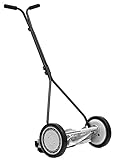
Great States 415-16 16-Inch 5-Blade Push Reel Mower
16-inch, 5 Blades, 1/2 to 2-1/2 inch Cut Height
If you have a small bermuda, zoysia or centipede lawn and want a reel mower without overthinking it, this is the one we would point you to first. The 16-inch width is the balance point of the category. Narrower mowers take noticeably more passes, and wider ones take more effort per step; at 16 inches with five blades, most adults can mow a 2,000 square foot lawn without a break. Five blades matter because every blade that passes the bedknife makes a cut, and more cuts per wheel rotation means grass is sheared more times per inch of travel. That gives a cleaner, more even finish, especially at low heights. The height range of 1/2 inch to 2-1/2 inches is aimed squarely at warm-season grass. Bermuda kept at an inch or so looks its best under a reel, and this one gets there easily. The limitation is the top end. Tall fescue and bluegrass want 3 inches or more in summer, and forcing them to 2-1/2 inches stresses the lawn. At about 25 pounds it is easy to hang on a garage wall. Uneven lawns will show every high spot at low settings, so level the worst dips before you commit to a short cut.
Pros
- Five-blade reel on a 16-inch frame is the sweet spot of cut quality and push effort
- Cuts as low as 1/2 inch, which suits bermuda and zoysia kept short
- About 25 pounds, easy to carry and store on a hook
- Tempered alloy steel reel and bedknife, with a welded torsion bar frame
- Priced in the budget tier while still using a five-blade reel
Cons
- Tops out at 2-1/2 inches, too low for tall fescue or bluegrass in summer
- Smaller wheels follow ground contours closely, so bumpy lawns can show scalped patches
The Bottom Line
The right default for a small warm-season lawn: light, cheap, and five blades for a cleaner cut than the 4-blade budget models.

American Lawn Mower Company 1815-18 18-Inch 5-Blade Reel Mower
18-inch, 5 Blades, 1/2 to 2-3/4 inch Cut Height
The American Lawn Mower Company has been making push reels for more than a century, and the 1815-18 is the model in its range we think most owners should look at. It splits the difference between the nimble 16-inch reels and the wide, effortful 20-inch ones. Two extra inches of width over a 16-inch mower does not sound like much, but it cuts the number of passes on a typical lawn by about a tenth, and it does so without the noticeably heavier push of a 20-inch reel. The height range runs from 1/2 inch to 2-3/4 inches. That quarter-inch more at the top than the Great States model gives a little more room for grasses like perennial ryegrass or fine fescue, and for letting warm-season grass stay taller in a drought. It still is not a cool-season lawn mower in summer. The 10-inch wheels bridge small dips better than 8-inch wheels, which reduces scalping on the kind of slightly lumpy suburban lawn most of us actually have. Parts availability is a quiet advantage. Bedknives, wheels and sharpening kits for this brand are easy to get, which matters for a tool that can last decades if maintained.
Pros
- 18-inch width saves passes without the heavy push of a 20-inch reel
- Height range of 1/2 to 2-3/4 inches is slightly more flexible than the 16-inch models
- 10-inch composite wheels ride better on uneven ground
- Heat-treated alloy steel blades on a ball-bearing reel
- From the longest-running reel mower maker in the US, with parts easy to find
Cons
- At around 27 pounds it is heavier to lift than the 16-inch models
- Still too low at the top end for cool-season lawns in summer
The Bottom Line
A good middle ground for a 3,000 to 4,000 square foot warm-season lawn that makes a 16-inch reel feel slow.

American Lawn Mower Company 1204-14 14-Inch 4-Blade Reel Mower
14-inch, 4 Blades, 1/2 to 1-3/4 inch Cut Height
This is the reel mower most people have seen, and the one behind most of the complaints about reel mowers in general. Both reputations are deserved. On a small bermuda or zoysia lawn mowed often, it is a delight: light enough to carry with one hand, narrow enough to fit a side yard, and capable of a clean scissor cut at an inch or so. At about 19 pounds it is the mower to choose when the lawn is a townhouse strip or a front yard up a flight of steps. The problems start when it is bought for the wrong lawn. The maximum cutting height is 1-3/4 inches, which is far too short for tall fescue, bluegrass or St. Augustine, and scalping those grasses to that height weakens them within a season. With four blades rather than five and a lighter reel, it also has less momentum, so grass that has got away from you bends over rather than being cut. Mow it every four to five days in the growing season and it performs. Skip a week and you will be going over the same strip twice. Buy it for the right lawn and it will last a long time; buy it because it is cheap and you will probably hate it.
Pros
- About 19 pounds, the lightest mower here and easy to carry up steps to a front lawn
- 14-inch width fits narrow side strips and small townhouse lawns
- Among the least expensive ways to get a real scissor cut
- Very simple mechanism with little to go wrong
- Huge owner base, so adjustment tips and spare parts are easy to find
Cons
- Maximum height of 1-3/4 inches is too short for most lawns other than bermuda and zoysia
- Four blades and a light reel stall in thick or overgrown grass
The Bottom Line
Only for very small, short-cut warm-season lawns, where its light weight and low price make it hard to beat.

Greenworks 20-Inch 5-Blade Push Reel Mower with Grass Catcher 25072
20-inch, 5 Blades, 1-3/8 to 2-1/2 inch Cut, Catcher
Most reel mowers throw clippings forward or backward and leave them on the lawn, which is usually fine because reel clippings are fine and break down fast. Some owners want them collected anyway, whether for a tidy finish, for compost, or because the lawn backs onto a patio. The Greenworks 20-inch includes a rear grass catcher in the box, which is the main reason to choose it. The reel itself is a five-blade, 20-inch unit with nine height positions from 1-3/8 to 2-1/2 inches. That is a narrower window than the Scotts, and it is shifted upward: it will not go below about an inch and a third, so it is not the mower for bermuda kept golf-course short, but it suits zoysia, St. Augustine kept low, and centipede. The 10-inch front and 6-inch rear wheels are a sensible layout for keeping the reel level on uneven ground. The catcher adds weight and it fills faster than you expect on a lawn that has been left to grow, so this is best on a lawn you mow often. The three-year warranty is a small but real point in its favour in a category where one year is typical.
Pros
- Includes a rear grass catcher, which most reels either lack or sell as an extra
- 20-inch width with five helical blades
- Nine height positions from 1-3/8 to 2-1/2 inches
- 10-inch front and 6-inch rear wheels help stop the reel scalping
- Three-year warranty is longer than most manual reels
Cons
- Lowest setting of 1-3/8 inches is too high for anyone wanting a golf-short bermuda
- At about 30 pounds with the catcher it is the heaviest of the conventional reels
The Bottom Line
Worth it if you want clippings collected rather than left on the lawn, and do not need a very short cut.
4. Which Grasses Suit a Reel Mower
Grass type is the single biggest predictor of whether you will be happy with a reel mower, and it is the thing most reviews skip. The key is the height the grass wants to be kept at, compared with the height range of the mower.
Bermuda is the ideal reel grass. It looks best cut short, often between 1/2 inch and 1-1/2 inches, and it grows sideways into a dense mat that a reel shears cleanly. Golf courses and sports fields mow bermuda with reels for exactly this reason: a rotary at those heights tends to tear and scalp, while a reel leaves a uniform, carpet-like surface. Zoysia is similar, doing well at 1 to 2 inches, although its stiff blades demand a sharp, well-adjusted reel.
Centipede and St. Augustine are workable. Centipede at 1 to 2 inches suits most reels. St. Augustine is kept taller, often 2-1/2 to 4 inches depending on variety and shade, so only the mowers with higher ranges can serve it, and its thick stolons can stall light reels.
Tall fescue is where most reel mower disappointment comes from. It should be mowed at around 3 to 4 inches, especially in summer heat, and most reel mowers stop at 2-1/2 or 3 inches. Cutting it shorter to suit the mower thins the lawn and invites weeds and heat stress. Its coarse, upright blades also tend to push aside rather than feed into the reel once they get long. Kentucky bluegrass is similar at 2-1/2 to 3-1/2 inches. If your lawn is one of these, the Fiskars StaySharp Max with its 4-inch top setting is the only mower on this list we would recommend.
| Grass | Ideal Height | Reel Fit |
|---|---|---|
| Bermuda | 1/2 to 1-1/2 in | Excellent |
| Zoysia | 1 to 2 in | Excellent |
| Centipede | 1 to 2 in | Good |
| Perennial ryegrass | 1-1/2 to 2-1/2 in | Good |
| St. Augustine | 2-1/2 to 4 in | Only high-range reels |
| Tall fescue | 3 to 4 in | Poor except Fiskars Max |
| Kentucky bluegrass | 2-1/2 to 3-1/2 in | Fair at best |
Not sure what grass you have? Look at a blade closely. Fine, narrow blades that spread by runners and turn tan in winter are almost always bermuda or zoysia. Wide, coarse blades that grow in clumps and stay green in cool weather are almost always tall fescue.
5. Cutting Height: The Spec That Decides Everything
When comparing reel mowers, look at the maximum cutting height before anything else. It varies from 1-3/4 inches on the smallest budget reels to 4 inches on the Fiskars, and it decides which lawns a mower can look after at all. The minimum height matters too, but mainly to bermuda owners chasing a golf-course finish.
Height on a reel mower is set by raising or lowering the rear roller or wheels relative to the cutting cylinder. On cheaper mowers that means adjusting a bolt or bracket on each side, and you need to set both sides equally or the cut will be slanted. Better mowers use a single lever or a handle-mounted adjuster. Whatever the mechanism, measure the result with a ruler from a hard surface to the bedknife edge, because the markings on the mower are not always accurate.
Remember that the setting is not the same as the result on a soft lawn. The wheels sink slightly into turf and thatch, so a mower set at 2 inches may leave grass at about 1-3/4 inches. On a thatchy zoysia lawn the difference can be larger. Set a little higher than your target, mow a strip, and measure the grass itself.
HEIGHT RANGES ON THIS LIST
4 in
Fiskars StaySharp Max maximum
3 in
Scotts Classic 20-inch maximum
1/2 in
Lowest setting on the Great States and ALM reels
1-3/4 in
ALM 1204-14 maximum
Pick a height based on your grass, not the mower, and then pick the mower that reaches that height with room to spare. You want your normal setting in the middle of the mower's range, not at the very top, so you can raise it in drought or heat. A bermuda lawn mowed at an inch works with any mower here; a fescue lawn mowed at 3-1/2 inches works with one.
6. Blade Count, Reel Width and Wheels
Blade count is the most visible spec on a reel mower and the most misunderstood. More blades mean more cuts per revolution of the reel, which means grass is clipped more often for each inch the mower travels. That gives a finer, more even finish, and it matters most at low heights, where each blade has to catch short grass cleanly.
Four blades is the budget standard and fine for a lawn kept at a medium height and mowed often. Five blades is the sweet spot for most home lawns and is what we would look for by default. Seven or more blades are found on golf and specialist machines and are aimed at very short bermuda; on a home lawn kept above an inch, the extra blades add little except cost and push effort.
Reel width decides how long the job takes. A 14-inch reel on a 2,000 square foot lawn needs roughly 40 percent more passes than a 20-inch reel. Wider reels also need more force to push, because they are cutting more grass with every step. For most people, 16 to 18 inches is the right balance; 20 inches suits bigger lawns and stronger pushers, and 14 inches suits tiny lawns and narrow strips.
Wheel size is the spec people ignore and then regret. Small 8-inch wheels drop into every dip, which tips the reel and scalps the high ground on either side. Larger 10-inch wheels bridge those dips and keep the cylinder level. On a perfectly smooth lawn it makes little difference; on a normal suburban lawn it is the difference between an even finish and a striped, patchy one.
Weight cuts both ways. A heavier reel has more momentum and cuts through thick patches more reliably, which is why the 52-pound Fiskars handles overgrown grass better than a 19-pound budget reel. But weight has to be pushed uphill and carried up steps. If your lawn has a real slope or needs carrying to reach, the lighter models are easier to live with.
7. The Scissor Cut and Why It Matters
A rotary mower cuts grass by hitting it with a blade spinning at high speed. Even a sharp rotary blade is really striking the grass at a speed that snaps it off, and a dull one tears it. A reel mower works differently. As the blades on the spinning cylinder pass a fixed bar called the bedknife, they trap each grass blade and shear it, exactly as scissors do.
That shearing action leaves a clean, flat cut rather than a frayed tip. A clean cut loses less moisture, heals faster and is less open to disease, and it does not turn brown at the tips a day or two after mowing, which is the tell-tale sign of a dull rotary blade. On fine-bladed grasses kept short, the difference is visible from across the street.
Clippings are the other benefit. Reel clippings are short and fine, and they sift down into the lawn and break down quickly rather than sitting on top in clumps. For most lawns there is no need to collect them, and leaving them returns nitrogen to the soil.
The scissor cut depends entirely on the gap between the reel blades and the bedknife. If it is too wide, the blades push grass over instead of trapping it, leaving uncut blades standing up in a ragged line. The standard test is a strip of paper: slide it between the reel and bedknife and turn the reel by hand. A properly adjusted reel cuts the paper cleanly along the full width. If it folds or tears the paper, it needs adjusting.
This is also why a rotary mower's blade condition matters so much by comparison. If you own both kinds, our guide on how often to sharpen mower blades covers the rotary side, where a dull blade quietly costs you lawn health all season.
8. Twigs, Pine Cones and Other Reel-Killers
A rotary mower smashes through debris. A reel mower stops dead. A twig thicker than a pencil, a pine cone, a sweetgum ball or a walnut will jam between the reel and the bedknife, stop the mower with a jolt, and sometimes nick the edge or knock the bedknife out of adjustment.
That makes a quick walk over the lawn before mowing part of the job. On a lawn under deciduous trees in autumn, or under pines, sweetgums or oaks at any time of year, you will be picking up debris every time. Some people find that becomes a relaxing habit; others find it the reason they give up on the reel. Be honest about which you are before you buy.
Tall seed heads and weeds are the other problem. Wiry stems, like those of plantain and dandelion flowers or the seed stalks of bahiagrass, often bend under the reel and spring back up uncut. Bahiagrass is so bad for this that most owners of it should not consider a reel at all. On other lawns, a quick pass with a string trimmer over the worst seed heads solves it.
THE HABIT THAT SAVES A REEL
Walk the lawn first. Every time.
Two minutes picking up sticks and cones before mowing prevents most jams, most nicked blades and most bedknife problems. If your yard is under trees that drop debris all season, factor that time in or choose a rotary.
Damp grass is a milder version of the same problem. Wet grass lies down and clumps, and a reel cuts it poorly. Mow a reel lawn in the afternoon, once the dew has dried off, and you will see a real difference in cut quality.
9. Backlapping and Bedknife Adjustment
Reel mowers need sharpening far less often than rotary blades, because the self-sharpening contact between reel and bedknife keeps the edges honed. But they do need occasional attention, and knowing how to do it yourself is the difference between a reel that cuts well for decades and one that gets thrown out after three seasons.
Adjustment comes first and is needed far more often. On most manual reels there are two adjustment screws or bolts, one on each side, that move the bedknife closer to or further from the reel. Use the paper test described above, working from one side to the other, and adjust until the reel cuts paper cleanly across its full width with only light contact. Too tight and the mower is hard to push and wears fast; too loose and it chews grass instead of cutting it.
Backlapping is the home sharpening method for reels. You coat the reel blades with a lapping compound, a grit paste, and turn the reel backwards against the bedknife, either by hand with a crank or by propping the mower and turning the wheels backwards. The grit hones both edges together so they meet cleanly. Most brands sell a sharpening kit that includes the compound and a handle.
Once a year is plenty for most home lawns, and many owners need it only every two or three seasons. If the reel has a nick from hitting a stone, or the bedknife is visibly rounded, backlapping may not be enough and a professional grind is the answer. A lawn equipment shop with reel-grinding equipment can restore a mower that seems worn out.
The Fiskars StaySharp Max is the exception. Its cutting system is designed so the blades do not contact the bedknife, and Fiskars pitches it as avoiding annual sharpening. That does not mean never sharpening, but it does mean less routine upkeep than a conventional reel.
10. When to Buy Something Else
We like reel mowers, but they are the right tool for fewer lawns than their fans suggest. If your lawn is bigger than about 5,000 square feet, a reel will take too long for most people to keep up with. If it is tall fescue or bluegrass, only one reel on this list can mow it at a healthy height. If it is under trees, you will spend as much time picking up sticks as mowing.
For small lawns that do not suit a reel, a compact battery rotary is usually the best alternative. They are nearly as quiet, need no fuel, cut at any height, and deal with twigs and long grass without fuss. Our guide to the best lawn mowers for small yards compares reels, battery mowers and corded mowers side by side for exactly this situation.
If what appeals to you is mainly the quiet and the lack of fuel and oil, the best electric lawn mowers give you most of that on a bigger lawn, with far less effort. They also bag, mulch and cope with a missed week, which a reel does poorly.
And if you are keeping a rotary as your main mower, the finish it gives depends largely on the blade. A fresh, sharp blade of the right type makes more difference than most people expect; see our guide to the best lawn mower blades for how to match and choose one.
11. Common Mistakes to Avoid
Buying a reel for tall fescue
Most reel mowers top out between 1-3/4 and 3 inches, and tall fescue wants 3 to 4 inches. Forcing it lower thins the lawn, invites weeds and stresses the grass in summer heat. Unless you buy a reel that reaches 4 inches, a rotary is the better tool for a fescue lawn.
Skipping a week of mowing
A reel cuts grass that stands up into the blades. Once grass gets long it bends over and the reel rolls across it, leaving a ragged, uneven finish and uncut stalks. Mow every four to seven days in the growing season, and never take more than a third of the blade in one pass.
Never adjusting the bedknife
Many reel mowers arrive with the bedknife slightly out of adjustment, and many owners decide the mower is bad without checking. Use the paper test: the reel should cut a strip of paper cleanly across its full width. A five-minute adjustment fixes most complaints about chewed or missed grass.
Mowing over sticks and cones
Twigs, pine cones and seed pods jam the reel and can nick the blades or knock the bedknife out of line. A quick walk over the lawn before mowing prevents most problems. Under trees that drop debris all season, factor in that time or choose a rotary mower instead.
Mowing wet grass
Dew and rain make grass lie flat and clump, and a reel cuts it poorly. It also leaves clippings clumped on the surface instead of sifting down into the lawn. Wait until the afternoon, when the grass has dried and stands up, for a noticeably cleaner cut and an easier push.
12. Frequently Asked Questions
Are reel mowers good for bermuda grass?
Yes, bermuda is the grass reel mowers suit best. It looks its best when kept short, usually between half an inch and an inch and a half, and a reel shears it cleanly at those heights where a rotary often tears and scalps. That is why golf courses use reels on bermuda. Choose a five-blade reel that goes down to half an inch.
Can a reel mower cut tall fescue?
Most cannot cut it well, because tall fescue should be kept at 3 to 4 inches and most reels top out at 3 inches or lower. The Fiskars StaySharp Max, which reaches 4 inches, is the exception on this list. Even then, mow often, because tall fescue that gets long tends to flop over rather than feed into the reel.
How big a lawn can I mow with a reel mower?
For most adults, up to about 2,000 to 3,000 square feet is comfortable, and a flat lawn of up to around 5,000 square feet is workable if you enjoy the exercise and mow often. Beyond that the job takes long enough that people start skipping mowings, which is exactly when reel mowers perform worst.
How often does a reel mower need sharpening?
Much less often than a rotary blade. Most home reels need adjusting several times a season but backlapping only once every one to three years, depending on lawn size and how much debris they hit. A reel with nicks or a rounded bedknife may need professional grinding, which a lawn equipment shop can do for a moderate fee.
Do reel mowers work on bumpy lawns?
Not well. The cutting cylinder sits close to the ground, so on uneven lawns it scalps the high spots and misses the dips. Larger wheels help by bridging small dips, which is why 10-inch wheels are worth having. Cutting a little higher also helps. A lawn full of roots or mole hills is better served by a rotary mower.
Are powered reel mowers worth it?
Right now we would still choose a good manual reel for most home lawns. The battery-assisted reel mowers we looked at had thin review histories and repeated complaints about struggling in damp grass. Gas-powered front-throw reels are excellent but are specialist machines costing many times more, sold mainly through dealers for golf-quality bermuda and zoysia.
Should I bag clippings from a reel mower?
Usually not. Reel clippings are short and fine, and they sift down into the lawn and break down quickly, returning nitrogen to the soil. Collecting them makes sense for a very tidy finish, for composting, or if clippings would blow onto a patio or pool. If you want a catcher included, the Greenworks 20-inch comes with one.
Related Lawn Mower Guides
Buyer's Guide
Best Lawn Mowers for Small Yards
Reel, battery and corded mowers compared for lawns where a big machine is overkill.
Buyer's Guide
Best Push Mowers
Gas, battery and reel push mowers ranked for cut quality, weight and ease of starting.
Buyer's Guide
Best Lawn Mower Blades
High-lift, mulching and low-lift blades explained, and how to match one to your mower.
The Bottom Line
For a small warm-season lawn kept short and mowed weekly, a five-blade reel like the Great States 415-16 or the American Lawn Mower 1815-18 gives a finish no rotary can match, for no fuel and almost no noise. If your lawn is tall fescue or bluegrass, the Fiskars StaySharp Max is the only reel here that can mow it at a healthy height.
If your lawn is big, bumpy, under trees or likely to go two weeks between mowings, be honest with yourself and buy a rotary. A reel mower rewards the right lawn and the right habits, and it punishes everything else.
More in Lawn & Yard Care
Guides in this category that pair with what you just read.
About the Author
Alex Rivers, Home Improvement Editor
Alex has spent over a decade working on residential and light commercial property maintenance, and now tests every tool, coating and machine that appears in these guides personally.