Best Electric Tankless Water Heaters
Whole-house and point-of-use electric tankless heaters compared on what decides whether they work: flow at your groundwater temperature and the amps your panel can spare.
Shaheer Ali Khan
Consumer Product Testing & Materials Performance Specialist
Last Updated
October 17, 2026
In This Guide
An electric tankless water heater can give you endless hot water with no venting and no gas line, but only if two numbers line up: how cold your water is in January and how many amps your service panel can spare. A 27 kW whole-house unit draws about 112 amps and still delivers under 3 gallons per minute from 40°F groundwater. Get those two numbers right and electric tankless is a tidy, reliable choice. Get them wrong and you end up with a lukewarm shower or a service upgrade you did not budget for.
Our Picks at a Glance
The Short Answer
Stiebel Eltron Tempra 24 Plus (Best Overall). The electric tankless we would put in a one- or two-bathroom house in a moderate or warm climate, because it handles overload more gracefully than anything else here.
We may earn a commission when you buy through these links, at no extra cost to you. How we test
Best Overall
Stiebel Eltron Tempra 24 Plus
1. How We Picked
Electric tankless heaters are easy to compare badly. Every box promises endless hot water, and the headline flow rates are measured with warm incoming water that most of the country never sees in winter. So we ignored the maximum GPM on the packaging and compared each heater on three things that decide whether it will actually work in your house: how much it can raise cold water at a realistic flow, how much electrical capacity it consumes, and what happens when you ask it for more than it can make.
We built the list from the manufacturers' own spec sheets, rating tables and installation requirements, and checked the flow figures against the basic physics of heating water, which no brand can get around. One kilowatt of electric heat raises one gallon per minute by about 6.8°F. A 27 kW unit therefore lifts roughly 184°F at 1 GPM, or about 61°F at 3 GPM. When a brand's chart matched that math, we used it. When we had to calculate a figure ourselves, the product description says so.
Electrical demand counted as heavily as heating power. A heater that needs 150 amps is not a fair comparison with one that needs 75, because in many homes the larger one requires a service upgrade that costs more than the heater. We also favoured units with good overload behaviour, real temperature control rather than a dial, simple element replacement, and warranties that cover the heating chamber for years rather than months.
We did not include gas units here, because gas tankless is a different decision with different installation costs; our main tankless water heater rankings cover both fuels side by side. The six heaters below are all 240 volt electric models from established brands with long sales histories, so parts, elements and support are available. Every rating and review count is the Amazon figure at the time of writing, rounded down.
2. The Honest Case For and Against Electric Tankless
The case for electric tankless is real. There is no venting, no gas line, no combustion and no flue to inspect. The units are small enough to hang on a closet wall, and nearly all the electricity becomes heat in the water, which is why makers quote efficiency above 99 percent. There is no tank losing heat around the clock. For a cabin, a small apartment, an addition or a remote bathroom, those advantages make electric tankless the simplest way to get hot water.
The case against is physics and wiring. Heating water instantly takes an enormous amount of power, and a whole-house electric unit draws as much current at full output as the rest of a typical home combined. A 27 kW heater pulls about 112 amps at 240 volts. That is why the first question about electric tankless is never which brand, but whether your service panel can supply it, and why the second is how cold your water is in January.
Efficiency also needs context. An electric tankless converts electricity to heat at close to 100 percent, but a heat pump water heater moves heat from the air rather than making it and typically uses a third to a quarter of the electricity for the same hot water. If your goal is lower bills rather than unlimited showers or saving space, read our heat pump water heater guide before you commit. The trade-offs in our tankless pros and cons guide apply here too.
Our view is simple. Electric tankless is an excellent choice for point-of-use, for small homes in warm climates, and for houses that already have generous electrical service. It is a poor choice for a large family in a cold climate on a 100 or 150 amp panel, where the right answer is usually a heat pump water heater or a gas unit. The rest of this guide gives you the numbers to tell which group you are in.
3. Our 6 Top Picks
The list runs from a 13 kW point-of-use unit to a 36 kW whole-house heater, because the right size depends on your climate and your panel far more than on brand. Two Stiebel Eltron Plus models lead for their flow control and build, two EcoSmart units cover value and maximum output, and the Rheem RTEX-18 is the low-amperage choice for small homes in warm climates. Every flow and electrical figure comes from the manufacturer's own specifications unless we say it is our calculation.

Best OverallStiebel Eltron Tempra 24 Plus
Whole-House Electric Tankless, 24 kW
The Tempra 24 Plus earns the top spot for one feature: Advanced Flow Control. Every electric tankless has a hard ceiling set by its kilowatts, and when you open more taps than it can heat, most units simply let the outlet temperature fall. The Plus models use a motorized valve to reduce flow instead, so the shower stays hot but runs a little weaker. That is the right failure mode for a house where two people sometimes shower at once. Electrically it is also one of the easier whole-house units to live with. Stiebel Eltron specifies two 50 amp double-pole breakers, a 100 amp draw at 240 volts, and recommends at least 150 amp household service, which many homes already have. The capacity limit is the honest catch. Stiebel's own chart shows about 4.7 GPM at 70°F incoming water but only 2.5 GPM at 40°F, so in Minnesota in February this is a one-shower heater. The adjustable range runs from 68°F to 140°F, and the warranty covers leakage for seven years and parts for three. If your groundwater is cold or you need two showers at once, step up to the Tempra 29 Plus.
Pros
- Advanced Flow Control trims flow instead of letting the temperature sag when demand exceeds capacity
- Needs 2 x 50 A double-pole breakers (100 A at 240 V), less panel capacity than most whole-house units
- Stiebel's chart shows about 4.7 GPM at 70°F inlet and 3.0 GPM at 50°F, with 105°F output
- Digital display with temperature presets, a flow-rate readout and an energy monitor
- 7-year leakage and 3-year parts warranty
Cons
- About 2.5 GPM at 40°F inlet, which is one shower in a northern winter
- Costs more than EcoSmart or Rheem units with similar kW
The Bottom Line
The electric tankless we would put in a one- or two-bathroom house in a moderate or warm climate, because it handles overload more gracefully than anything else here.

Best Value Whole-HouseEcoSmart ECO 27
Whole-House Electric Tankless, 27 kW
The ECO 27 is the unit most people have heard of, and for a whole-house electric tankless it is fairly priced. It uses three 9 kW elements for 27 kW total and modulates its power to the flow rate, so a hand-wash at a sink does not fire all three elements at full output. EcoSmart's own sizing chart, based on 105°F output, puts it at about 5.2 GPM with 70°F incoming water, 4.2 GPM at 60°F, 3.4 GPM at 50°F and 2.8 GPM at 40°F. That is two showers in a warm climate and roughly one in a cold one. Electrical requirements are where you need to stop and check. EcoSmart specifies three 40 amp double-pole breakers, three runs of 8 AWG wire and a 112.5 amp draw. On a 200 amp service that is more than half the panel, and an electrician has to confirm the rest of the house still fits. When you ask for more hot water than it can make, the ECO 27 does not restrict flow the way a Stiebel Eltron Plus does, so the temperature drifts down. The lifetime warranty is a genuine plus, but read the terms; EcoSmart ties it to installation by a licensed professional.
Pros
- 27 kW of self-modulating heat from three 9 kW elements
- EcoSmart's chart shows 5.2 GPM at 70°F inlet and 3.4 GPM at 50°F, with 105°F output
- Low 0.3 GPM activation flow, so a slow trickle at a sink still turns it on
- Digital temperature control in 1-degree steps
- Limited lifetime warranty when professionally installed for residential use
Cons
- Needs 3 x 40 A double-pole breakers and draws 112.5 A, too much for many panels
- No flow restriction when overloaded, so the temperature drops instead
The Bottom Line
One of the best-known whole-house electric tankless units, and the value pick wherever the panel can spare 112.5 amps and the groundwater is not icy.

Best for Cooler ClimatesStiebel Eltron Tempra 29 Plus
Whole-House Electric Tankless, 28.8 kW
The Tempra 29 Plus is the model we would choose for a two-bathroom house where winter groundwater falls into the 40s or 50s. It adds about 5 kW over the Tempra 24 Plus, and Stiebel Eltron's rating table shows the difference clearly: an 87°F temperature rise at 2.25 GPM and a 66°F rise at 3.0 GPM on 240 volts. In practical terms, from 40°F inlet water to a 105°F shower, it delivers roughly 3 GPM, which is one full shower plus a tap, or two low-flow showerheads. You keep Advanced Flow Control, so if someone starts the dishwasher mid-shower the unit slows the flow slightly rather than letting the water turn lukewarm. The cost is electrical. The Tempra 29 Plus needs three 40 amp double-pole breakers and draws 120 amps at full output, which puts it in the same panel conversation as the ECO 27 and ahead of the Tempra 24 Plus. Homes on 208 volt service, common in some apartments and condos, should note that output drops to 21.6 kW. Stiebel's 7-year leakage and 3-year parts warranty is shorter than EcoSmart's lifetime coverage, but you get flow control in exchange.
Pros
- 28.8 kW at 240 V with the same Advanced Flow Control as the Tempra 24 Plus
- Stiebel rates an 87°F rise at 2.25 GPM and a 66°F rise at 3.0 GPM
- About 3 GPM at 105°F from 40°F inlet water by the energy math
- 7-year leakage and 3-year parts warranty
Cons
- Needs 3 x 40 A double-pole breakers, a 120 A draw
- Output falls by about a quarter on 208 V service (21.6 kW)
The Bottom Line
The step up from the Tempra 24 Plus for colder groundwater or a second simultaneous shower, if your panel can supply three 40 amp circuits.
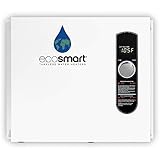
Most Output for Cold GroundwaterEcoSmart ECO 36
Whole-House Electric Tankless, 36 kW
If you live where groundwater is genuinely cold and you still want electric tankless, 36 kW is roughly the minimum for two simultaneous showers, and the ECO 36 is the most widely sold unit at that size. EcoSmart says it heats nearly 3.5 GPM from 37°F groundwater and up to about 6 GPM in warmer climates. Our own check of the energy math agrees: 36 kW lifting water from 40°F to 105°F works out to a little under 4 GPM. That is a real whole-house number in a cold climate, and it is what separates this unit from the 27 kW class. The problem is the electrical bill of materials. The ECO 36 needs four 40 amp double-pole breakers, four runs of 8 AWG wire and a 150 amp draw. On a 200 amp service, that leaves very little for a range, dryer, heat pump and everything else, and many houses need a 300 or 400 amp upgrade before this unit is legal to install. Price that upgrade before you price the heater. Like the ECO 27, it lets the temperature fall when overloaded instead of slowing the flow, and its reviews are more mixed than the smaller models.
Pros
- 36 kW, the largest residential size EcoSmart makes
- EcoSmart says it heats nearly 3.5 GPM from 37°F groundwater
- Up to about 6 GPM in warmer climates
- Self-modulating, with a digital setpoint in 1-degree steps
- Limited lifetime warranty
Cons
- Needs 4 x 40 A double-pole breakers and draws 150 A, which usually means a service upgrade
- Overloads by dropping temperature, with no flow restriction
The Bottom Line
The electric tankless to consider when cold groundwater rules out everything smaller, but only after an electrician confirms the service can carry 150 amps of water heater.
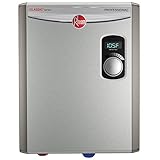
Best for Small Homes and Warm ClimatesRheem RTEX-18
Small-Home Electric Tankless, 18 kW
Not every house needs 27 kW. In a warm-climate condo, a one-bathroom bungalow or an accessory dwelling unit with low-flow fixtures, the 18 kW Rheem RTEX-18 is often enough, and it needs far less electrical capacity than the units above it. Rheem specifies two 40 amp breakers, 8 AWG copper wire and a 75 amp draw at 240 volts. Its rating table shows a 62°F temperature rise at 2.0 GPM and a 41°F rise at 3.0 GPM, so with 70°F incoming water it can feed one shower and a sink at once, and with 60°F water it runs a single shower comfortably. From 40°F groundwater it manages only about 1.9 GPM at 105°F, which is why we would not put it in a northern home as the only water heater. The design is straightforward: two heating chambers with copper immersion elements that can be replaced individually, bottom 3/4-inch connections and a digital thermostat adjustable from 80°F to 140°F. The weak spot is coverage. Rheem warrants the heating chamber for five years and parts for one, well short of EcoSmart's lifetime warranty. Pick it for its modest electrical demands, not for longevity promises.
Pros
- 18 kW from two heating chambers, on 2 x 40 A breakers (75 A)
- Rheem rates a 62°F rise at 2.0 GPM and a 41°F rise at 3.0 GPM
- Field-replaceable copper immersion elements
- Digital thermostat from 80°F to 140°F in 1-degree steps, 0.3 GPM turn-on
Cons
- Only about 1.9 GPM from 40°F water, not a whole-house heater in the North
- 5-year heating chamber and 1-year parts warranty is the shortest here
The Bottom Line
A sensible whole-house heater for a small home or apartment in a warm climate, and the electric tankless that asks least of your panel.
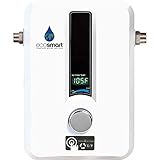
Best Point-of-UseEcoSmart ECO 11
Point-of-Use Electric Tankless, 13 kW
Point-of-use is where electric tankless makes the most sense, and the ECO 11 is the unit we would start with. It mounts under a sink or in a vanity, measures about 11.5 by 8 by 3.75 inches, and sits next to the fixture it feeds, which ends the long wait for hot water at a bathroom at the far end of the house. Despite the name, it is a 13 kW heater on 240 volts, with two 5.5 kW elements, a 54 amp draw, a single 60 amp breaker and 6 AWG wire. EcoSmart's chart, based on 105°F output, shows 2.34 GPM with 67°F incoming water and 1.31 GPM at 37°F. That covers a kitchen sink or two bathroom sinks almost anywhere, and a single low-flow shower in a warm climate. It switches on at 0.25 GPM, which matters with modern low-flow aerators that cheaper units sometimes fail to detect. The limits are honest ones. It is not a whole-house heater, and it is not a plug-in appliance; you need a dedicated 240 volt circuit. EcoSmart's lifetime warranty requires installation by a licensed professional for residential use.
Pros
- Compact 11.5 x 8 x 3.75 inch unit fits under a sink or in a vanity
- 13 kW at 240 V on a single 60 A breaker and 6 AWG wire
- EcoSmart's chart shows 2.34 GPM at 67°F inlet and 1.31 GPM at 37°F, with 105°F output
- Activates at 0.25 GPM, so it works with low-flow aerators
- Limited lifetime warranty when professionally installed
Cons
- One shower in a warm climate at most; not a whole-house heater
- Still needs a dedicated 240 V, 60 A circuit, not a plug-in outlet
The Bottom Line
The point-of-use unit to buy for a remote bathroom, kitchen or tank-booster, as long as you run a proper 240 volt circuit to it.
4. Groundwater Temperature Decides Everything
Every electric tankless has a fixed amount of heat to give, so the flow it can deliver depends entirely on how far it has to raise the water. That distance is the temperature rise: the outlet temperature you want minus the temperature of the water coming in. Most people shower at around 100°F to 105°F. If your incoming water is 70°F, the heater only needs a 35°F rise. If it is 40°F, it needs a 65°F rise, and the same heater delivers barely half the flow.
Incoming water temperature varies far more than people expect. In much of the northern United States, winter groundwater sits in the 40s, and in some places dips into the high 30s. Across the middle of the country it is commonly in the 50s. In Florida, the Gulf Coast and the desert Southwest it can be 70°F or warmer. Size for the coldest month, not the average, because January is when an undersized unit leaves someone with a cold rinse.
| Model | kW | GPM at 40°F inlet | GPM at 60°F inlet | GPM at 70°F inlet |
|---|---|---|---|---|
| EcoSmart ECO 11 | 13 | about 1.4 | about 2.0 | about 2.5 |
| Rheem RTEX-18 | 18 | about 1.9 | about 2.7 | about 3.5 |
| Stiebel Eltron Tempra 24 Plus | 24 | 2.5 | 3.6 | 4.7 |
| EcoSmart ECO 27 | 27 | 2.8 | 4.2 | 5.2 |
| Stiebel Eltron Tempra 29 Plus | 28.8 | about 3.0 | about 4.4 | about 5.6 |
| EcoSmart ECO 36 | 36 | about 3.8 | about 5.5 | about 7.0 |
The table assumes a 105°F outlet temperature and 240 volt service. Figures without the word about come from the manufacturers' own charts; the others are our calculation from kilowatts using the 6.8°F per kilowatt rule, and they line up closely with the published charts for similar models. Real installations can deliver slightly less, because long pipe runs and cold basements cost a few degrees before the water reaches the shower.
Now compare those numbers with your fixtures. A standard showerhead is 2.5 GPM or less, and many newer ones are 2.0 or 1.8. A kitchen tap runs at about 1.5. A typical household wants one shower plus one tap at the same time, about 4 GPM. In a warm climate a 24 to 27 kW unit covers that easily. With 40°F water, even 36 kW is only just there. Our tankless sizing guide walks through the calculation fixture by fixture.
5. Breakers, Wire and Your Service Panel
Whole-house electric tankless units split their heating elements across several circuits, each with its own double-pole breaker and its own wire run back to the panel. That is why the specifications read like 3 x 40 A. It means three separate 40 amp, 240 volt circuits, not one. Add the amps together to get the total draw, and compare that with the size of your main service, usually printed on the main breaker at the top of the panel.
| Model | Breakers | Total draw at 240 V | Typical panel reality |
|---|---|---|---|
| EcoSmart ECO 11 | 1 x 60 A | 54 A | Fits most 200 A panels with a free double space |
| Rheem RTEX-18 | 2 x 40 A | 75 A | Often workable on 200 A service |
| Stiebel Eltron Tempra 24 Plus | 2 x 50 A | 100 A | Stiebel recommends at least 150 A service |
| EcoSmart ECO 27 | 3 x 40 A | 112.5 A | Needs a load calculation on 200 A service |
| Stiebel Eltron Tempra 29 Plus | 3 x 40 A | 120 A | Needs a load calculation on 200 A service |
| EcoSmart ECO 36 | 4 x 40 A | 150 A | Frequently needs a 300 to 400 A service upgrade |
A 200 amp service does not mean 200 spare amps. An electrician performs a load calculation that adds up the home's other demands, such as the range, dryer, air conditioner or heat pump, electric heat and any EV charger, and applies the code's rules for how much of each to count. If the tankless heater pushes the total over the service rating, the options are shedding another load, a load management device, or upgrading the service. Upgrades often involve the utility and can cost more than the heater itself.
Panel space matters too. A 3 x 40 A unit needs six breaker spaces, and a 4 x 40 A unit needs eight. Older or crowded panels may not have them. The wire is not trivial either: EcoSmart specifies 8 AWG copper for each 40 amp circuit and 6 AWG for the ECO 11's 60 amp circuit, and the runs should be as short as practical. Follow the manufacturer's wire size exactly rather than the minimum someone remembers from another job.
If you are not sure what you have, find the main breaker first; our guide to the best circuit breaker finders helps when panel labels are missing or wrong. Then get the load calculation done before you buy. It is the single most useful step in an electric tankless project, and it is the one most often skipped. If the answer is that you need an upgrade, compare that total cost against a heat pump or gas unit, which need far less electrical capacity.
6. How to Size One for Your House
Start with the coldest incoming water you will see. You can check it yourself in winter by running a cold tap for a minute and putting a kitchen thermometer in a glass, or ask your water utility, which often publishes source water temperatures. Subtract that figure from 105°F. That is your design temperature rise, and it matters more than the number of bathrooms.
Next, decide how much hot water you need at once. List the fixtures that realistically run together in your house at the busiest moment, usually a shower plus a sink, or two showers on a school morning. Use the flow printed on the showerhead or tap aerator where you can find it. Then add them up. Remember that a shower is a mix of hot and cold water, so the heater supplies most but not all of the shower's flow at 105°F.
Divide the heater's kilowatts by your temperature rise and multiply by 6.8 to get its flow. A 27 kW unit with a 55°F rise gives about 3.3 GPM. If that number covers your simultaneous demand, the size works. If it falls short, you either step up a size, accept that two showers will not run together in winter, or switch to a unit with flow control so the shortfall shows up as lower pressure rather than cold water. Our full sizing walkthrough has worked examples.
Avoid the opposite mistake as well. Oversizing a whole-house electric unit buys flow you will rarely use while consuming electrical capacity you may need later for a heat pump or an EV charger. A couple in a warm climate with low-flow fixtures does not need 36 kW. The Rheem RTEX-18 or the Tempra 24 Plus will do, and each leaves far more of the panel free.
7. Self-Modulation and Flow Control Explained
Every heater on this list self-modulates. A flow sensor reads how much water is moving, the controller reads the inlet temperature and setpoint, and the unit sends only as much power to the elements as that flow needs. This is what keeps the outlet temperature steady when you nudge the tap, and it is why a hand-wash at a sink does not fire the full 27 or 36 kW. Modulation does not make a heater more efficient at turning electricity into heat, but it does stop overshooting.
Modulation cannot create capacity. When demand exceeds the heater's maximum, something has to give, and there are two possible outcomes. Most units, including the EcoSmart and Rheem models here, keep the flow you asked for and let the temperature fall. The water stays warm but not hot, and the person in the shower notices. Stiebel Eltron's Plus models take the other route with Advanced Flow Control: a motorized valve reduces the flow until the heater can hold the setpoint, so the water stays hot and runs a little lighter.
For a house where demand occasionally exceeds capacity, which is most houses with electric tankless in a cold month, flow control is the better failure. A slightly weaker shower is an annoyance. A shower that drops ten degrees when the washing machine starts is a complaint. That single behaviour is the main reason a Tempra Plus ranks above a cheaper unit with more kilowatts.
Minimum activation flow matters in the other direction. A tankless heater only turns on above a threshold flow, around 0.25 to 0.3 GPM for the EcoSmart and Rheem units and higher for some Stiebel models. With modern low-flow bathroom aerators running at 0.5 GPM or less, a heater with a high threshold can fail to switch on at a barely open tap. If you have low-flow fixtures, check the activation figure and open the tap a little further before assuming the heater is faulty.
8. Whole-House vs Point-of-Use
A whole-house unit replaces your water heater. It is installed where the tank used to be, feeds every fixture through the existing pipes, and needs the large electrical service described above. A point-of-use unit sits beside one fixture or one bathroom, under a sink or inside a vanity, and heats only the water for that location. It needs one circuit rather than three or four, and it delivers hot water within seconds because the pipe run is a few feet long.
Point-of-use is where electric tankless is most clearly the right answer. A remote bathroom over a garage, a kitchen far from the water heater, a basement bar, a detached workshop or a guest suite are all good candidates. Each avoids the long wait for hot water and the gallons of cold water run down the drain while waiting. The ECO 11 on our list is the classic example, and it fits a single 60 amp circuit.
A third approach uses a point-of-use unit as a booster. Installed after an existing tank, it tops up the temperature when the tank runs low, which extends the time before the shower goes cold without replacing the tank. It is a cheap way to stretch an undersized water heater in a house where a second bathroom has been added.
Small 120 volt units exist and are sold for hand sinks, but they are limited to around 3.5 kW and a fraction of a gallon per minute at a useful temperature rise. They are fine for a hand-wash sink in an office or a shop. They will not run a shower or a kitchen sink, and buyers who expect them to are the source of most of their bad reviews.
9. Running Costs and the Alternatives
An electric tankless heater does not waste energy keeping a tank hot, so its running cost is essentially the cost of heating the water you actually use. That is lower than an electric tank, which loses some heat through its walls around the clock, but the difference is modest for most households because modern tanks are well insulated. The big savings people expect from tankless usually come from replacing an old, poorly insulated tank, not from the technology.
Compared with a heat pump water heater, electric tankless costs more to run. Both use electricity, but a heat pump unit moves heat from the surrounding air and typically delivers three to four units of heat for each unit of electricity. Electric tankless delivers one. For a family using a lot of hot water, the heat pump's running cost is the lowest of any electric option, although it needs space, a drain and a room that can tolerate being cooled. Our tankless water heater cost breakdown compares upfront and running costs across types.
Gas tankless is the other comparison. It produces far more heat than any residential electric unit, so it delivers much higher flow from cold groundwater, but it needs a gas line large enough for its input and proper venting. Condensing gas units vent through plastic pipe and recover heat from the exhaust; non-condensing units need stainless venting. If you have gas available, our condensing vs non-condensing guide explains the choice.
Some utilities bill residential customers for peak demand as well as energy used, and a 27 or 36 kW heater can set a high peak in a few minutes of showering. Most residential tariffs do not, but check yours before you install a large unit. If you plan to run your water heater from backup power during outages, note that an electric tankless is far beyond what a portable generator can supply, as our guide to running a water heater on a generator explains.
10. Installation, Maintenance and Troubleshooting
Installation is electrical work first and plumbing second. The plumbing is simple, two 3/4-inch connections on most whole-house units and smaller fittings on point-of-use models, but the circuits, breakers, wire and load calculation need a licensed electrician, and most manufacturers tie their warranties to professional installation. Fit isolation valves on the inlet and outlet so the unit can be serviced or flushed without draining the house, and install it where a leak will be noticed and can drain.
Hard water is the main enemy of any tankless heater. Scale builds on the elements and in the heating chambers, reduces heat transfer and eventually burns out an element. Clean the inlet screen periodically and descale according to the manufacturer's schedule, more often in hard water areas. Our guide on how to flush a tankless water heater covers the process. A water softener or scale-inhibiting filter ahead of the heater can extend element life considerably.
Electric tankless units have fewer parts than gas models: no igniter, no fan, no flue. When something fails it is usually an element, a flow sensor, a thermal cutout or a breaker. Units with field-replaceable elements, like the EcoSmart and Rheem models, are cheap to repair, and a replacement element is a common spare to keep on hand. Expect a long service life with care; our article on how long tankless water heaters last has realistic ranges.
If the water runs warm but never hot, the cause is usually one tripped breaker, a failed element, or simply demand beyond the unit's capacity on a cold day. If it does not heat at all, check the breakers, the flow rate at the tap and the inlet screen. Our troubleshooting guide for a tankless water heater not heating goes step by step. And because a slow leak at a fitting inside a closet can soak drywall for weeks before anyone notices, a quick check with one of the best moisture meters after installation is cheap insurance.
11. Common Mistakes to Avoid
Sizing From the Box Flow Rate
The big GPM figure on the box is measured with warm incoming water. In a northern winter the same heater may deliver half that. Size from your coldest incoming water temperature and the manufacturer's rating table, and assume the worst month, not the average, decides whether a second shower runs hot.
Buying Before the Load Calculation
A 27 kW unit draws about 112 amps, and a 36 kW unit 150. Many 200 amp services cannot add that without an upgrade that costs more than the heater. Get an electrician's load calculation first, then choose the heater the panel can actually carry, not the other way round.
Expecting a 120 V Unit to Run a Shower
Small 120 volt point-of-use heaters are around 3.5 kW and suit a hand-wash sink. They cannot heat shower or kitchen flow to a useful temperature. Showers and kitchen sinks need a 240 volt unit with roughly 13 kW or more, and its own dedicated circuit.
Ignoring Hard Water
Scale is the main reason electric tankless elements fail early. In hard water, clean the inlet screen and descale on the maker's schedule, and consider a softener or scale-inhibiting filter. A heater that is never maintained in hard water can lose an element in a few years.
Oversizing Just in Case
Buying 36 kW for a small home in a warm climate wastes money and ties up panel capacity you may want later for a heat pump or EV charger. Match the heater to realistic simultaneous demand and your groundwater temperature, and leave headroom in the panel instead of in the water heater.
Before You Buy
Also Needed for This Job
12. Frequently Asked Questions
What is the best electric tankless water heater?
For most one- or two-bathroom homes in moderate or warm climates, the Stiebel Eltron Tempra 24 Plus, because its Advanced Flow Control keeps water hot when demand runs high and it needs only two 50 amp breakers. The EcoSmart ECO 27 is the better value if your panel can supply three 40 amp circuits and 112.5 amps.
What size breaker does an electric tankless water heater need?
It depends on the model. Whole-house units use several double-pole breakers: the Tempra 24 Plus needs two 50 amp, the ECO 27 and Tempra 29 Plus need three 40 amp, and the ECO 36 needs four 40 amp. A point-of-use ECO 11 needs a single 60 amp breaker. Always follow the manufacturer's specification.
Can a 200 amp service handle an electric tankless water heater?
Often, but not always. A 200 amp service is not 200 spare amps, and a 27 kW heater alone draws about 112 amps. An electrician's load calculation, counting your range, dryer, heating, cooling and any EV charger, decides whether it fits. Whole-house 36 kW units frequently require a service upgrade first.
How many GPM do I need from a tankless water heater?
Add the fixtures you run at once. A shower is typically 1.8 to 2.5 GPM and a kitchen tap about 1.5, so a shower plus a tap is around 4 GPM. Then check what the heater delivers at your coldest incoming water temperature, which in northern states may be in the 40s.
Do electric tankless water heaters work in cold climates?
Yes, but output drops sharply with cold groundwater. With 40°F incoming water, a 27 kW unit delivers under 3 GPM at shower temperature, roughly one shower. Cold-climate homes need 29 to 36 kW for two showers, which requires a lot of electrical capacity, so a heat pump or gas unit is often the better fit.
Is electric tankless cheaper to run than a tank?
Somewhat, because it does not keep a tank hot around the clock, but the savings over a modern insulated electric tank are modest. A heat pump water heater is much cheaper to run than either, typically using a third to a quarter of the electricity, though it needs more space and a suitable location.
How long does an electric tankless water heater last?
With maintenance, often well over a decade, since there is no tank to corrode. Elements, flow sensors and thermal cutouts are the usual failures, and on many models elements can be replaced individually. Hard water shortens life, so clean the inlet screen and descale on the manufacturer's schedule, or fit a softener.
Related Water Heater Guides
Buyer's Guide
Best Tankless Water Heaters
Gas and electric tankless heaters ranked together, for homes that have both fuels to choose from.
Sizing
What Size Tankless Do I Need?
Fixture flow rates, temperature rise and worked examples for sizing any tankless heater.
Buyer's Guide
Best Heat Pump Water Heaters
The cheapest electric water heaters to run, for homes where a big tankless will not fit the panel.
The Bottom Line
Electric tankless works brilliantly when the numbers fit. Check your coldest incoming water temperature, add up what you run at once, and get a load calculation before you buy. For a one- or two-bathroom house in a moderate or warm climate, the Stiebel Eltron Tempra 24 Plus is our pick, and the EcoSmart ECO 27 is the value choice where the panel can spare 112.5 amps.
In a cold climate, go up to the Tempra 29 Plus or the ECO 36 only if your service can carry it, and compare that total cost honestly with a heat pump or gas unit. For a remote bathroom or kitchen, the EcoSmart ECO 11 is the simplest fix of all.
More in Home Improvement
Guides in this category that pair with what you just read.
About the Author
Shaheer Ali Khan, Consumer Product Testing & Materials Performance Specialist
Shaheer Ali Khan holds a PhD in Materials Science and Engineering from Georgia Tech and is an ASQ Certified Quality Engineer and Certified Reliability Engineer. He leads testing for household appliances, vacuums, cleaning products, and caulks, adhesives and sealants.