Best Interior Paint
A good wall paint hides in two coats, levels without roller marks and survives a wet sponge a year later. The label claims rarely tell you which ones do, so here is what actually separates them.
Alex Rivers
Home Improvement Editor
Last Updated
September 29, 2026
In This Guide
The difference between a budget wall paint and a premium one is not colour, it is solids: how much pigment and resin is left on the wall once the water evaporates. More solids means better hide, fewer coats and a film that shrugs off scrubbing. Everything else on the can, including most paint-and-primer claims, matters less than that and less than choosing the right sheen for the room.
Our Picks at a Glance
- Best Overall: KILZ Tribute Interior Paint and Primer — 100% Acrylic Paint and Primer, Low VOC
- Best for Buying Colour Online: Magnolia Home by Joanna Gaines Classic Interior Paint and Primer — 100% Acrylic Paint and Primer, Curated Colours
- Best for Bathrooms: Zinsser Perma-White Mold and Mildew-Proof Interior Paint — Self-Priming Acrylic, Mildew-Resistant Film
- Best for Utility Spaces: KILZ Complete Coat Interior/Exterior Paint and Primer — Interior/Exterior Acrylic, Paint and Primer
- Best Budget: Rust-Oleum Sure Color Interior Wall Paint and Primer — Pre-Mixed Colours, Paint and Primer
- Best Paint-Store Mid-Tier: Benjamin Moore Regal Select Interior Paint — Paint-Store Benchmark, 100% Acrylic
- Premium Benchmark: Sherwin-Williams Emerald Interior Acrylic Latex Paint — Paint-Store Premium, Self-Priming Acrylic
1. How We Picked and Tested
Interior paint is sold on colour and on claims, and the claims are hard to compare because every brand uses its own language: one-coat, paint-and-primer, stain-release, scuff-resistant. We ignored the marketing and started with what can be checked: resin type, published coverage and recoat times, VOC information, sheen range, and whether the manufacturer publishes technical data at all.
Because the buy buttons on this site go to Amazon, we gave priority to paints that can genuinely be ordered online and delivered, which rules out most house-brand paints sold only at one big-box chain. We then added two paint-store benchmarks, Benjamin Moore Regal Select and Sherwin-Williams Emerald, clearly marked, so you can see what the extra money buys.
Each paint went onto sections of the same primed drywall wall. We rolled a mid-tone colour over a pale base with a 3/8-inch nap roller, noted how many coats it took to hide, and looked for flashing over patched areas. After two weeks of cure we marked the panels with pencil, crayon, coffee and a greasy fingerprint, cleaned them with a damp sponge and mild detergent, and checked for burnishing, which is the shiny patch left when a flat or matte paint is scrubbed.
This was a practical, side-by-side test in one house rather than a laboratory scrub machine, and we weigh it alongside manufacturer data and long-term owner reviews. Ratings and review counts are rounded from what we saw across retailers, including the paint-store brands' own sites for the two benchmarks.
2. What Makes a Wall Paint Good
Paint is pigment, binder, water and additives. Once the water evaporates, only the pigment and binder stay on the wall, and the proportion that stays, called volume solids, is the best single predictor of how a paint will perform. Higher solids means a thicker dry film per coat, which means better hide, fewer coats and more material standing between the wall and whatever you scrub off it later.
Binder type is the second thing to check. 100% acrylic binders adhere better, stay more flexible, resist scrubbing and hold colour longer than vinyl-acrylic blends, which are common in the cheapest contractor and builder-grade paints. Every pick on this list is acrylic, and the technical data sheet will tell you if a paint you are considering is not.
Hide versus coverage
These two words are often used interchangeably and they mean different things. Coverage, or spread rate, is how many square feet a gallon will paint, usually 350 to 400 on smooth drywall. Hide is how well a coat obscures the colour underneath. A thin, cheap paint can spread a long way and still need three coats to hide a colour change, which makes it more expensive in practice than a thicker paint that hides in two.
The third thing is washability, and it is where sheen and binder quality meet. Scrub resistance is usually tested by running a brush back and forth over the film until it wears through, and better paints last many times more cycles. In a house, the practical questions are simpler: does a scuff come off without leaving a shiny patch, and does the colour survive a sponge. That is the test we care about, and it is where the premium picks pull clearly ahead.
3. Our 7 Top Picks
Five of the seven paints below can be ordered online and delivered, which matters if you want to buy through the links on this page: KILZ Tribute, the Magnolia Home line, Zinsser Perma-White, KILZ Complete Coat and Rust-Oleum Sure Color. The last two picks, Benjamin Moore Regal Select and Sherwin-Williams Emerald, are paint-store benchmarks sold mainly through their own stores and dealers. We include them because they set the standard the others are measured against, and because for a heavily used room they are worth the trip.

KILZ Tribute Interior Paint and Primer
100% Acrylic Paint and Primer, Low VOC
KILZ built its name on primers, and Tribute is the product where that expertise shows up in a finish coat. It is a 100% acrylic paint-and-primer, which is the first thing to check on any wall paint: acrylic binders adhere better, resist scrubbing and hold colour longer than the vinyl-acrylic blends common in the cheapest lines. KILZ rates Tribute to cover light-to-medium stains and to handle light-to-dark colour changes, and that primer-first formulation is why the paint-and-primer claim is more credible here than on most cans. In our testing, a mid-tone grey covered a pale beige wall in two coats with no flashing over previously patched areas that had been spot-primed. The eggshell levelled well from a 3/8-inch nap roller with little stipple, and a pencil mark and a coffee splash wiped away cleanly after two weeks of cure. Coverage is rated up to 400 square feet per gallon, with a 2-hour recoat time that makes two coats in a day realistic. KILZ calls it low VOC and the odour was mild during application. It comes in matte, eggshell, satin and semi-gloss, so one product can handle every wall in the house and the trim as well. The limitation is the same one every paint faces: a deep red or navy over white will still need a tinted primer or a third coat, whatever the label says.
Pros
- 100% acrylic resin, the binder that gives the best adhesion, washability and colour retention
- Stain-blocking primer chemistry from a company whose core business is primer
- Rated to cover light-to-medium stains and light-to-dark colour changes
- Up to 400 square feet per gallon with a 2-hour recoat time
- Sold in matte, eggshell, satin and semi-gloss, and available online
Cons
- Deep, saturated colours still take a tinted primer or three coats
- Colour selection online is narrower than at a tinting counter
The Bottom Line
The best wall paint you can order and have delivered, with real primer credentials behind the paint-and-primer label.

Magnolia Home by Joanna Gaines Classic Interior Paint and Primer
100% Acrylic Paint and Primer, Curated Colours
Buying paint online has one obvious problem: you cannot have it tinted to a chip. The Magnolia Home Classic Interior line solves that by selling a curated palette of pre-mixed colours, and it is the most practical way we know to choose a colour online and have it delivered. The paint itself is made by KILZ and is a 100% acrylic paint-and-primer, so the performance underneath the branding is genuine. In our testing it behaved much like KILZ Tribute: good levelling, mild odour, and two-coat coverage on similar-tone colour changes. It is sold in eggshell, satin and semi-gloss, which covers living spaces, busy rooms and trim, and the Amazon listing gives a VOC content of 50 grams per litre, comfortably in low-VOC territory. The sample size is what makes it work. Paint colour looks completely different on a wall in your own light than it does on a phone screen, and 8-ounce samples let you roll a two-foot square on two or three walls and look at it morning and evening before buying gallons. Do that every time. The downsides are price and range. You are paying somewhat more than for KILZ Tribute, largely for the colour curation, and the palette is small next to a paint store's fan deck. If you already know the exact colour you want, buy Tribute tinted to match instead.
Pros
- Made by KILZ on a 100% acrylic paint-and-primer formula
- Sold on Amazon in a curated range of pre-mixed colours, so no tinting counter is needed
- 8-ounce samples make it easy to test a colour on the wall before committing to gallons
- Eggshell, satin and semi-gloss cover walls, busy rooms and trim
- Low-VOC formula with mild odour
Cons
- Priced above KILZ Tribute for broadly similar performance, so you are paying partly for the palette
- Limited colour range compared with a paint-store fan deck
The Bottom Line
The easiest way to buy a well-chosen colour online and know exactly what will arrive.
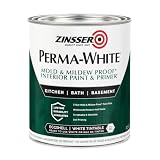
Zinsser Perma-White Mold and Mildew-Proof Interior Paint
Self-Priming Acrylic, Mildew-Resistant Film
Bathrooms without adequate ventilation are hard on paint. Moisture condenses on the walls and ceiling every day, and mildew spores find the organic material in an ordinary paint film and settle in, producing the grey-black specks that come back however often you wipe them. Zinsser Perma-White is formulated specifically for that environment, and it is the paint we would put in any bathroom, laundry room or basement that tends to feel damp. The film contains a mildewcide and carries a 5-year guarantee against mildew growth on the paint itself, which is a stronger claim than most general paints make. It is moisture-resistant and designed to resist blistering, and it is self-priming: Zinsser rates it to go over glossy paint, vinyl wall coverings and laminate without sanding, and to seal new drywall, joint compound and porous flat paint without a separate primer. That makes a bathroom refresh a two-product job rather than three. Two limits are worth knowing. First, the mildew protection is for the paint film only, so existing mildew must be killed and cleaned off before you paint, or it will grow through. Second, it tints only to light and pastel colours. If you want a deep green bathroom, use a quality satin wall paint with good ventilation instead. Coverage is 250 to 400 square feet per gallon, lower on porous surfaces.
Pros
- Paint film carries a 5-year mildew-proof guarantee, the strongest claim in this category
- Self-priming over glossy paint, new drywall, joint compound and porous flat paint
- Moisture-resistant and blister-resistant, designed for bathrooms, laundry rooms and basements
- Washable, scrubbable finish in eggshell, satin and semi-gloss
- Tintable to light and pastel colours
Cons
- Only tints to lighter shades, so it is not a choice for dark or saturated bathroom colours
- Coverage of 250 to 400 square feet per gallon is lower on porous surfaces than general wall paints
The Bottom Line
The specialist paint for rooms that steam up, where an ordinary wall paint grows spots within a year.
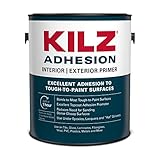
KILZ Complete Coat Interior/Exterior Paint and Primer
Interior/Exterior Acrylic, Paint and Primer
Not every interior wall is a living room. Mudrooms, basement stairwells, garage walls, laundry rooms and the inside of an attached-garage door all take more abuse than a bedroom, and some of them straddle the line between inside and outside. KILZ Complete Coat is rated for both interior and exterior use, and that versatility is the reason to buy it: one colour in one product can paint the mudroom walls, the inside and outside of the back door and the garage trim without a second can. It is a paint-and-primer with a low-VOC, low-odour formula, and KILZ rates coverage at 300 to 350 square feet per gallon on smooth surfaces and 200 to 300 on rough ones, dry to the touch in about 2 hours with a 4-hour recoat. In our testing it hid a colour change well in two coats, and the satin sheen stood up to repeated scrubbing of scuff marks without burnishing noticeably. Where it gives ground to KILZ Tribute is finish quality. Interior-exterior paints are formulated for flexibility and weather resistance first, and on a large, smooth wall lit from the side the levelling is good rather than flawless. That is irrelevant in a garage or a mudroom and worth noticing in a formal dining room. The lower rated coverage per gallon also means buying slightly more for the same area.
Pros
- Rated for interior and exterior use, so one can covers a mudroom, garage wall and back door
- Paint-and-primer formula with strong hide in reviews and in our colour-change test
- Low VOC and low odour for an interior-exterior product
- Dries to the touch in about 2 hours
- Available in flat, eggshell, satin and semi-gloss
Cons
- Rated coverage of 300 to 350 square feet per gallon on smooth surfaces is lower than dedicated wall paints
- Levelling is good rather than excellent, so it is not our pick for large, smooth living-room walls under raking light
The Bottom Line
A tough, versatile paint for mudrooms, basements, garages and stairwells rather than the formal living room.
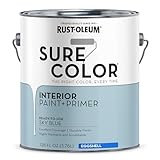
Rust-Oleum Sure Color Interior Wall Paint and Primer
Pre-Mixed Colours, Paint and Primer
Rust-Oleum is better known for metal paints and spray cans, but Sure Color is a straightforward interior wall paint-and-primer sold in a short list of pre-mixed colours, and it is the budget pick here for a specific kind of job. Because every can is mixed at the factory, there is no tinting step, and gallons from different batches are far less likely to show a visible colour shift than hand-tinted paint from a counter, which matters when you are repainting a rental unit and topping up months later. Rust-Oleum rates it to cover up to 400 square feet per gallon, dry to the touch in about an hour and recoat in 4 hours, and to go on drywall, wood, aluminium, steel and brick. The eggshell is the most useful sheen for living spaces. In our testing it was easy to roll and dried to an even finish, but the film is noticeably thinner than KILZ Tribute or the paint-store benchmarks, and a colour change that the premium paints handled in two coats looked slightly patchy until the second coat had fully dried. Plan on two full coats, not a coat and touch-ups. The palette is limited to whites, off-whites, greys, beiges and a few deeper accents. For a whole-house colour scheme you will outgrow it quickly; for closets, rentals and a quick neutral refresh it is good value.
Pros
- Pre-mixed colours in the can, so there is nothing to tint and nothing to mis-match between gallons
- Covers up to 400 square feet per gallon and dries to the touch in about an hour
- Rated for drywall, wood, aluminium, steel and brick
- Budget pricing that suits rentals, closets and quick refreshes
- Washable and scrubbable finish in eggshell and other sheens
Cons
- Limited palette of whites, neutrals and a few accent colours
- Film feels thinner than the premium picks and needed a full second coat in every test
The Bottom Line
A sound budget choice for rentals, closets and neutral refreshes, as long as you plan on two full coats.
Benjamin Moore Regal Select Interior Paint
Paint-Store Benchmark, 100% Acrylic
Regal Select is here as a benchmark: the paint many professional painters would reach for on a typical repaint, and the standard the online options are measured against. It is not sold through Amazon in any meaningful way; you buy it at Benjamin Moore stores and independent dealers, and the link on this page falls back to an Amazon search. Knowing that, here is why it is worth considering anyway. Regal Select is a 100% acrylic paint-and-primer built around Benjamin Moore's Gennex colour system, which uses zero-VOC waterborne colorants, so tinting a deep colour does not add solvents the way many universal colorants do. It includes a stain-release feature that helps food, crayon and scuffs wash off, and mildew resistance in the film. The five finishes include a pearl sheen that sits between eggshell and satin, which is a very practical sheen for hallways and children's rooms. In our testing it levelled beautifully, touched up invisibly in the eggshell and hid a mid-tone colour change in two coats with a clean, even film. Where it earns its price is in rooms where the walls get washed and touched up repeatedly: a family room, a hallway, a kid's bedroom. For a guest room or a closet, the online picks are more than good enough.
Pros
- The mid-tier paint-store standard that many contractors use as their everyday wall paint
- 100% acrylic resin with Gennex zero-VOC colorant system
- Stain-release technology and mildew resistance
- Five finishes including flat, matte, eggshell, pearl and semi-gloss
- Tinted to any Benjamin Moore colour with an accurate, consistent match
Cons
- Sold through Benjamin Moore retailers rather than Amazon, so the link on this page falls back to a search
- Priced well above the big-box and online options
The Bottom Line
Worth the trip to a Benjamin Moore dealer for the rooms you care most about, and a useful benchmark for everything else.
Sherwin-Williams Emerald Interior Acrylic Latex Paint
Paint-Store Premium, Self-Priming Acrylic
Emerald is Sherwin-Williams' top interior wall paint and the second paint-store benchmark on this list. Like Regal Select, it is sold through the company's own stores rather than Amazon, so the link here falls back to a search; you will want to buy it at the counter, where it can be tinted to any Sherwin-Williams colour. Sherwin-Williams positions Emerald as its best overall interior performer, claiming strong hide, coverage, washability and resistance to scrubbing, staining, water spotting and burnishing, and it is self-priming on most repaints. It is GREENGUARD-certified for low chemical emissions, and the film has antimicrobial properties that inhibit mold and mildew on the paint surface. It comes in several sheens, including matte, satin and semi-gloss. In our testing the Emerald matte was the most impressive finish here: it hid a strong colour change in two coats with coverage that looked nearly complete after one, and a matte that usually burnishes when scrubbed stayed flat after repeated cleaning. That combination, a low-sheen look with a washable film, is where premium paint most clearly earns its price, because budget matte paints tend to show every wipe. Its cost is the only real objection. For a deep accent colour, a busy family room or a matte finish that needs to be cleanable, it is worth it. For a spare bedroom in a light neutral, it is not.
Pros
- Sherwin-Williams' top interior line, with excellent hide, washability and burnish resistance
- Self-priming for fewer coats on most repaints
- GREENGUARD-certified for low emissions with minimal odour
- Antimicrobial film that inhibits mold and mildew growth on the paint surface
- Tinted to any Sherwin-Williams colour at the store
Cons
- Sold at Sherwin-Williams stores rather than Amazon, so the link falls back to a search
- Premium pricing that is hard to justify outside high-traffic rooms or deep colours
The Bottom Line
The paint to buy when a single coat of hide, a deep colour or a heavily scrubbed wall justifies a premium price.
4. Which Sheen for Which Room
Sheen decides how a wall looks and how it wears, often more than the brand does. Higher sheen means a harder, smoother, more washable film, and it also means every dent, patch and roller mark shows. Lower sheen hides imperfections and looks softer, and it is harder to clean without burnishing. Choosing a sheen is a trade between those two, room by room.
| Sheen | Best rooms | Why |
|---|---|---|
| Flat | Ceilings, formal dining rooms, low-traffic adult bedrooms | Hides imperfections best, but marks easily and can burnish when scrubbed |
| Matte | Living rooms, bedrooms, home offices | Near-flat look with better washability in premium lines |
| Eggshell | Most living spaces, hallways in light use | The default: slight sheen, wipes clean, still forgiving of wall flaws |
| Satin or pearl | Kids' rooms, hallways, kitchens, bathrooms | Stands up to regular scrubbing and moisture |
| Semi-gloss | Trim, doors, cabinets, window casings | Hard, very washable film; shows every flaw on a large wall |
Eggshell is the right default for most walls in most homes. It has enough sheen to wipe clean, not so much that it highlights patched drywall, and every pick on this list offers it or a close equivalent. If you are unsure, choose eggshell, and move up to satin only for rooms where walls get touched, splashed or steamed daily.
Bathrooms and kitchens deserve satin, or a specialist paint such as Zinsser Perma-White. The tighter film resists moisture and grease, and it gives mildew less to grip. Ceilings are the opposite case: flat is almost always right, because it hides the long-angle light that reveals every flaw overhead. Our guide to the best ceiling paint covers the flat, spatter-resistant products designed for that job.
The matte category is where paint quality shows most clearly. A budget matte usually burnishes the first time you scrub a fingerprint, leaving a shiny patch that is more noticeable than the mark was. Premium mattes, such as Sherwin-Williams Emerald, are formulated to resist that, and they are the only way to get a truly low-sheen look in a busy room that you can still clean.
5. Do Paint-and-Primer Claims Hold Up?
Almost every wall paint now says paint and primer on the can, and the phrase is mostly marketing. What it usually means is a higher-solids paint that seals and hides well enough to skip a separate primer on a routine repaint. It does not mean the paint contains a dedicated primer, and it does not replace a real primer on the surfaces that need one.
For repainting a sound, clean, previously painted wall in a similar colour, a quality paint-and-primer is genuinely all you need. Two coats of any pick on this list will do the job with no primer. That covers most interior painting, which is why the claim persists: in the common case, it is true enough.
THE RULE
Use a separate primer on bare drywall, patches, stains, gloss and dramatic colour changes.
Paint-and-primer products are designed for repainting sound, similar-colour paint. New drywall, patched areas, water or smoke stains, glossy surfaces and big jumps in colour each need a dedicated primer matched to the problem.
Patches are where the claim fails most often. Spackle and joint compound absorb paint differently from the surrounding wall, so a painted patch can show as a dull or shiny spot called flashing. Spot-prime every patch before painting. Our guides to the best spackle and to joint compound vs spackle explain which filler to use and why they behave differently under paint.
Stains need a stain-blocking primer, because water, smoke and marker stains bleed through ordinary paint no matter how many coats you apply. Glossy paint and laminate need a bonding primer, or a self-priming product rated for them, like Perma-White. And a jump from white to a deep colour goes faster with a primer tinted towards the final colour, which usually saves a full coat of the more expensive topcoat.
6. VOCs, Odour and Indoor Air
Volatile organic compounds are the solvents that evaporate from paint as it dries, and they are responsible for much of the smell and the headache of a freshly painted room. Regulations have pushed VOC levels in interior latex paint far down over the past two decades, and every pick on this list is a low-VOC, water-based acrylic. The practical differences between them are smaller than labels suggest.
Two details matter. First, many zero-VOC or low-VOC claims apply to the untinted base paint. Universal colorants added at the store can contain VOCs, and a deep colour can carry noticeably more than the base. Benjamin Moore's Gennex system uses zero-VOC colorants for that reason, and pre-mixed paints like Magnolia Home and Sure Color have their VOC content fixed at the factory.
Second, VOC content is not the same as emissions over time. Independent certifications such as GREENGUARD test what a dried paint actually releases into room air. If someone in your home has asthma or chemical sensitivity, or you are painting a nursery, a certified low-emission paint such as Sherwin-Williams Emerald is the more meaningful choice than a lower number on the label.
Whatever you buy, ventilate. Open windows and run a box fan blowing out during painting and for a couple of days afterwards, and keep children and pets out of the room overnight. Low-VOC paint still releases some compounds as it cures, and the smell fades faster with airflow. Painting in warm, dry weather helps it cure faster too.
7. Hide, Coverage and How Much Paint to Buy
To estimate paint, measure the perimeter of the room, multiply by the ceiling height, and subtract about 20 square feet for each door and 15 for each typical window. Divide by the spread rate on the can, usually 350 to 400 square feet per gallon on smooth, previously painted drywall, and multiply by two coats. Round up to the next gallon.
TYPICAL NUMBERS FOR A 12 X 14 FT ROOM, 8 FT CEILINGS
366
Square feet of wall after one door and two windows
2 coats
Needed for a colour change with any paint on this list
2-3 gal
Wall paint to buy, depending on spread rate
250-400
Square feet per gallon across the picks, by surface
Adjust for the surface. Textured walls, fresh drywall and porous flat paint absorb more, and spread rates can fall to 250 to 300 square feet per gallon. Deep colours, especially reds, yellows and some blues, have less hiding pigment and often need a third coat or a tinted primer. Budget for that before you start rather than running out halfway across the last wall.
Buy all the paint for a room at once, and if you need more than one gallon, box it: pour all the gallons into a five-gallon bucket and mix them together. Even paint tinted at the same counter can vary slightly from can to can, and the difference shows as a faint line where one gallon ended. Boxing eliminates it.
Finally, do not treat one coat as a goal. A one-coat claim is usually based on a similar colour over a sound, primed surface. Two thinner coats level better, dry more evenly and last longer than one heavy coat, and they hide small mistakes in the first. Every paint on this list looks better with two.
8. Big-Box vs Paint-Store Lines
The biggest price jump in interior paint is between the big-box and online brands and the paint-store brands, and the obvious question is whether it is worth it. For most rooms, the honest answer is no. A quality 100% acrylic paint from KILZ or Zinsser, rolled in two coats over a properly prepared wall, will look excellent and last years.
Where paint-store lines earn their price is in the difficult cases. Deep and saturated colours hide faster and look richer. Matte finishes stay flat when scrubbed. Touch-ups blend invisibly months later. High-traffic walls survive repeated cleaning without wearing through. If a room involves any of those, Benjamin Moore Regal Select or Sherwin-Williams Emerald is the safer bet.
The paint store also gives you something a website cannot: a tinting counter with accurate matching to thousands of colours, staff who can tell you which primer to use, and frequent sales that narrow the price gap considerably. Paint-store brands also run their own sub-lines at several price points, and the cheaper ones are not always better than a good online paint.
A sensible split for a whole house is to use a paint-store premium in the one or two rooms that take the most abuse or carry the boldest colour, and a quality online paint such as KILZ Tribute everywhere else. That puts the money where you will see it, and it keeps a large repaint within a sensible budget.
9. Tools and Technique Matter as Much as the Can
A premium paint applied with a cheap roller will look worse than a mid-range paint applied well. Use a good-quality 3/8-inch nap roller cover for smooth and lightly textured walls, and a 1/2-inch nap for heavier texture. Roll in a W pattern, keep a wet edge, and finish each section with light, parallel strokes from ceiling to floor.
For the edges, a good angled sash brush does more for a clean finish than any paint upgrade. Our guide to the best paint brushes covers the brushes that hold enough paint to cut in a long ceiling line in one pass. Where the line is high-contrast or geometric, tape it; our guide to the best painter's tape explains which tape is safe on paint that went on only a day earlier.
Spraying makes sense for empty rooms, new construction and large repaints where masking time is paid back in speed. It uses more paint than rolling, and it still needs back-rolling on walls for an even texture. Our guide to the best paint sprayer covers which airless and HVLP sprayers handle interior latex without thinning.
The last step most people rush is drying time. Latex paint feels dry within an hour, but it continues to cure for days and reaches full hardness over a few weeks. Hang pictures and push furniture back gently, avoid scrubbing for the first couple of weeks, and keep a labelled sample of each colour for touch-ups. Write the colour, sheen and product line on the lid, because in two years you will not remember.
10. Common Mistakes to Avoid
Buying on price per gallon
A cheap paint that needs three coats to hide a colour change costs more in money and time than a quality paint that hides in two. Compare the cost of the finished wall, not the can. Check the resin type too: 100% acrylic paints outlast vinyl-acrylic blends on walls that get cleaned.
Choosing sheen by photo
A satin that looks lovely in a magazine will highlight every drywall patch and roller mark on a long wall lit from a window. Use eggshell as the default for living spaces, satin for bathrooms, kitchens and kids' rooms, flat for ceilings, and semi-gloss for trim and doors only.
Skipping primer on patches
Paint-and-primer products do not seal spackle and joint compound, which absorb paint differently and show through as dull or shiny spots called flashing. Spot-prime every patch with a real primer, let it dry, then paint. The same applies to stains, bare drywall and glossy surfaces.
Not testing the colour at home
Paint colours shift dramatically between a screen, a store light and your own walls. Buy samples, roll two-foot squares on at least two walls, and look at them in morning and evening light before buying gallons. It is the cheapest insurance in any paint project.
Scrubbing too soon
Latex paint is dry to the touch in an hour but takes weeks to reach full hardness. Scrubbing a wall in the first week or two can burnish the finish or wear through the film. Wipe gently with a damp cloth if you must, and save real cleaning for after the paint has cured.
11. Frequently Asked Questions
What is the best interior paint you can buy online?
Among paints genuinely sold and shipped online, KILZ Tribute is our pick: a 100% acrylic paint-and-primer from a primer specialist, with good hide, levelling and washability. The Magnolia Home line, also made by KILZ, is the easier choice if you want a pre-mixed designer colour. For bathrooms, Zinsser Perma-White is the specialist choice that resists mildew.
Is Benjamin Moore or Sherwin-Williams worth the extra money?
For high-traffic rooms, deep colours and matte finishes that need cleaning, often yes. Their top lines hide faster, touch up better and resist burnishing. For a light neutral in a spare bedroom or closet, a quality online paint will look just as good. Both brands run frequent sales, which narrow the price difference considerably.
What sheen should I use for walls?
Eggshell is the right default for most living spaces, because it wipes clean and still hides minor wall flaws. Use satin or pearl in kitchens, bathrooms, hallways and kids' rooms, flat on ceilings and in low-traffic formal rooms, and semi-gloss for trim, doors and cabinets. Higher sheens are more washable but show more imperfections.
Do I need primer if my paint says paint and primer?
Not for repainting a sound, clean, previously painted wall in a similar colour. You do need a separate primer on bare drywall, spackle and joint compound patches, water or smoke stains, glossy surfaces and big colour changes. In those cases, use a primer matched to the problem, then two coats of paint.
How many coats of interior paint do I need?
Plan on two coats for almost every job, including colour changes with premium paint. Two thinner coats level better and last longer than one heavy one. Deep reds, yellows and some blues may need a third coat or a primer tinted towards the final colour, which usually saves money over an extra topcoat.
Is low-VOC paint safe for a nursery?
Low-VOC water-based paints are far less harsh than older solvent paints, but they still release some compounds as they cure. For a nursery, choose a paint with an independent low-emission certification such as GREENGUARD, paint well ahead of the baby's arrival, keep the room ventilated for several days, and remember that colorants can add VOCs to a deep colour.
How long does interior paint take to cure?
Most latex wall paints are dry to the touch within one or two hours and can be recoated in two to four hours, depending on the product. Full cure, when the film reaches its final hardness and washability, takes a few weeks. Avoid scrubbing, taping with medium-adhesion tape or leaning furniture against fresh walls in the first week.
Related Painting Guides
Buyer's Guide
Best Painter's Tape
Which tape is safe on fresh paint, which seals textured walls and when to skip tape entirely.
Buyer's Guide
Best Ceiling Paint
Flat, spatter-resistant ceiling paints and the colour-change formulas that show where you have rolled.
Buyer's Guide
Best Spackle
Fillers that sand smooth and take primer cleanly, so patches disappear under the finish coat.
The Bottom Line
For most walls in most homes, a quality 100% acrylic paint rolled in two coats over a well-prepared surface is all you need, and KILZ Tribute is the best of those you can order online. Use Magnolia Home when a pre-mixed designer colour is the point, Zinsser Perma-White in any room that steams up, and KILZ Complete Coat for mudrooms, garages and other hard-working spaces.
Spend paint-store money where it shows: deep colours, cleanable matte finishes and the one or two rooms that take the most abuse. And remember that sheen choice, primer on patches and a good brush and roller will change the result more than any upgrade to the can.
More in Home Improvement
Guides in this category that pair with what you just read.
About the Author
Alex Rivers, Home Improvement Editor
Alex has spent over a decade working on residential and light commercial property maintenance, and now tests every tool, coating and machine that appears in these guides personally.